




























Views
Downloads
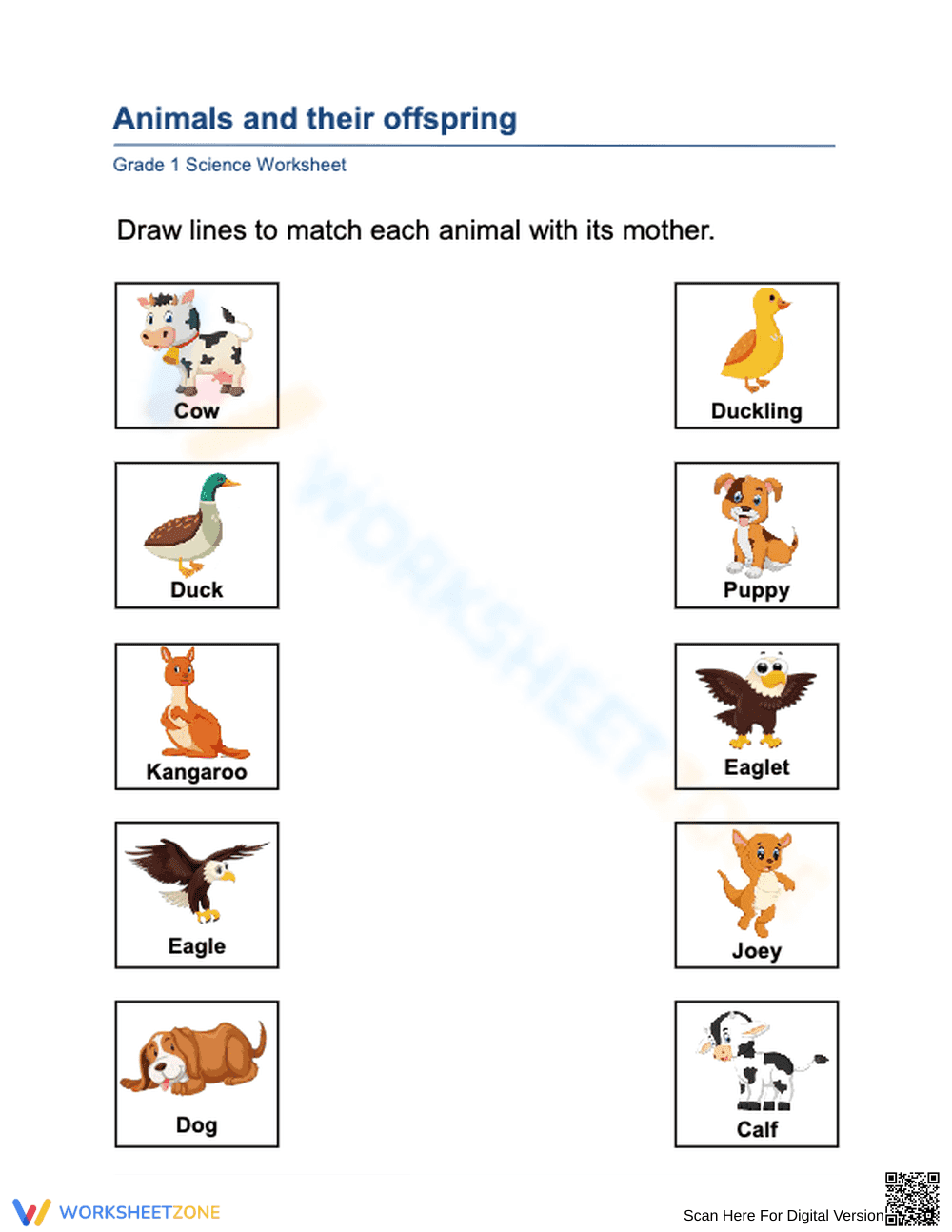

Printable Animal Parents & Offspring Worksheet | Grade 1

Paste this activity's link or code into your existing LMS (Google Classroom, Canvas, Teams, Schoology, Moodle, etc.).
Students can open and work on the activity right away, with no student login required.
You'll still be able to track student progress and results from your teacher account.
Identifying the relationship between animal parents and their young is a fundamental step in early life science education. This Grade 1 worksheet helps students recognize patterns of similarity and differences in the natural world. By matching mothers to their babies, learners build essential observation skills and biological vocabulary while meeting core curriculum requirements.
At a Glance
- Grade: 1 · Subject: Science
- Standard:
1-LS3-1— Observe how young animals are like, but not exactly like, their parents- Skill Focus: Animal offspring identification and matching
- Format: 2 pages · 5 problems · Answer key included · PDF
- Best For: Science centers and independent practice
- Time: 10–15 minutes
What's Inside
This resource contains a high-quality printable activity page and a corresponding answer sheet for easy grading. Students engage with five distinct animal pairs: cows and calves, ducks and ducklings, kangaroos and joeys, eagles and eaglets, and dogs and puppies. The clear illustrations and bold text labels support emerging readers and visual learners by providing immediate context for biological terms.
Zero-Prep Workflow
- Print (30 seconds): Select the single-sided worksheet for student use and the answer key for your records.
- Distribute (1 minute): Hand out the sheets during your life science block or place them in a dedicated science center.
- Review (30 seconds): Use the included answer key to quickly verify student matching accuracy or for self-correction.
Total teacher prep time is under two minutes, making this an ideal sub plan or last-minute reinforcement activity for busy classrooms.
Standards Alignment
This activity aligns with `1-LS3-1`: "Make observations to construct an evidence-based account that young plants and animals are like, but not exactly like, their parents." Additionally, it supports `1-LS1-2` by highlighting the biological connection between parents and their young that is essential for species survival. Both standard codes can be copied directly into lesson plans, IEP goals, or district curriculum mapping tools.
How to Use It
Use this worksheet during your Life Science unit after a direct instruction lesson on animal families. It serves as an excellent formative assessment to check for student understanding of parent-offspring relationships. Observe students as they match the pairs to identify who might need more support with specific vocabulary like "joey" or "eaglet." The task usually takes about ten to fifteen minutes to complete.
Who It's For
Designed primarily for first-grade students, this worksheet is also suitable for kindergarten enrichment or second-grade review. It pairs naturally with non-fiction animal books or an anchor chart showing different animal life cycles and family groups in various habitats across the globe.
The development of biological classification skills in early childhood is a critical precursor to understanding complex ecological systems. This worksheet targets the 1-LS3-1 standard by requiring students to perform visual matching between adult animals and their offspring, such as the joey and kangaroo or calf and cow. Research by Fisher & Frey (2014) highlights the importance of using visual scaffolds and clear nomenclature to support the gradual release of responsibility in primary science education. By identifying specific patterns of similarity, students move beyond simple recognition toward an evidence-based account of how living things grow and change. This resource provides five focused tasks that reinforce essential vocabulary while providing teachers with immediate data on student mastery. The inclusion of a full answer key ensures that this document is ready for immediate classroom integration, supporting high-leverage instructional practices in the life sciences.


