




























Views
Downloads

Bee Life Cycle Worksheet | Essential Grade 1 Science

Paste this activity's link or code into your existing LMS (Google Classroom, Canvas, Teams, Schoology, Moodle, etc.).
Students can open and work on the activity right away, with no student login required.
You'll still be able to track student progress and results from your teacher account.
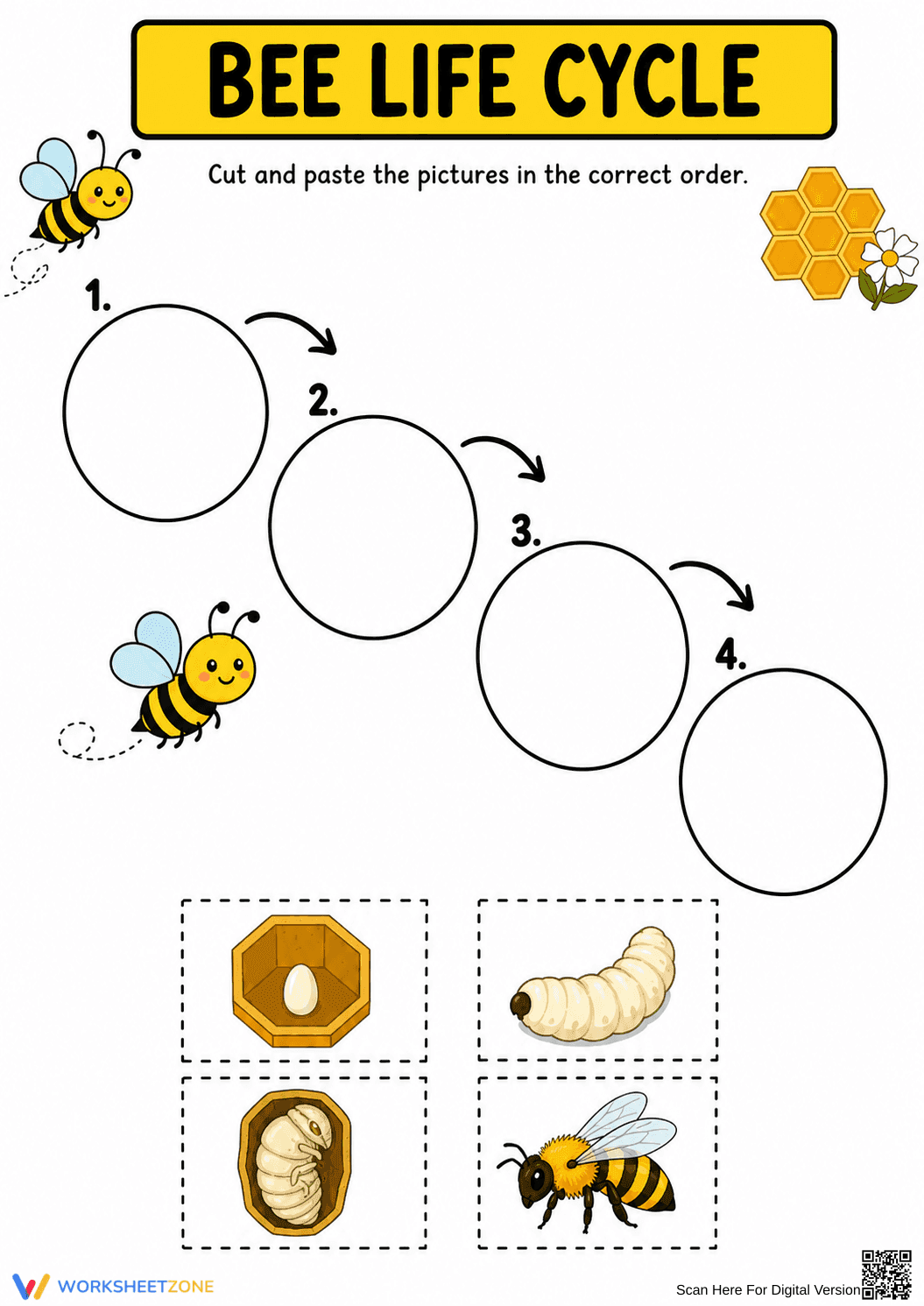
This Bee Life Cycle Sequencing worksheet provides a hands-on approach for early learners to visualize biological growth. Students identify and order the four primary stages of a honeybee's development, transforming abstract concepts into a concrete visual model. It effectively builds foundational scientific observation skills while strengthening fine motor coordination through tactile engagement.
At a Glance
- Grade: 1 · Subject: Science
- Standard:
1-LS1-2— Read texts and use media to determine patterns in behavior of parents and offspring- Skill Focus: Bee life cycle sequencing
- Format: 1 page · 4 problems · Answer key included · PDF
- Best For: Independent science centers and morning work
- Time: 15–20 minutes
The resource consists of a single-page PDF featuring a clear, numbered sequencing path and a dedicated cut-out section. It includes four high-quality illustrations representing the egg (within a honeycomb cell), larva, pupa, and adult bee stages. The layout is designed for high-contrast printing, ensuring that the visual cues for each stage are easily distinguishable for young learners. A full-color answer key is provided for quick grading or self-correction.
This worksheet is designed for immediate classroom implementation with a total teacher prep time of under 2 minutes. First, print the required number of copies for your group. Second, distribute the sheets along with scissors and glue sticks; the self-explanatory layout requires minimal verbal instruction. Finally, review the completed sequences as a whole group or use the included answer key for rapid formative assessment during independent work time.
This activity is primarily aligned with `1-LS1-2`, focusing on identifying patterns in the life cycles of living things. By observing the distinct stages of the bee, students recognize the predictable sequence of growth and development common to insects. It also supports `K-LS1-1` by encouraging students to observe what animals need to survive at different stages. Both standard codes can be copied directly into lesson plans, IEP goals, or district curriculum mapping tools.
Use this worksheet as a summative assessment after a read-aloud about pollinators or as a quiet-time activity during a science unit on insects. For a formative assessment, observe students as they arrange the pictures before gluing; check if they can explain why the larva comes after the egg. This activity typically takes 15 to 20 minutes to complete, depending on the students' scissor skills.
This resource is ideal for first-grade classrooms, but it is also highly effective for Kindergarten students needing fine motor practice or second graders reviewing life cycles. It pairs naturally with a classroom observation hive, a non-fiction text about honeybees, or an anchor chart detailing insect anatomy.
Research from Fisher & Frey (2014) emphasizes that tactile sequencing activities, such as this cut-and-paste worksheet, significantly improve the retention of chronological processes in early childhood science education. By physically manipulating the stages of the 1-LS1-2 bee life cycle, students move beyond rote memorization toward a conceptual understanding of biological patterns. This worksheet provides 4 specific tasks that bridge the gap between visual recognition and logical ordering. According to the NAEP science framework, early exposure to life cycle models builds the necessary scaffolding for more complex ecological studies in later grades. The inclusion of a clear, numbered path ensures that students remain focused on the scientific sequence rather than getting lost in the mechanics of the task. This resource serves as a reliable tool for documenting student progress toward mastery of life science standards.


