


























Views
Downloads
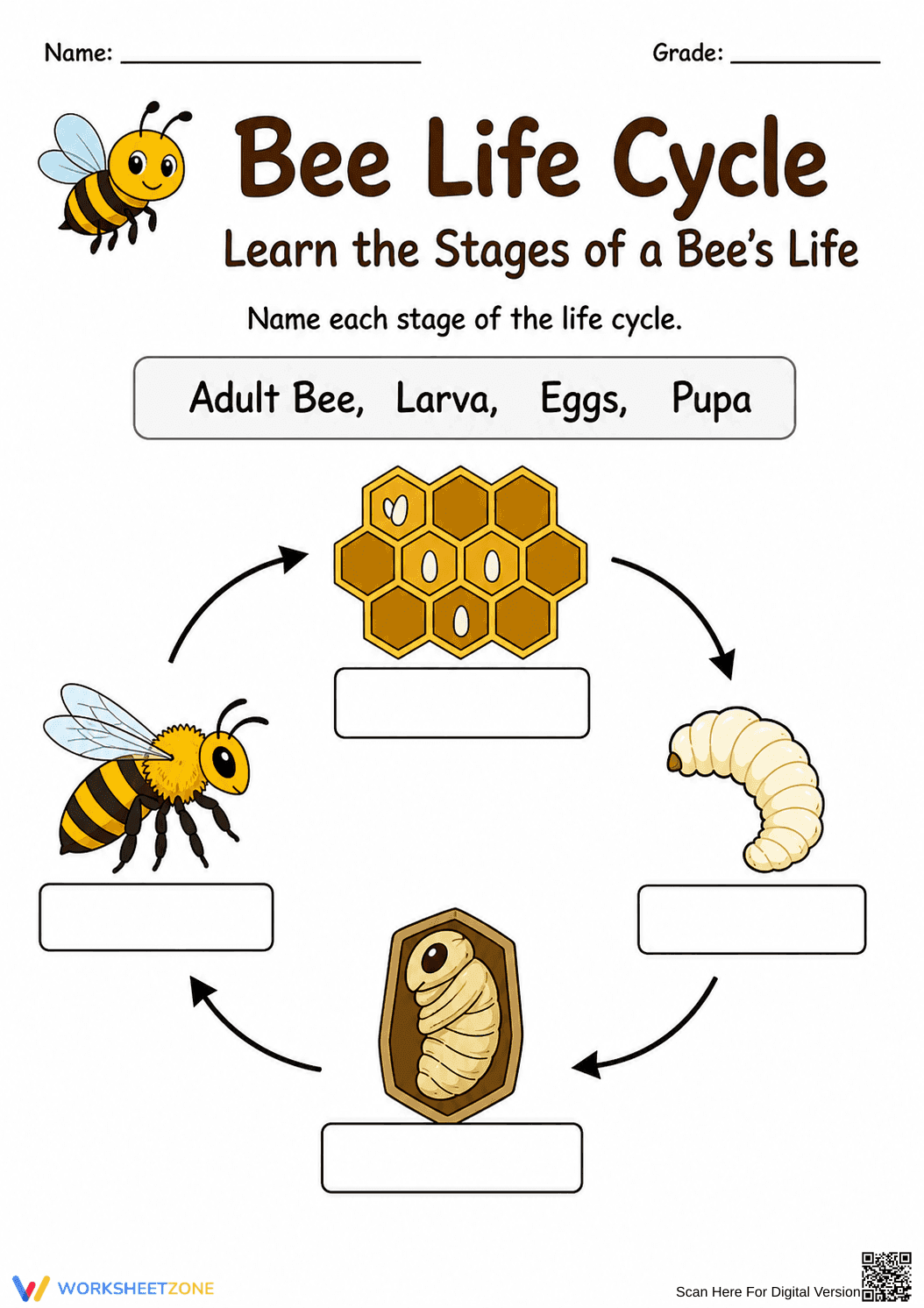

Bee Life Cycle Worksheet | Grade 3 Printable
Paste this activity's link or code into your existing LMS (Google Classroom, Canvas, Teams, Schoology, Moodle, etc.).
Students can open and work on the activity right away, with no student login required.
You'll still be able to track student progress and results from your teacher account.
This Grade 3 bee life cycle worksheet helps students identify and sequence the four primary stages of a honeybee's development. By matching visual representations to scientific terminology, learners build a foundational understanding of biological growth and metamorphosis. This resource ensures students can distinguish between eggs, larva, pupa, and adult forms effectively.
At a Glance
- Grade: 3 · Subject: Science
- Standard:
3-LS1-1— Develop models to describe that organisms have unique and diverse life cycles- Skill Focus: Life cycle sequencing and labeling
- Format: 1 page · 4 problems · Answer key included · PDF
- Best For: Introduction to insect metamorphosis and biology
- Time: 10–15 minutes
This single-page PDF features a clear, circular diagram representing the continuous nature of an insect's life. It includes high-quality illustrations of a honeycomb with eggs, a developing larva, a pupa in a cell, and a fully formed adult bee. A word bank is provided at the top to support vocabulary acquisition, and a comprehensive answer key is included for rapid grading and immediate student feedback.
The zero-prep design allows for immediate classroom implementation. First, print the single-page PDF in less than 30 seconds. Next, distribute the sheets to students as a warm-up activity or an exit ticket. Finally, use the included answer key to review the stages as a whole group or for individual grading. This streamlined workflow makes it an ideal choice for emergency sub plans or quick formative assessments during a busy science block.
This resource is aligned with `3-LS1-1`, which requires students to develop models to describe that organisms have unique and diverse life cycles. By labeling the specific stages of the bee, students are creating a mental and physical model of growth and development. This standard code can be copied directly into lesson plans, IEP goals, or district curriculum mapping tools to ensure compliance with state and national frameworks.
Use this worksheet during the "Explain" phase of a 5E lesson cycle to reinforce direct instruction about insects and pollinators. It serves as an excellent formative assessment tool; observe if students can correctly identify the pupa stage, which is often the most challenging to distinguish from the larva. The expected completion time is 10 to 15 minutes, making it perfect for a science center rotation or a quiet independent practice session.
This activity is designed for Grade 1 through Grade 3 students, with scaffolding provided via the word bank for younger learners. It is particularly effective for English Language Learners (ELLs) who benefit from the direct pairing of clear images and specific academic vocabulary. Pair this worksheet with a non-fiction passage about honeybees or a classroom observation of a live insect habitat to deepen the learning experience.
According to the RAND AIRS 2024 report on elementary science instruction, visual modeling of biological processes significantly improves long-term retention of complex systems. This worksheet addresses the 3-LS1-1 standard by requiring students to engage with the specific stages of the bee life cycle, moving beyond simple observation to active labeling and categorization. Research from Fisher & Frey (2014) emphasizes that providing clear visual cues alongside academic vocabulary—such as larva and pupa—supports the gradual release of responsibility in early childhood science. By utilizing this structured 4-task model, educators provide the necessary scaffolding for students to master the concept of metamorphosis. This resource provides a reliable, evidence-based method for assessing student understanding of how organisms grow and change over time, ensuring that foundational life science concepts are solidified before moving to more complex ecological interactions.


