




























Views
Downloads
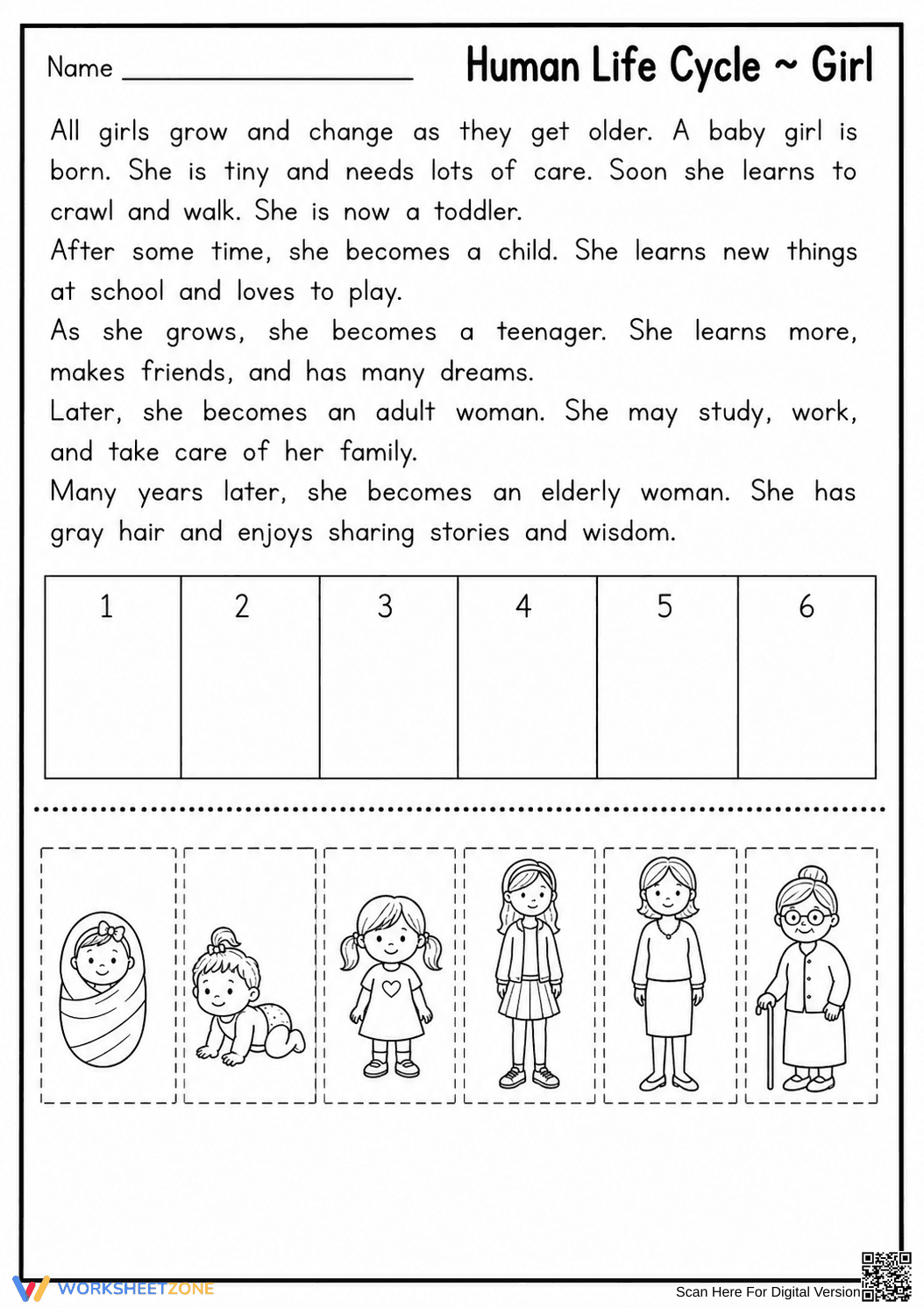

Grade 2 Human Life Cycle — Printable No-Prep Worksheet

Paste this activity's link or code into your existing LMS (Google Classroom, Canvas, Teams, Schoology, Moodle, etc.).
Students can open and work on the activity right away, with no student login required.
You'll still be able to track student progress and results from your teacher account.
This Grade 2 science and reading comprehension worksheet helps students understand the stages of human growth by sequencing a short informational text. Students read a simple passage about a girl's life cycle and then physically order the corresponding images, reinforcing both scientific concepts and chronological reading skills.
At a Glance
- Grade: 2 · Subject: Science
- Standard:
CCSS.ELA-LITERACY.RI.2.3— Describe the connection between scientific concepts or steps in a text.- Skill Focus: Sequencing and Life Cycles
- Format: 1 page · 6 problems · PDF
- Best For: Independent practice or centers
- Time: 15–20 minutes
What's Inside
Inside this single-page resource, educators will find a short reading passage detailing six stages of a female human's life: baby, toddler, child, teenager, adult, and elderly woman. Below the text, six numbered boxes provide space for the interactive task. The bottom features six illustrations that students cut out and paste into the correct sequential order based on the text.
Zero-Prep Workflow
- Print (1 minute): Simply print the single-page PDF for each student. No special materials are required beyond standard classroom scissors and glue sticks.
- Distribute (1 minute): Hand out the worksheets during a science block or literacy center. The instructions are self-explanatory, allowing students to begin immediately.
- Review (3 minutes): Quickly check the pasted images against the chronological order described in the text.
Total teacher prep time is under two minutes, making this an excellent option for emergency sub plans or quick independent work activities.
Standards Alignment
This activity is aligned to primary standard CCSS.ELA-LITERACY.RI.2.3: Describe the connection between a series of historical events, scientific ideas or concepts, or steps in technical procedures in a text. It also supports early science standards regarding organism growth and development. Both standard codes can be copied directly into lesson plans, IEP goals, or district curriculum mapping tools.
How to Use It
This worksheet is highly versatile for early elementary classrooms. Use it as an independent practice activity after direct instruction on life cycles, allowing students to demonstrate their understanding through a hands-on task. Alternatively, it serves as a fantastic cross-curricular literacy center where students practice reading informational text and sequencing events. Teachers can observe students during the cut-and-paste process as a quick formative assessment to ensure they comprehend chronological order words like "soon," "after," and "later." Expected completion time is 15 to 20 minutes.
Who It's For
This resource is designed for Grade 2 students, though it is easily adaptable for advanced first graders or third graders needing foundational review. The visual supports and hands-on cutting activity provide excellent differentiation for visual and kinesthetic learners, as well as English Language Learners who benefit from matching pictures to vocabulary. Pair this worksheet with a whole-class anchor chart about animal and human life cycles for maximum impact.
Integrating cross-curricular activities that combine reading comprehension with scientific concepts significantly enhances early elementary learning outcomes. By aligning with CCSS.ELA-LITERACY.RI.2.3 to describe the connection between scientific concepts or steps in a text, this worksheet ensures students are practicing rigorous academic skills. According to a recent EdReports 2024 analysis, instructional materials that blend hands-on interactive tasks—such as cutting and pasting—with informational text sequencing lead to higher retention of domain-specific vocabulary and improved chronological reasoning. When students physically manipulate the stages of the human life cycle to match a written narrative, they solidify their understanding of both the biological process and the text structure. This dual-focus approach maximizes instructional minutes while providing a developmentally appropriate, engaging task that supports diverse learning styles.


