


























Views
Downloads

Apple Tree Life Cycle Printable Worksheet | Grade K-2
Paste this activity's link or code into your existing LMS (Google Classroom, Canvas, Teams, Schoology, Moodle, etc.).
Students can open and work on the activity right away, with no student login required.
You'll still be able to track student progress and results from your teacher account.
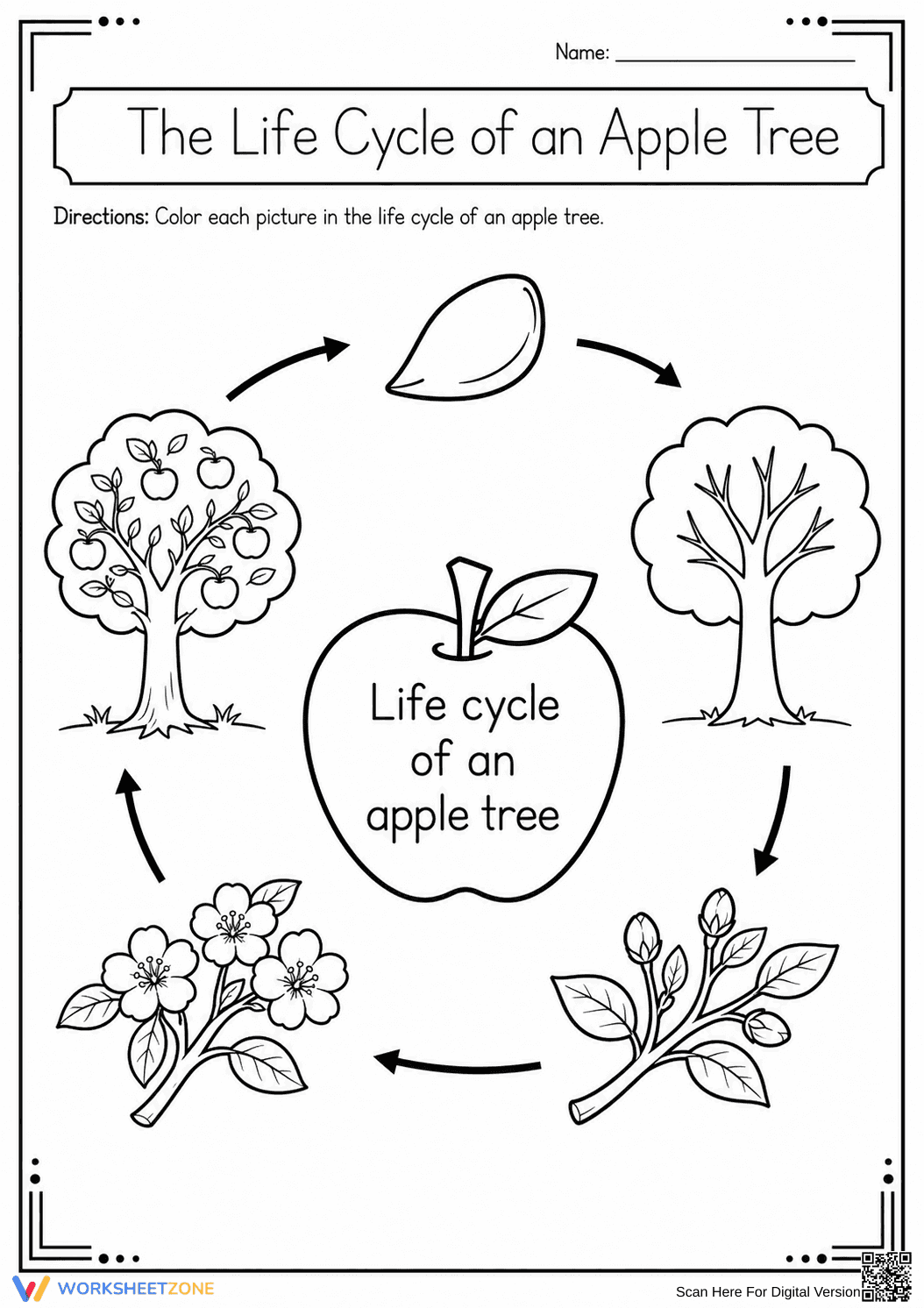
This printable apple tree life cycle worksheet provides early learners with a visual framework to understand botanical growth. Students engage with four distinct stages of development, from seed to fruit-bearing tree, through a coloring activity that reinforces sequencing. It serves as an ideal introductory tool for primary science units focused on living things and natural patterns.
At a Glance
- Grade: K-2 · Subject: Science
- Standard:
K-LS1-1— Use observations to describe patterns of what plants need to survive and grow- Skill Focus: Plant life cycle sequencing
- Format: 1 page · 4 stages · Coloring activity · PDF
- Best For: Introduction to botany and fine motor practice
- Time: 15–20 minutes
The resource consists of a single-page PDF featuring a central apple-shaped title surrounded by a circular flow diagram. It includes four detailed illustrations representing the seed, a young tree, apple blossoms, and a mature tree laden with fruit. Directional arrows guide the student through the chronological order of growth, and the clear, bold outlines are specifically designed for young children to color with ease.
The zero-prep workflow for this activity is designed for maximum efficiency in busy classrooms. First, print the single-page PDF for your class (30 seconds). Next, distribute the sheets along with coloring supplies (1 minute). Finally, review the stages as a group while students work, checking for understanding of the circular nature of the cycle (5 minutes). Total teacher preparation time is under 2 minutes, making it an excellent choice for morning work or sub plans.
This worksheet aligns with `K-LS1-1`, requiring students to use observations to describe patterns in the natural world. By identifying the sequential stages of an apple tree, students recognize the predictable patterns of growth and development in plants. This standard code can be copied directly into lesson plans, IEP goals, or district curriculum mapping tools to ensure compliance with state and national science frameworks.
Use this worksheet during the "explore" phase of a 5E science lesson on plants. It works well as a follow-up to a read-aloud about seasons or orchards. For a formative assessment, observe if students color the stages in the correct order indicated by the arrows. Expected completion time is 15 to 20 minutes depending on the level of detail students apply to their coloring and the depth of the accompanying discussion.
This resource is tailored for Kindergarten and 1st-grade students, though it remains useful for 2nd-grade review. It is particularly effective for English Language Learners (ELLs) who benefit from visual representations of vocabulary. Pair this with a real apple-tasting activity or a seed-planting demonstration to provide a multi-sensory learning experience that connects the classroom activity to the real world.
This educational resource focuses on the life cycle of an apple tree, specifically aligned with the K-LS1-1 standard which emphasizes observing patterns in living organisms. By utilizing a circular diagram with 4 distinct stages, the worksheet supports the development of sequencing skills and botanical literacy in early childhood. Research by Fisher & Frey (2014) highlights the importance of visual scaffolds and non-linguistic representations in helping young learners internalize complex scientific concepts. The inclusion of a coloring component not only engages students but also aids in the development of fine motor skills necessary for early writing. This worksheet provides a structured yet flexible approach to science instruction, allowing educators to integrate it into broader units on nature, seasons, or agriculture. It serves as a reliable tool for formative assessment, ensuring students can identify the chronological progression from seed to mature plant within a classroom or homeschool setting.


