




























Views
Downloads
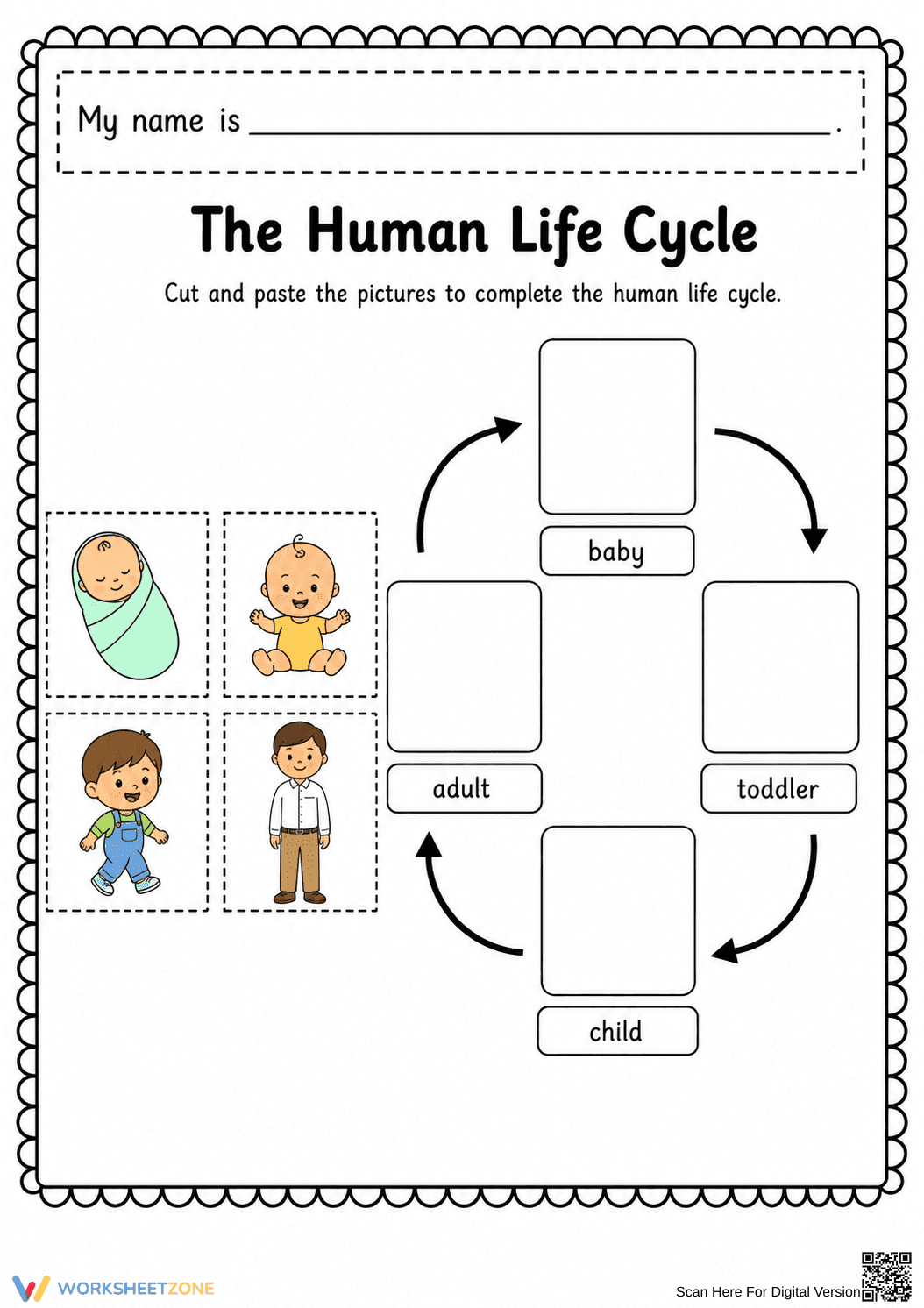

Grade 1 Human Life Cycle — Printable No-Prep Worksheet

Paste this activity's link or code into your existing LMS (Google Classroom, Canvas, Teams, Schoology, Moodle, etc.).
Students can open and work on the activity right away, with no student login required.
You'll still be able to track student progress and results from your teacher account.
This printable science worksheet helps young students master the stages of human growth by sequencing the human life cycle. Students will cut out illustrations of a baby, toddler, child, and adult, then paste them into a continuous circular diagram to demonstrate their understanding of biological development and growth over time.
At a Glance
- Grade: 1 · Subject: Science
- Standard:
1-LS3-1— Understand that young animals change and grow into adults- Skill Focus: Sequencing life cycle stages
- Format: 1 page · 4 problems · Answer key included · PDF
- Best For: Independent practice and centers
- Time: 10–15 minutes
Inside this single-page resource, educators will find a clear, visually engaging cut-and-paste activity designed for early learners. The worksheet features a large circular flow chart with four empty boxes connected by directional arrows. At the bottom of the page, four dashed cut-out squares display age-appropriate illustrations of human development stages. Students use these visual cues and the provided text labels to complete the cycle. A standard answer key is included.
This resource is designed for immediate classroom implementation with a streamlined zero-prep workflow:
- Print (1 min): Print the PDF. No special materials needed beyond scissors and glue.
- Distribute (1 min): Hand out during your science block or place in a center.
- Review (1 min): Use the key to quickly check work.
With total prep time under two minutes, this is excellent for sub plans.
This activity aligns with 1-LS3-1: Make observations to construct an evidence-based account that young plants and animals are like, but not exactly like, their parents. By organizing human growth stages, students build prerequisite knowledge about how organisms develop. Both standard codes can be copied directly into lesson plans, IEP goals, or district curriculum mapping tools.
Use this worksheet during direct instruction as a guided application activity. After reading a book about growing up, students can independently sequence the stages. Alternatively, it serves as an excellent science center station where students practice fine motor skills. As a formative assessment tip, observe students arranging pieces before gluing to gauge their understanding of chronological sequencing. Expected completion time is 10 to 15 minutes.
Designed for first-grade students, this is also effective for kindergarten enrichment or second-grade review. Visual illustrations and simple text labels provide built-in differentiation for early readers and English Language Learners. It pairs perfectly with introductory life science units or anchor charts depicting animal life cycles.
Integrating hands-on sequencing tasks into early childhood science instruction significantly reinforces long-term conceptual retention. According to a recent ScienceDirect TpT Analysis, interactive worksheets that combine physical manipulation—such as cutting and pasting—with cognitive sorting tasks consistently improve student engagement and content mastery in primary grades. This specific activity targets 1-LS3-1, directly helping students understand that young animals change and grow into adults through a clear, visual progression. By physically moving the stages of human development into a continuous circular diagram, young learners solidify their grasp of biological chronologies. The tactile nature of the exercise supports fine motor development while simultaneously addressing core life science standards, making it a highly efficient instructional tool. Educators can rely on this structured approach to deliver rigorous, standards-aligned content that remains accessible and developmentally appropriate for early elementary students.


