


























Views
Downloads

Printable Pine Tree Life Cycle Worksheet | Grade 1 Science
Paste this activity's link or code into your existing LMS (Google Classroom, Canvas, Teams, Schoology, Moodle, etc.).
Students can open and work on the activity right away, with no student login required.
You'll still be able to track student progress and results from your teacher account.
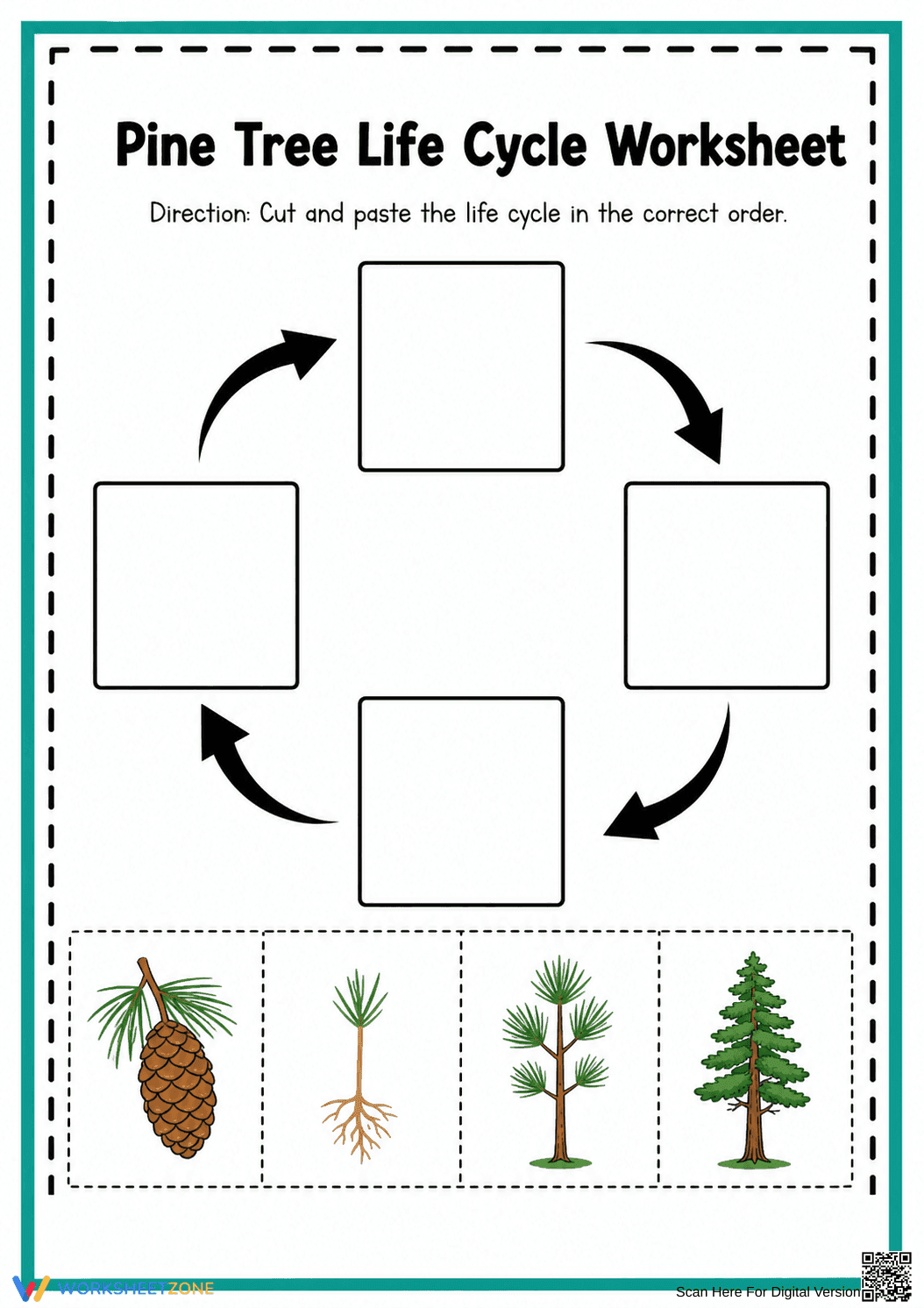
This engaging science worksheet helps students master the stages of a pine tree's development by sequencing its growth from cone to mature tree. By cutting and pasting four distinct life stages into a continuous circular model, young learners build foundational biology skills while simultaneously practicing fine motor coordination.
At a Glance
- Grade: 1 · Subject: Science
- Standard:
3-LS1-1— Develop models to describe organism life cycles- Skill Focus: Sequencing plant life stages
- Format: 1 page · 4 problems · PDF
- Best For: Independent practice or science centers
- Time: 10–15 minutes
Inside this single-page resource, educators will find a clear, circular diagram featuring four blank sequencing boxes connected by directional arrows. At the bottom of the page, students are provided with four beautifully illustrated cut-outs representing the key phases of a pine tree's growth: a pine cone, a small seedling with visible roots, a growing sapling, and a fully mature pine tree. The layout is highly intuitive, requiring no additional materials beyond scissors and glue.
This resource is designed for a seamless, zero-prep classroom experience:
- Print (1 minute): Simply print the single-page PDF for each student. No complex assembly or pre-cutting is required.
- Distribute (1 minute): Hand out the worksheets along with scissors and glue sticks. The visual directions are self-explanatory for early readers.
- Review (3 minutes): Quickly check student work as they paste the four stages into the correct cyclical order.
With under two minutes of total teacher prep time, this activity is an excellent addition to emergency sub plans or spontaneous science centers.
This activity aligns with 3-LS1-1: Develop models to describe that organisms have unique and diverse life cycles but all have in common birth, growth, reproduction, and death. By physically moving the stages into a continuous loop, students create a working model of biological growth. Both standard codes can be copied directly into lesson plans, IEP goals, or district curriculum mapping tools.
This versatile worksheet fits perfectly into multiple instructional moments. Use it as an independent practice activity immediately following a whole-class read-aloud about trees or seasonal changes. Alternatively, place it in a science center where students can work collaboratively to discuss the order of the images before gluing them down. As a formative assessment tip, observe whether students correctly identify the pine cone as the starting seed stage before the rooted seedling. Expected completion time ranges from 10 to 15 minutes depending on cutting proficiency.
This resource is primarily designed for kindergarten, first-grade, and second-grade students developing early science and sequencing skills. It naturally supports learners who benefit from tactile, hands-on activities to solidify abstract concepts like time and growth. Pair this worksheet with a nature walk to collect real pine cones or a direct instruction lesson on gymnosperms and evergreen plants.
Integrating hands-on modeling into early elementary science instruction significantly enhances student comprehension of biological processes. According to a ScienceDirect TpT Analysis, interactive sequencing tasks that require physical manipulation of materials improve both conceptual retention and fine motor development in young learners. This worksheet directly supports 3-LS1-1 by having students develop models to describe organism life cycles through a structured cut-and-paste format. By transforming a static diagram into an active sorting exercise, educators can better assess student understanding of chronological growth patterns in plants. The visual scaffolds, such as directional arrows and distinct botanical illustrations, ensure that the cognitive load remains focused on the scientific sequence rather than complex text decoding, making it an essential tool for early childhood science curricula.


