


























Views
Downloads
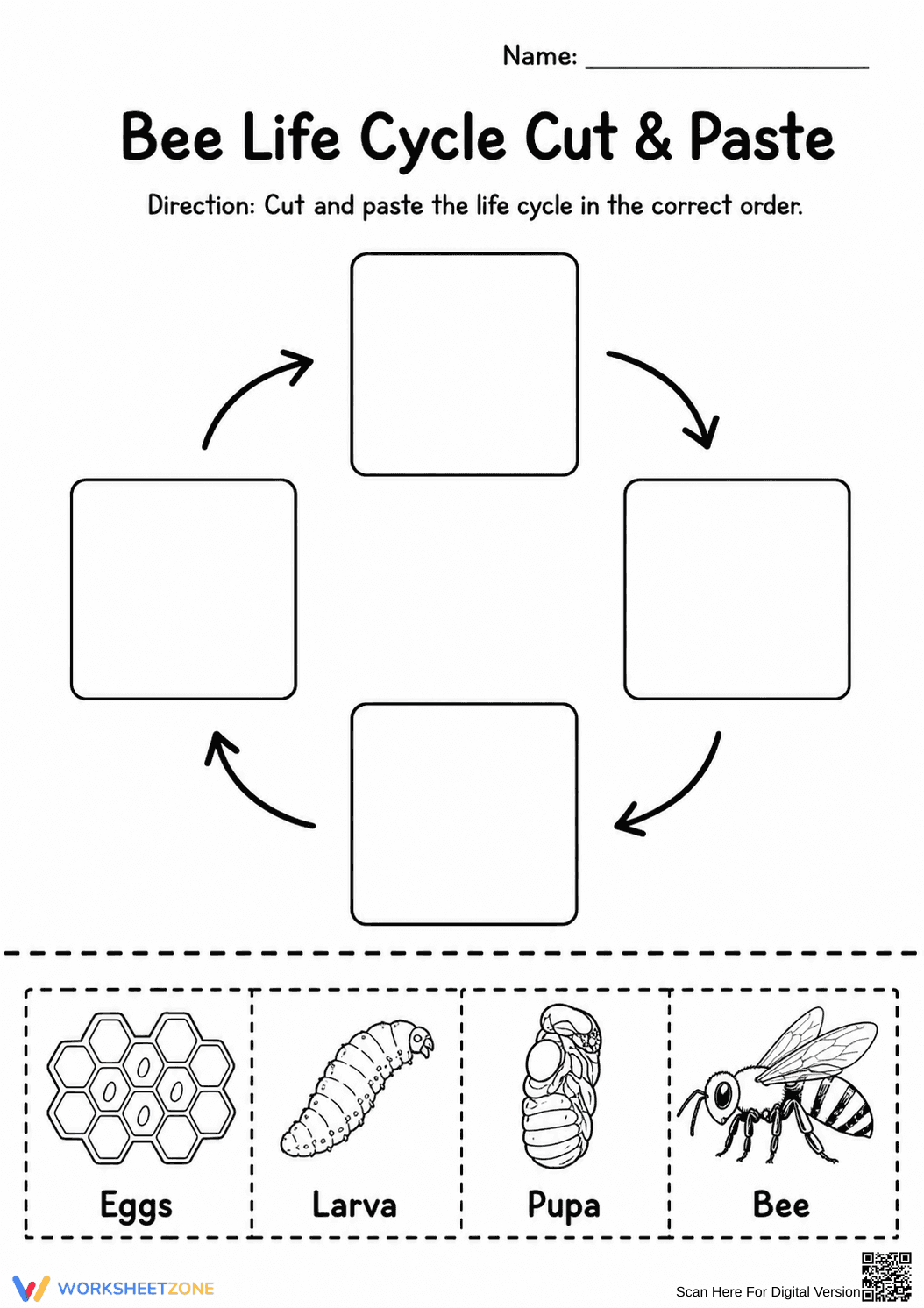

Grade 1 Bee Life Cycle — Printable No-Prep Worksheet
Paste this activity's link or code into your existing LMS (Google Classroom, Canvas, Teams, Schoology, Moodle, etc.).
Students can open and work on the activity right away, with no student login required.
You'll still be able to track student progress and results from your teacher account.
This hands-on science worksheet helps early elementary students master the stages of a bee's development by sequencing its life cycle. By cutting and pasting four distinct growth phases into a circular diagram, young learners actively build their understanding of biological changes while practicing essential fine motor skills.
At a Glance
- Grade: 1 · Subject: Science
- Standard:
1-LS3-1— Observe and describe how animals grow and change- Skill Focus: Sequencing life cycles
- Format: 1 page · 4 problems · No answer key · PDF
- Best For: Independent science centers
- Time: 10–15 minutes
This single-page resource features a circular graphic organizer with four blank squares connected by directional arrows. At the bottom, students find four labeled illustrations representing the key stages of a bee's life: eggs, larva, pupa, and adult bee. The dashed cut-lines provide clear boundaries to support scissor skills, while bold arrows guide the logical flow of the sequence.
This activity is designed for immediate classroom implementation with zero teacher preparation required.
- Print (1 minute): Print the single-page PDF. No specialized materials are needed.
- Distribute (1 minute): Hand out the sheets with scissors and glue.
- Review (3 minutes): Check the four pasted squares for accurate chronological order.
With a total prep time under two minutes, this resource is an ideal addition to any emergency sub plan.
This activity aligns with 1-LS3-1 by having students make observations to construct an evidence-based account of how animals grow and change, focusing on the distinct developmental stages of insects. Both standard codes can be copied directly into lesson plans, IEP goals, or district curriculum mapping tools.
Deploy this worksheet during independent science centers after a whole-class read-aloud about insects or pollinators. Students can work at their own pace, allowing the teacher to circulate and facilitate small-group discussions about metamorphosis. Alternatively, use it as a formative assessment at the end of a life cycles unit. As students work, observe their ability to follow the directional arrows—a key indicator of their grasp on cyclical, continuous processes rather than simple linear timelines. Expect students to complete the cutting, sorting, and pasting within 10 to 15 minutes.
This resource is primarily designed for kindergarten and first-grade students developing their foundational science knowledge and fine motor coordination. The clear, high-contrast illustrations make it highly accessible for English Language Learners and students requiring visual scaffolds. For a comprehensive lesson, pair this cut-and-paste activity with a non-fiction picture book about honeybees or a classroom anchor chart detailing the roles of worker bees and queens.
Integrating hands-on manipulatives into early science instruction significantly reinforces conceptual retention. According to a recent EdReports 2024 analysis of elementary science curricula, students who physically sequence biological events demonstrate a higher mastery of chronological scientific processes compared to those who only complete passive observation tasks. This worksheet directly supports 1-LS3-1 by requiring learners to observe and describe how animals grow and change through distinct developmental phases. By combining tactile cutting and pasting with the cognitive task of ordering the eggs, larva, pupa, and adult bee, educators provide a multi-sensory learning experience. This approach not only solidifies the specific biological vocabulary but also strengthens the spatial reasoning required to interpret cyclical diagrams, laying critical groundwork for more advanced STEM concepts in later grades.


