




























Views
Downloads

Penguin Life Cycle Worksheet | Essential Grade K Science

Paste this activity's link or code into your existing LMS (Google Classroom, Canvas, Teams, Schoology, Moodle, etc.).
Students can open and work on the activity right away, with no student login required.
You'll still be able to track student progress and results from your teacher account.
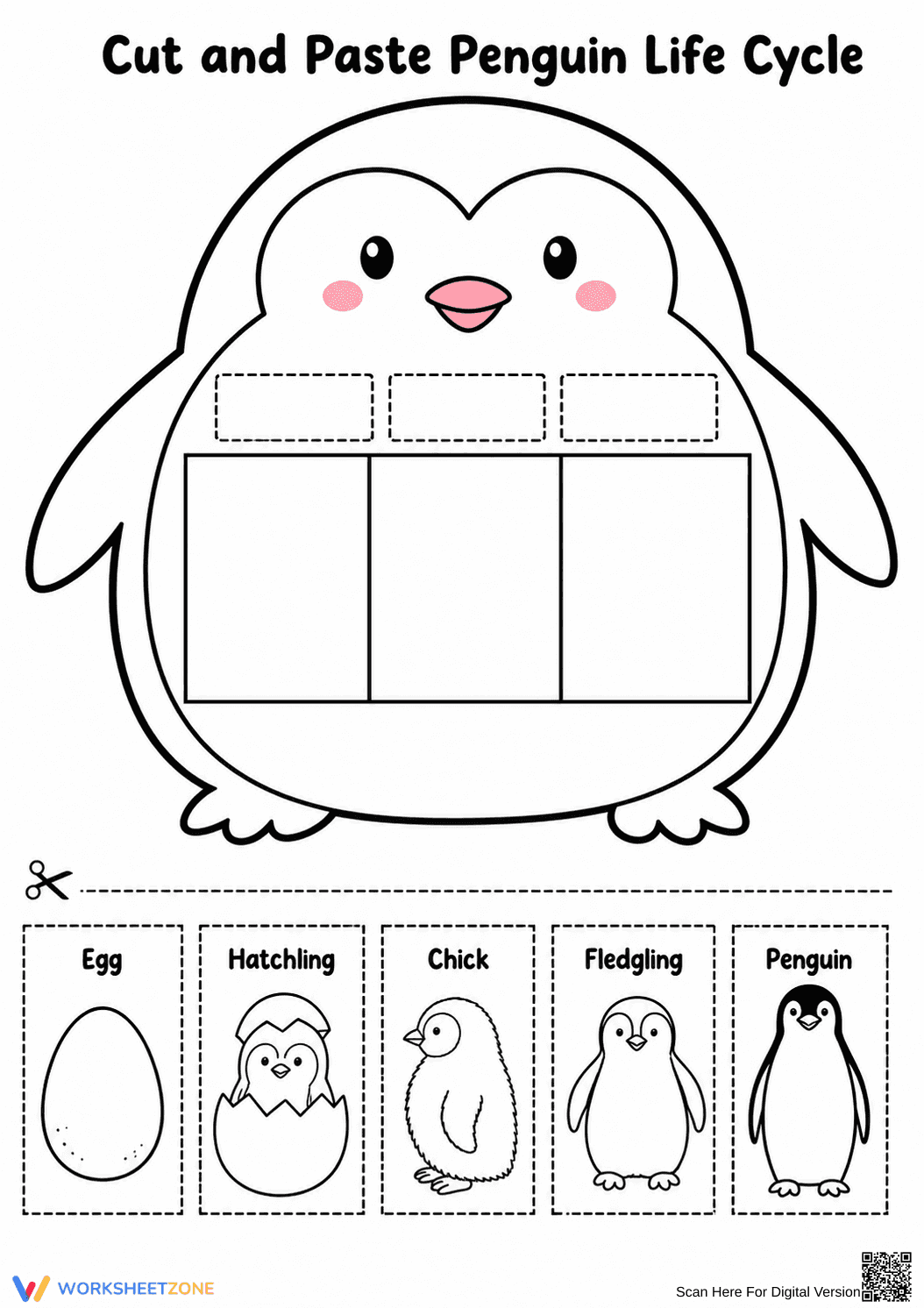
This printable penguin life cycle worksheet helps early learners sequence the biological stages of an Antarctic bird. By ordering growth phases, students develop a foundational understanding of how living things change. This activity transforms biological concepts into a tactile experience for young scientists.
At a Glance
- Grade: Kindergarten · Subject: Science
- Standard:
K-LS1-1— Use observations to describe patterns of what living things need to survive- Skill Focus: Biological sequencing & fine motor skills
- Format: 1 page · 3 tasks · Answer key included · PDF
- Best For: Independent science centers or morning work
- Time: 15–20 minutes
What's Inside
The worksheet features a large, friendly penguin graphic containing three designated sequencing boxes. At the bottom of the page, students find five distinct, labeled image tiles: Egg, Hatchling, Chick, Fledgling, and Penguin. This single-page PDF is designed for high-contrast printing, ensuring that the dashed cutting lines and labels remain clear for students developing their scissor skills.
Zero-Prep Workflow
The zero-prep design allows for immediate use in any early childhood setting:
- Print (30 seconds): Generate enough copies for your small group or whole class using any standard black-and-white printer.
- Distribute (30 seconds): Provide each student with the sheet, a pair of safety scissors, and a glue stick.
- Review (1 minute): Briefly discuss the visual tiles before students begin their independent work.
Total teacher preparation time is under two minutes, making this an ideal resource for emergency sub plans or transition periods.
Standards Alignment
This resource aligns with `K-LS1-1`, requiring students to use observations to describe patterns in the natural world. By selecting the correct sequence from the provided options, students demonstrate their ability to recognize the chronological order of animal development. This standard code can be copied directly into lesson plans, IEP goals, or district curriculum mapping tools.
How to Use It
Use this worksheet during the "Explore" phase of a science lesson on polar animals. After reading a non-fiction text about penguins, have students complete the sequence to check for comprehension. As a formative assessment, observe which students correctly identify the "Hatchling" versus the "Chick" to gauge their attention to detail regarding animal growth stages. Completion typically takes 15 to 20 minutes.
Who It's For
This activity is tailored for Kindergarten and early First Grade students. It provides excellent support for English Language Learners (ELLs) through the use of clear, labeled illustrations that pair vocabulary with visual evidence. It pairs naturally with a classroom anchor chart showing various bird life cycles or a read-aloud of "A Penguin Story."
The use of tactile sequencing activities, such as this penguin life cycle worksheet, is supported by research into early childhood cognitive development. According to Fisher & Frey (2014), the gradual release of responsibility model is most effective when students can manipulate physical representations of abstract concepts. This worksheet facilitates that transition by providing a structured framework for independent practice. By aligning with the K-LS1-1 standard, the activity ensures that students are not just performing a craft, but are actively engaging with the crosscutting concept of patterns in biological science. Research from the NAEP suggests that early exposure to life science sequencing significantly improves later scientific literacy and the ability to interpret complex diagrams. This resource provides the necessary scaffolding for young learners to master the essential skill of chronological biological observation while simultaneously strengthening the fine motor control required for academic success in primary grades.


