




























Views
Downloads
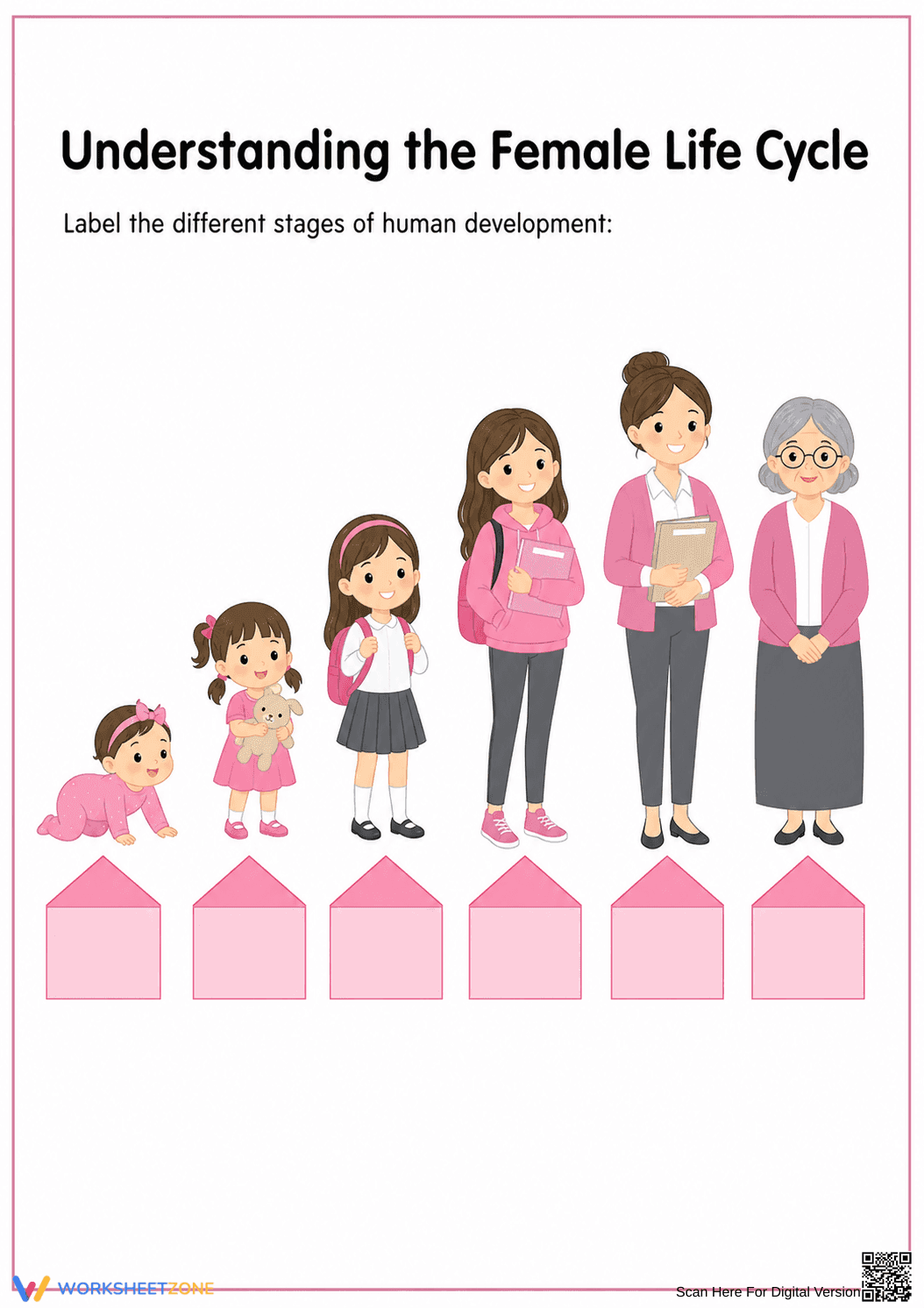

Essential Female Life Cycle Worksheet | Grade 1 Science

Paste this activity's link or code into your existing LMS (Google Classroom, Canvas, Teams, Schoology, Moodle, etc.).
Students can open and work on the activity right away, with no student login required.
You'll still be able to track student progress and results from your teacher account.
This human development worksheet helps students identify and sequence the biological stages of the female life cycle. By labeling clear illustrations, learners connect vocabulary to physical changes from infancy to old age. This activity provides a foundational understanding of how living things grow and change over time.
At a Glance
- Grade: 1 · Subject: Science
- Standard:
1-LS3-1— Observe and describe how young plants and animals are similar to their parents.- Skill Focus: Life cycle sequencing
- Format: 1 page · 6 problems · Answer key included · PDF
- Best For: Introduction to human biology and growth
- Time: 15–20 minutes
What's Inside: This one-page PDF features six high-quality illustrations of a female at different life stages: baby, toddler, child, teenager, adult, and elderly. Each image includes a dedicated labeling box for student responses. The layout is clean and spacious, making it accessible for early writers who are still developing fine motor skills.
Zero-Prep Workflow
- Print: Select the single-page PDF and print enough copies for your class in under 30 seconds.
- Distribute: Hand out the worksheets as a warm-up or concluding activity during your life science unit.
- Review: Use the included answer key to check for understanding or project the page for a whole-class discussion.
This resource is designed for immediate use with no teacher setup required, making it an excellent choice for emergency sub plans or quick formative assessments.
Standards Alignment
This worksheet aligns with 1-LS3-1: "Make observations to construct an evidence-based account that young plants and animals are like, but not exactly like, their parents." By examining the progression from baby to adult, students observe the consistent traits and changes inherent in human development. Both standard codes can be copied directly into lesson plans, IEP goals, or district curriculum mapping tools.
How to Use It
Use this as a formative assessment after reading a book about growing up or human biology. Ask students to point to which stage they are currently in to build a personal connection to the scientific content. Expected completion time ranges from 15 to 20 minutes depending on the student's writing speed. For an extension, have students describe one physical change that happens between two specific stages.
Who It's For
This resource is primarily designed for Grade 1 students but is highly adaptable for Kindergarten or Grade 2 learners. It is particularly useful for English Language Learners (ELLs) who need visual support to master developmental vocabulary. This worksheet pairs well with an anchor chart showing various animal life cycles for comparative biology lessons.
Fisher & Frey (2014) emphasize the importance of visual scaffolds in early science literacy to help students bridge the gap between observation and academic vocabulary. This worksheet utilizes clear, representative imagery to reduce cognitive load while focusing on the sequential nature of biological development. By requiring students to label specific stages, the activity reinforces the concept that organisms undergo predictable changes over time, a core component of the 1-LS3-1 standard. Research from the NAEP suggests that early exposure to life science concepts through structured observation tasks improves long-term retention of biological principles. This resource provides a concrete entry point for young learners to discuss complex topics like aging and development in a classroom-appropriate manner. The 6-task structure ensures sufficient practice without overwhelming early writers, making it an ideal tool for diverse primary classrooms. It serves as a reliable assessment of a student's ability to recognize developmental milestones.


