


























Views
Downloads
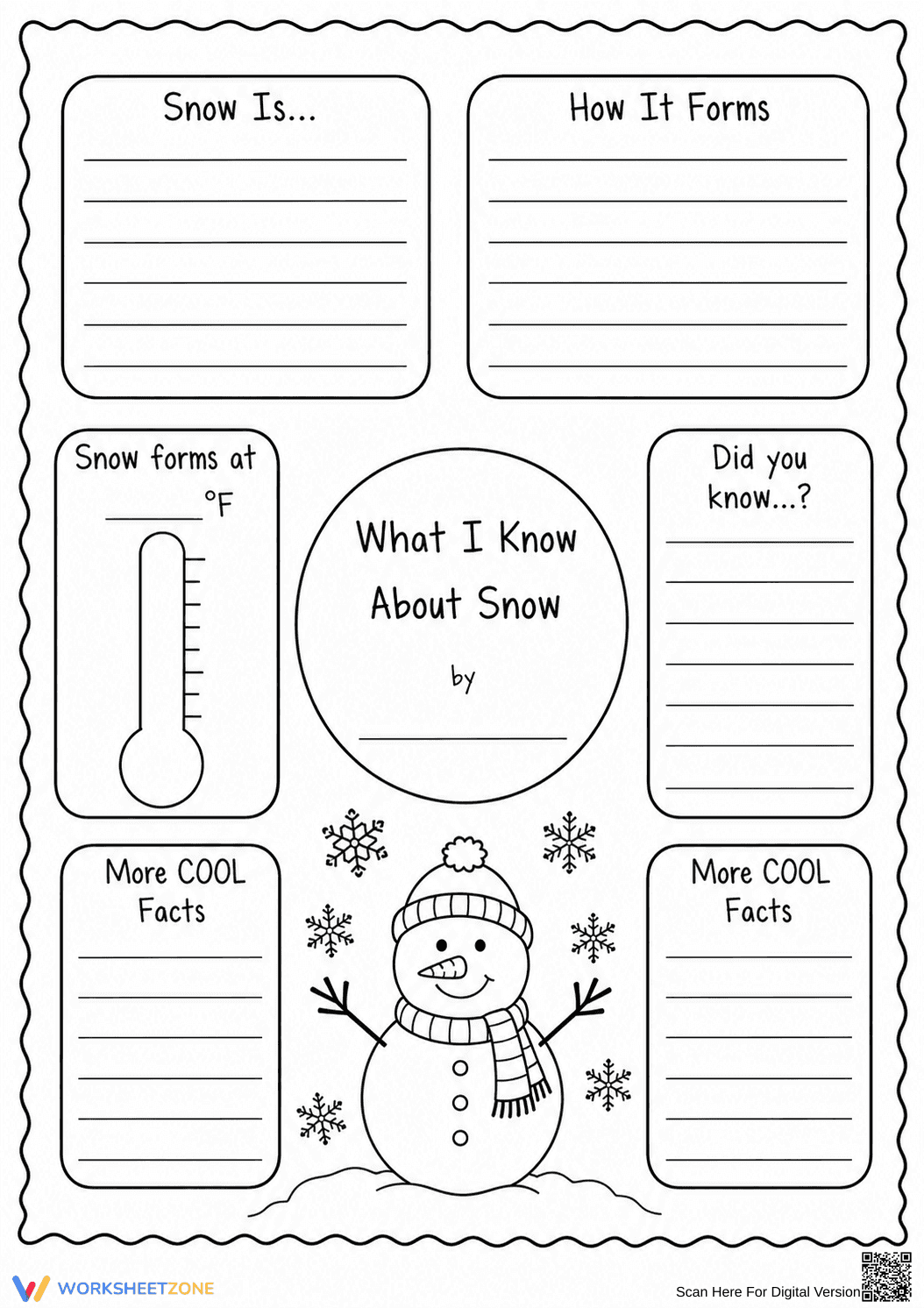

Grade 2 Snow Facts — Printable No-Prep Worksheet
Paste this activity's link or code into your existing LMS (Google Classroom, Canvas, Teams, Schoology, Moodle, etc.).
Students can open and work on the activity right away, with no student login required.
You'll still be able to track student progress and results from your teacher account.
This Grade 2 informational writing worksheet helps students organize their research about winter weather and snow formation. By completing the structured graphic organizer, students demonstrate their understanding of how precipitation forms and the specific conditions required for snow. It provides a clear framework for recording scientific observations and interesting facts about the life cycle of a snowflake.
At a Glance
- Grade: 2 · Subject: Science
- Standard:
CCSS.ELA-LITERACY.W.2.2— Write informative texts to examine a topic and convey ideas and information- Skill Focus: Informational Writing
- Format: 1 page · 6 prompts · No answer key · PDF
- Best For: Winter weather research and writing
- Time: 20–30 minutes
This single-page PDF features a clean, engaging layout with six distinct sections for student input. It includes a "Snow Is..." definition box, a "How It Forms" process section, a thermometer graphic for recording the freezing point, and three separate areas for "Did you know?" and "COOL Facts." The visual snowman illustration makes it approachable for early elementary learners while providing enough space for detailed writing.
Zero-Prep Workflow
- Print: Select the single-page PDF and print enough copies for your class in under 30 seconds.
- Distribute: Hand out the worksheets alongside a weather-themed book or digital resource for immediate student engagement.
- Review: Students spend 20 minutes researching and writing, followed by a 5-minute share-out of their favorite facts.
Total teacher prep time is under 2 minutes, making this an ideal sub plan or morning work activity during the winter months.
The primary standard addressed is CCSS.ELA-LITERACY.W.2.2, which requires students to write informative texts that name a topic and use facts to develop points. It also supports science standards by encouraging students to describe weather conditions and temperature. Both standard codes can be copied directly into lesson plans, IEP goals, or district curriculum mapping tools.
Use this worksheet as a summative activity after a direct instruction lesson on the water cycle or winter weather. It serves as an excellent formative assessment to check if students understand the relationship between temperature and precipitation. Expected completion time is 25 minutes when paired with a short informational text or video about meteorology.
This resource is designed for Grade 2 and Grade 3 students but can be used for Grade 1 with additional scaffolding or Grade 4 as a quick review. It pairs naturally with an anchor chart about the states of matter or a classroom reading of informational texts about the life cycle of a snowflake.
According to the RAND AIRS 2024 report on elementary literacy, graphic organizers significantly improve informational writing outcomes by reducing the cognitive load of structural planning. This worksheet utilizes a non-linear layout to help students categorize 6 different types of data about snow, from temperature to formation processes. By aligning with CCSS.ELA-LITERACY.W.2.2, the resource ensures that students are practicing the essential skill of examining a topic and conveying information clearly. Research from Fisher & Frey (2014) suggests that providing such scaffolds allows students to focus on content acquisition rather than formatting, leading to higher-quality written responses in science-integrated ELA blocks. This printable tool is a reliable addition to any winter-themed curriculum, providing a structured yet flexible way for young learners to document their scientific discoveries about the natural world while building foundational research habits.


