




























Views
Downloads

Snowflake Life Cycle Worksheet | Essential Grade 2 Science

Paste this activity's link or code into your existing LMS (Google Classroom, Canvas, Teams, Schoology, Moodle, etc.).
Students can open and work on the activity right away, with no student login required.
You'll still be able to track student progress and results from your teacher account.
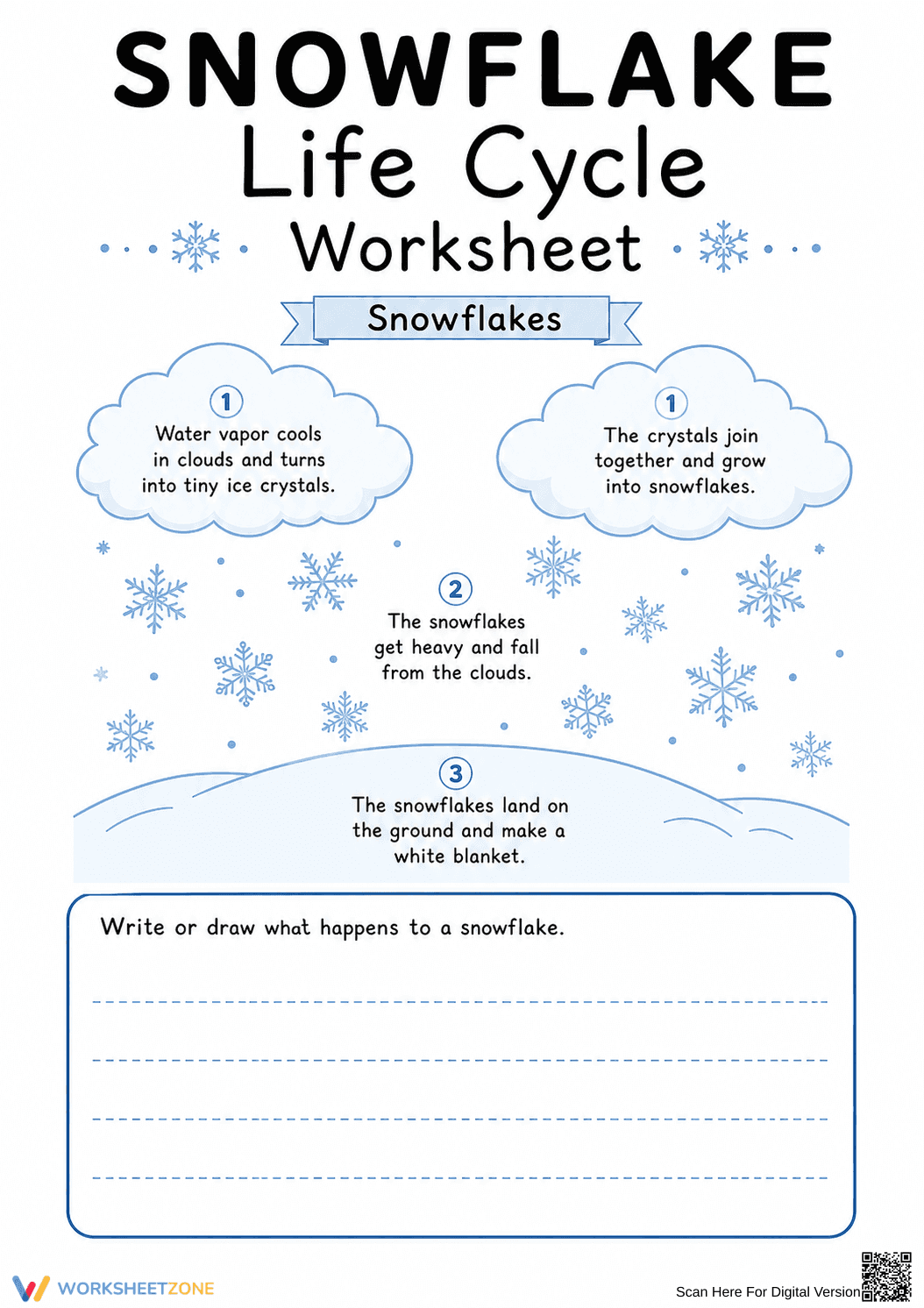
This Grade 2 snowflake life cycle worksheet provides a clear, visual guide to the formation of winter precipitation. Students explore how water vapor transforms into ice crystals and eventually falls to earth. By combining scientific observation with a creative writing prompt, this resource ensures students master weather sequencing while developing descriptive literacy skills.
At a Glance
- Grade: 2 · Subject: Science & Writing
- Standard:
CCSS.ELA-LITERACY.RI.2.3— Describe the connection between a series of scientific ideas or steps- Skill Focus: Snowflake formation sequencing
- Format: 1 page · 4 tasks · Answer key included · PDF
- Best For: Winter science units and weather centers
- Time: 15–20 minutes
This single-page PDF features a structured layout with three numbered informational stages. Each stage includes a clear illustration of clouds and snowflakes paired with concise, grade-appropriate text. Below the instructional section, a large response box with primary-ruled lines invites students to synthesize their learning through either a written paragraph or a detailed illustration of the process.
The zero-prep workflow is designed for immediate classroom implementation. First, print the single-page PDF (30 seconds). Second, distribute the sheets during your weather or winter science block (1 minute). Finally, review student responses using the included answer key or use the writing prompt as a quick formative assessment (5 minutes). This resource is an ideal "grab-and-go" option for substitute folders or emergency lesson plans.
This resource aligns with CCSS.ELA-LITERACY.RI.2.3: "Describe the connection between a series of historical events, scientific ideas or concepts, or steps in technical procedures in a text." It also supports NGSS weather concepts by illustrating the transition of water vapor to solid ice. Both standard codes can be copied directly into lesson plans, IEP goals, or district curriculum mapping tools.
Use this worksheet as a concluding activity after a read-aloud about winter weather or a direct instruction lesson on the water cycle. It serves as an excellent formative assessment to check if students can sequence the physical changes of water. Expect students to spend approximately 15 to 20 minutes completing the reading and the creative response section independently.
This printable is designed for second-grade classrooms, but is highly effective for Grade 1 enrichment or Grade 3 review. It is particularly helpful for English Language Learners (ELLs) who benefit from the visual scaffolding of the numbered clouds. Pair this with a physical "snow in a jar" experiment or a weather-themed anchor chart for a comprehensive science lesson.
According to the RAND AIRS 2024 report, integrating visual sequencing with writing prompts significantly improves retention of scientific concepts in early elementary learners. This worksheet utilizes the CCSS.ELA-LITERACY.RI.2.3 standard to bridge the gap between reading informational text and demonstrating comprehension through production. By focusing on the snowflake life cycle, the resource provides a concrete example of state changes in water, a fundamental concept in NGSS-aligned curricula. Research from Fisher & Frey (2014) suggests that such scaffolded structures, even within a single worksheet, support the gradual release of responsibility. This 1-page tool ensures that students can access the core content through its dual-modality approach of text and imagery, making it a reliable asset for diverse classroom settings. Teachers can use the 4 tasks to verify that students understand the chronological progression of natural phenomena.


