


























Views
Downloads

Essential Sunflower Life Cycle Worksheet | Grade 1
Paste this activity's link or code into your existing LMS (Google Classroom, Canvas, Teams, Schoology, Moodle, etc.).
Students can open and work on the activity right away, with no student login required.
You'll still be able to track student progress and results from your teacher account.
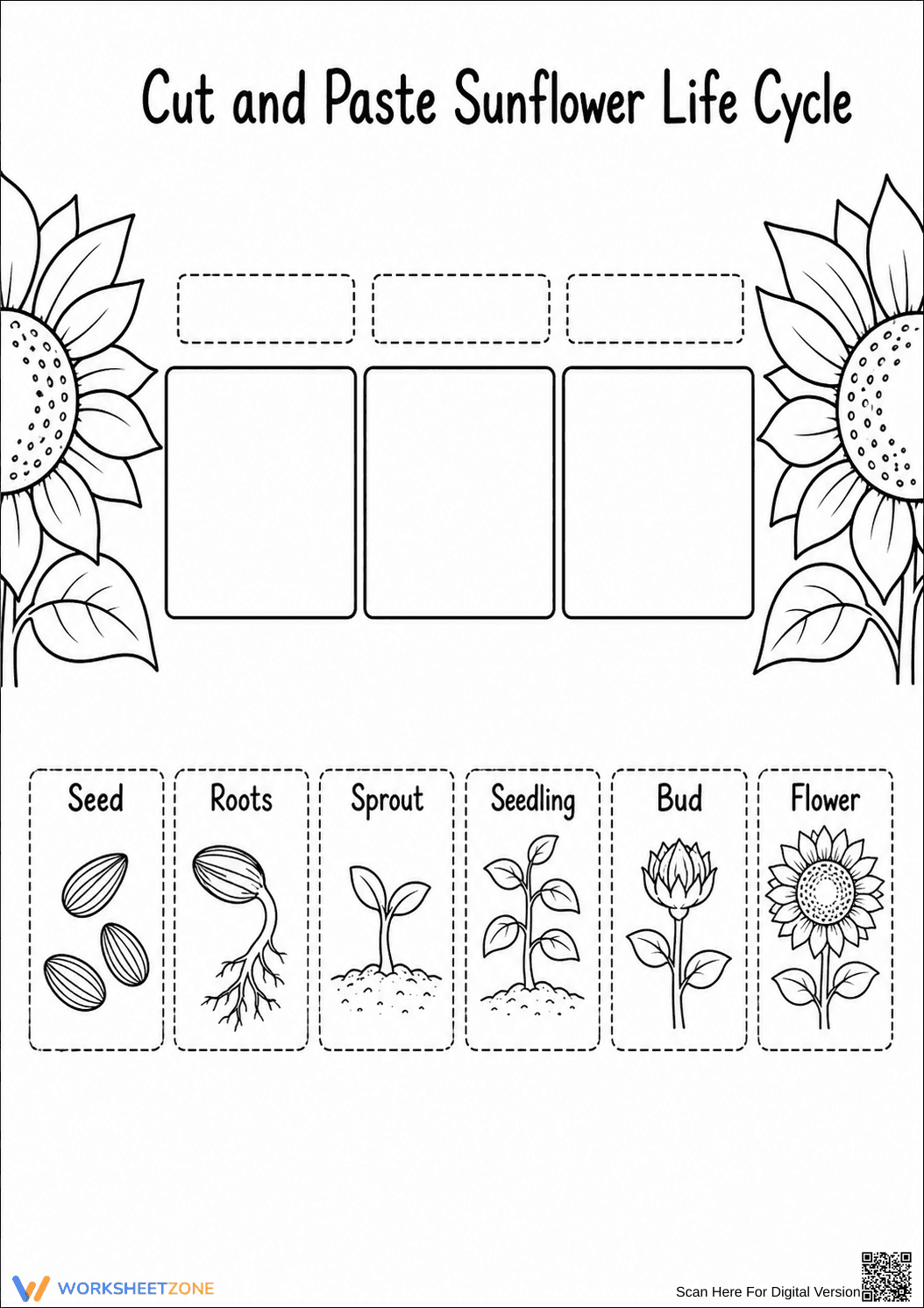
This Grade 1 sunflower life cycle worksheet provides a hands-on sequencing activity to help students visualize plant growth. By identifying and ordering the stages from seed to flower, learners develop a concrete understanding of biological patterns. This resource transforms abstract botanical concepts into a tactile learning experience that reinforces scientific vocabulary and fine motor coordination.
At a Glance
- Grade: 1 · Subject: Science
- Standard:
1-LS1-1— Use materials to describe patterns of what plants need to survive and grow- Skill Focus: Plant Life Cycle Sequencing
- Format: 1 page · 6 tasks · Answer key included · PDF
- Best For: Early elementary science centers and sequencing
- Time: 15–20 minutes
This single-page PDF features a clean, high-contrast layout designed for young learners. It includes six distinct, labeled illustrations representing the sunflower's journey: Seed, Roots, Sprout, Seedling, Bud, and Flower. The top section provides designated placement boxes for sequencing, while the bottom contains the cut-out tiles. The black-and-white line art is specifically chosen to allow for student coloring, adding an artistic component to the science lesson.
Zero-Prep Workflow
- Print: Generate the required number of copies for your group in under 30 seconds.
- Distribute: Provide the sheets along with scissors and glue sticks to students for immediate engagement.
- Review: Facilitate a brief closing discussion as students finish their sequencing to check for understanding in approximately 5 minutes.
This streamlined workflow makes the activity an ideal choice for emergency sub plans or transition periods between core subjects.
Standards Alignment
This resource aligns with `1-LS1-1`, focusing on how plants have different parts that help them survive and grow. Students observe the physical changes in the sunflower as it progresses through its life cycle. By organizing these stages, learners demonstrate their understanding of growth patterns in living organisms. Both standard codes can be copied directly into lesson plans, IEP goals, or district curriculum mapping tools.
How to Use It
Use this worksheet during the "Explore" phase of a lesson on botany. After reading a picture book about sunflowers, have students work in pairs to cut and arrange the stages before gluing them down. It also serves as an effective formative assessment tool; observe whether students can correctly place the "Sprout" before the "Seedling" to gauge their grasp of chronological biological development. Expected completion time is 15 to 20 minutes.
Who It's For
This activity is designed for first-grade students, but it is also highly effective for kindergarteners and English Language Learners (ELLs) who benefit from the visual-label associations. It pairs naturally with a classroom seed-planting project or a "Parts of a Plant" anchor chart. The large icons and clear text support students with developing fine motor skills and those requiring visual aids for comprehension.
According to the RAND AIRS 2024 report on early childhood science education, hands-on sequencing activities significantly improve the retention of biological concepts in primary students. This worksheet utilizes the 1-LS1-1 standard to bridge the gap between observation and conceptual modeling. By engaging in the tactile process of cutting and pasting, students internalize the chronological stages of a sunflower's life cycle, moving from simple identification to understanding the continuity of life. Research from Fisher & Frey (2014) suggests that combining visual labels with physical manipulation supports vocabulary acquisition in early learners. This resource provides a structured environment for students to practice these skills without the cognitive load of complex text. The inclusion of the standard code and clear student outcomes ensures that this activity meets rigorous instructional requirements while remaining accessible for diverse classroom settings.


