


























Views
Downloads

Printable Plant Life Cycle Worksheet | Grades 1-3
Paste this activity's link or code into your existing LMS (Google Classroom, Canvas, Teams, Schoology, Moodle, etc.).
Students can open and work on the activity right away, with no student login required.
You'll still be able to track student progress and results from your teacher account.
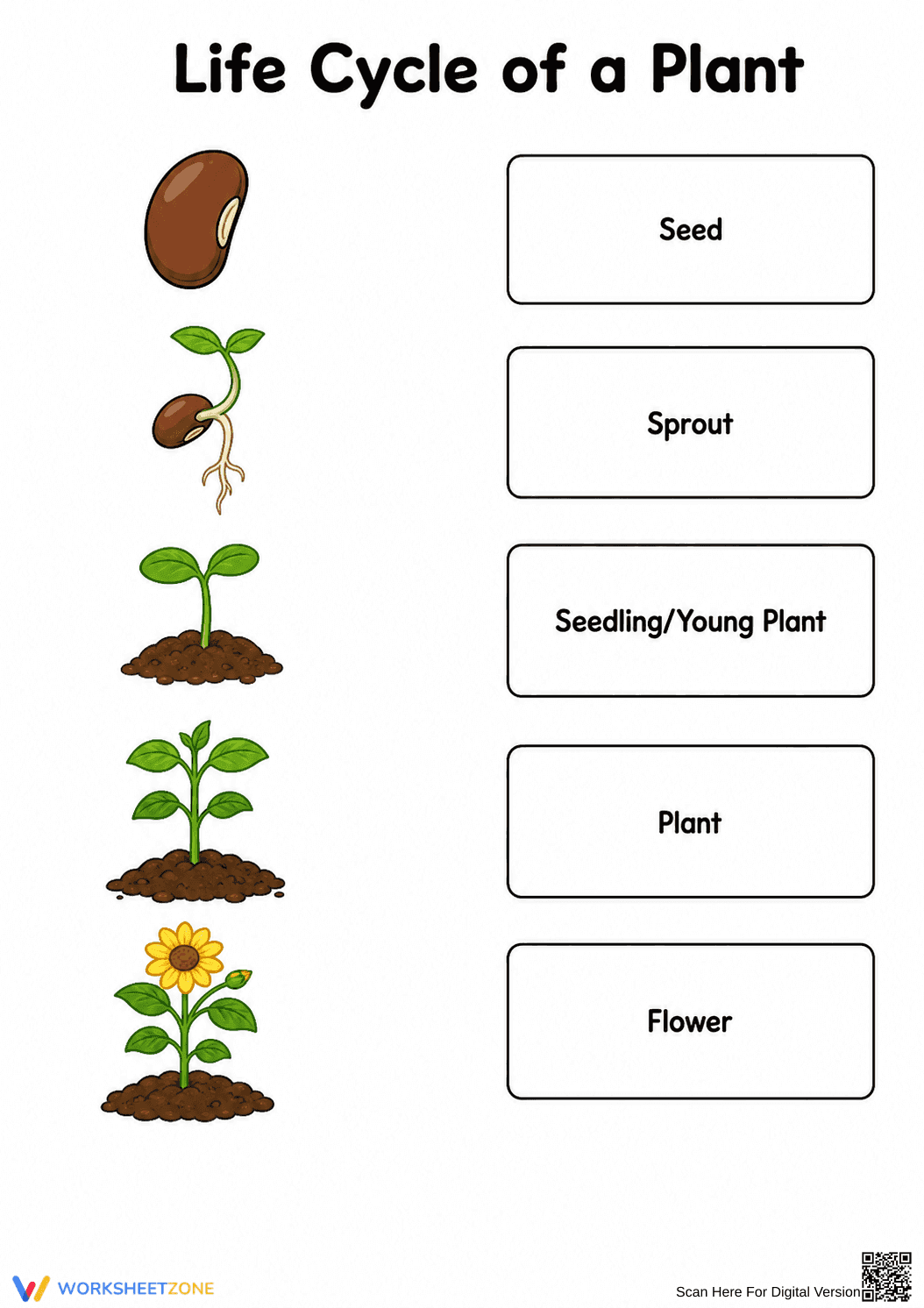
This engaging plant life cycle worksheet helps early elementary students visualize and sequence how plants grow from seed to flower. By matching vivid illustrations to their corresponding developmental stages, learners build foundational biology vocabulary and grasp the continuous nature of life cycles in a clear, accessible format.
At a Glance
- Grade: 1-3 · Subject: Science
- Standard:
3-LS1-1— Describe that organisms have unique and diverse life cycles.- Skill Focus: Sequencing plant growth stages
- Format: 1 page · 5 problems · Answer key included · PDF
- Best For: Independent practice or science centers
- Time: 10–15 minutes
Inside this resource, educators will find a single-page matching activity featuring five distinct stages of plant development: seed, sprout, seedling, mature plant, and flower. The layout pairs high-quality, full-color illustrations with clear text boxes, allowing students to easily draw connecting lines or use the sheet as a reference guide. A complete answer key is provided to ensure quick and accurate grading.
Designed for maximum efficiency, this resource requires absolutely no teacher setup.
- Print (1 minute): Simply print the PDF directly from your device. The clear layout ensures high-quality reproduction even in grayscale.
- Distribute (1 minute): Hand out the worksheets along with pencils or markers. The instructions are intuitive and self-explanatory.
- Review (3 minutes): Use the included answer key to quickly check student work or project it on the board for self-correction.
With a total prep time of under two minutes, this activity is an ideal addition to emergency sub plans or last-minute science centers.
This worksheet is directly aligned with Next Generation Science Standard 3-LS1-1: Develop models to describe that organisms have unique and diverse life cycles but all have in common birth, growth, reproduction, and death. It also supports early elementary life science frameworks by introducing essential botanical vocabulary. Both standard codes can be copied directly into lesson plans, IEP goals, or district curriculum mapping tools.
This versatile activity fits perfectly into various instructional moments. Use it as an introductory exploration before a hands-on seed planting lab, allowing students to preview the growth stages they will observe. Alternatively, assign it as an independent review task after direct instruction on plant biology. As a formative assessment tip, observe whether students confuse the sprout and seedling stages; this can indicate a need to review the specific physical changes that occur as the root system develops. Expected completion time is 10 to 15 minutes.
This resource is primarily designed for first through third-grade students developing their understanding of life sciences. The highly visual nature of the matching task provides excellent scaffolding for English Language Learners and visual learners who benefit from picture-to-text associations. It pairs wonderfully with a read-aloud book about gardening or a classroom anchor chart detailing the parts of a plant.
Understanding biological sequencing through visual aids is a critical component of early science education. Aligned with 3-LS1-1, this resource requires students to describe that organisms have unique and diverse life cycles by matching specific developmental stages. According to a recent ScienceDirect TpT Analysis, integrating clear, image-based matching tasks significantly improves vocabulary retention and conceptual understanding in elementary life sciences. When young learners actively connect terms like seedling and sprout to accurate illustrations, they build stronger cognitive frameworks for more complex biological processes later on. This targeted practice reduces cognitive load while maximizing engagement, ensuring that foundational concepts are firmly established. By utilizing this structured visual approach, educators can effectively support diverse learning needs and foster a deeper, lasting appreciation for the natural world and its continuous cycles.


