




























Views
Downloads
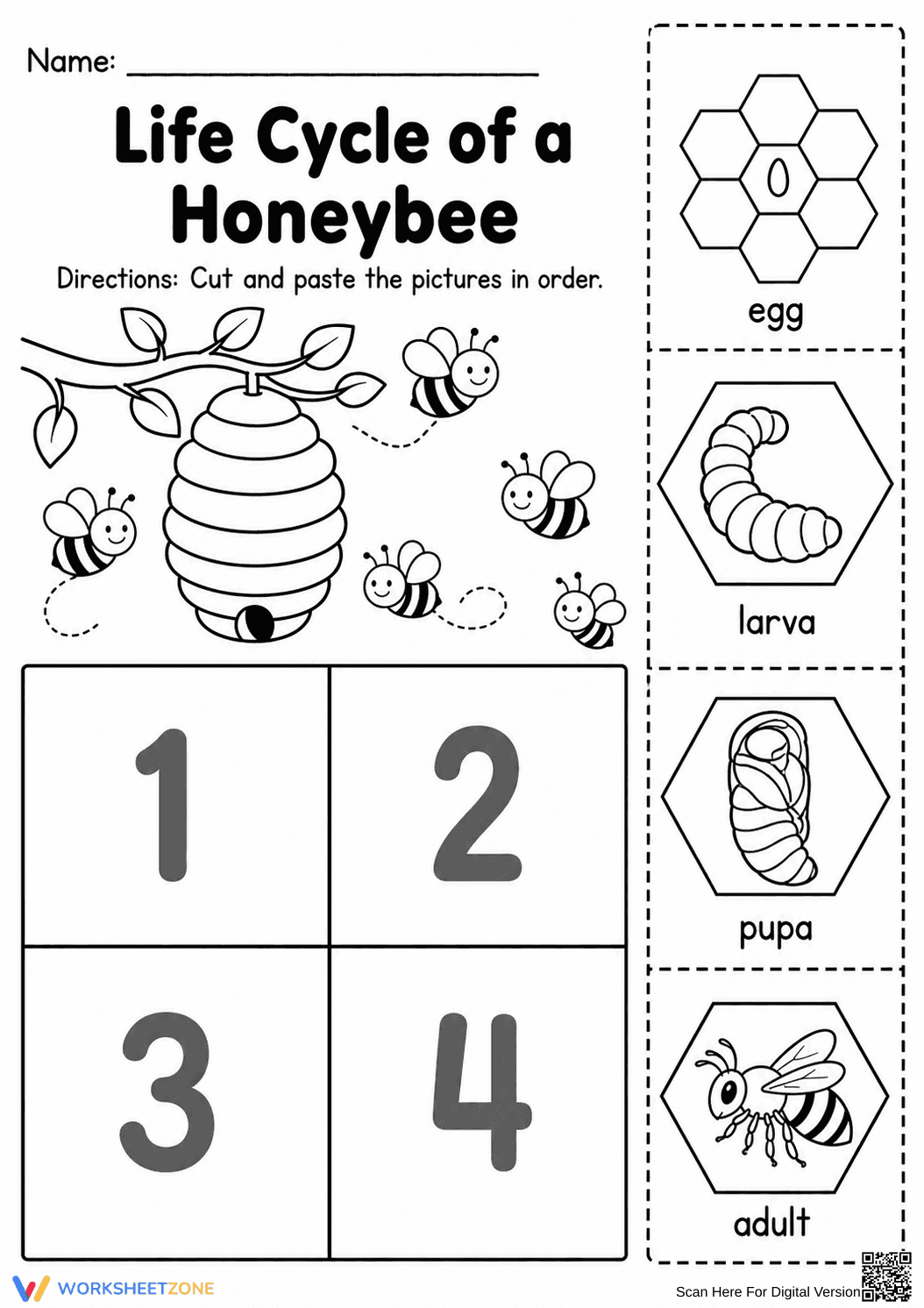

Grade 2 Honeybee Life Cycle — Printable No-Prep Worksheet

Paste this activity's link or code into your existing LMS (Google Classroom, Canvas, Teams, Schoology, Moodle, etc.).
Students can open and work on the activity right away, with no student login required.
You'll still be able to track student progress and results from your teacher account.
This science worksheet helps students master insect development by sequencing the honeybee life cycle. By cutting and pasting the four phases—egg, larva, pupa, and adult—learners actively build their understanding of biological growth in a hands-on format.
At a Glance
- Grade: 2 · Subject: Science
- Standard:
3-LS1-1— Develop models to describe organism life cycles- Skill Focus: Sequencing Life Cycles
- Format: 1 page · 4 problems · PDF
- Best For: Independent practice and science centers
- Time: 15–20 minutes
Inside this resource, educators will find a single-page activity for early elementary learners. The worksheet features a beehive illustration alongside four numbered squares. A dashed cut-out section provides labeled illustrations of the egg, larva, pupa, and adult stages. Students use scissors and glue to place each stage in chronological sequence, reinforcing science content and fine motor skills.
This resource offers a streamlined workflow.
- Print (1 minute): Print the single-page PDF. No special materials needed beyond scissors and glue.
- Distribute (1 minute): Hand out during a science block or place in a center.
- Review (3 minutes): Quickly check that the four stages are glued in the correct 1-to-4 sequence.
Total teacher preparation time is under two minutes, making this an excellent option for sub plans.
This activity aligns with 3-LS1-1, asking students to develop models to describe that organisms have unique life cycles. It supports this expectation by having students model the specific developmental sequence of a honeybee. Both standard codes can be copied directly into lesson plans, IEP goals, or district curriculum mapping tools.
Use this as a formative assessment after direct instruction on insect life cycles, allowing students to demonstrate understanding independently. Alternatively, it serves as an interactive science center activity. As an observation tip, watch if students confuse the larva and pupa stages before gluing, indicating a need for reteaching. Expected completion time is 15 to 20 minutes.
Designed for second-grade students, this is also appropriate for first-grade enrichment or third-grade review. The visual cut-and-paste format provides built-in differentiation for English Language Learners who benefit from picture cues. It pairs perfectly with a read-aloud book about bees or a lesson on habitats.
Understanding biological sequencing through hands-on modeling is a critical component of early science education. Aligned with 3-LS1-1, this activity requires students to develop models to describe organism life cycles. According to a ScienceDirect TpT Analysis, integrating fine motor tasks like cutting and pasting with core science content significantly increases student engagement and retention of sequential vocabulary. By physically moving the stages of the honeybee from egg to adult, learners solidify their cognitive map of biological development. Providing structured, visual sequencing tasks allows young students to build the foundational scientific literacy necessary for more complex biological studies, ensuring they grasp universal patterns of growth.


