


























Views
Downloads

Essential Bean Life Cycle Worksheet | Kindergarten Science
Paste this activity's link or code into your existing LMS (Google Classroom, Canvas, Teams, Schoology, Moodle, etc.).
Students can open and work on the activity right away, with no student login required.
You'll still be able to track student progress and results from your teacher account.
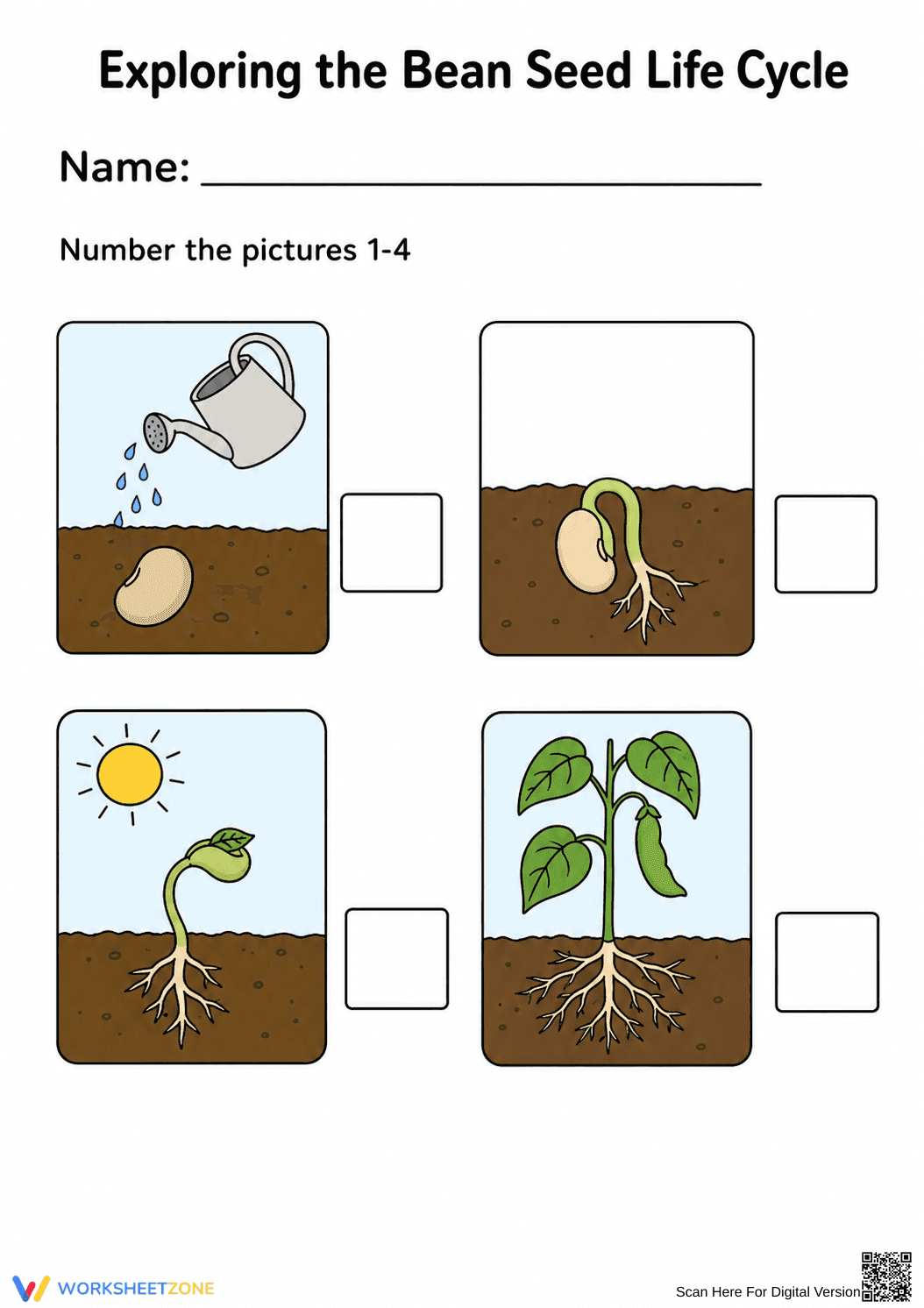
This Kindergarten science worksheet helps students master the chronological stages of a bean plant's development. By numbering four distinct illustrations, learners demonstrate their understanding of how a seed transforms into a mature plant. It provides a clear, visual method for assessing observational skills and basic biological sequencing in early childhood classrooms.
At a Glance
- Grade: Kindergarten · Subject: Science
- Standard:
K-LS1-1— Use observations to describe patterns of what plants need to survive- Skill Focus: Sequencing life cycle stages
- Format: 1 page · 4 problems · Answer key included · PDF
- Best For: Independent science center activity
- Time: 10–15 minutes
The worksheet features a clean, one-page layout containing four high-quality illustrations of a bean plant. These include a seed being watered, a sprout emerging from the soil, a seedling growing under the sun, and a mature plant with pods. Each image is paired with a dedicated numbering box. The document includes a clear name line at the top for easy classroom organization and student accountability.
Zero-Prep Workflow
- Print: Generate the single-page PDF and print copies for your class in under 30 seconds.
- Distribute: Hand out the sheets during your science block or as a quiet transition activity.
- Review: Discuss the correct sequence as a whole group to provide immediate feedback and reinforce the concept.
The total teacher preparation time is under two minutes, making it an ideal choice for busy mornings or emergency sub plans.
Standards Alignment
This activity aligns with K-LS1-1, which requires students to use observations to describe patterns of what plants and animals need to survive and how they grow. By identifying the progression from seed to plant, students recognize the pattern of life. This standard code can be copied directly into lesson plans, IEP goals, or district curriculum mapping tools.
How to Use It
Use this worksheet as a formative assessment after a hands-on seed planting activity. It allows you to observe if students can translate their real-world experience into a conceptual sequence. Alternatively, place it in a science center alongside actual bean seeds and magnifying glasses. Expected completion time ranges from 10 to 15 minutes depending on the student's fine motor skills and prior knowledge.
Who It's For
This resource is tailored for Kindergarten students but serves as an excellent scaffold for Grade 1 students who need a visual refresher. It is particularly effective for English Language Learners (ELLs) because it relies on visual literacy rather than heavy text. Pair this with a "Parts of a Plant" anchor chart for a comprehensive botany lesson that supports diverse learners.
Research by Fisher & Frey (2014) emphasizes the importance of visual scaffolding and sequencing in early childhood education to build cognitive schemas. This worksheet utilizes these principles by requiring students to identify the K-LS1-1 life cycle stages through clear, observable patterns. By engaging with the bean seed life cycle, students develop the foundational skills necessary for more complex biological studies in later grades. According to the RAND AIRS 2024 report, structured visual tasks in early science education significantly improve long-term retention of natural cycles. This 4-task activity provides the precise level of cognitive load required for Kindergarteners to achieve mastery without frustration. The inclusion of a clear numbering system reinforces both mathematical sequencing and scientific observation, creating a cross-curricular learning opportunity that fits easily into any elementary schedule.


