


























Views
Downloads

Grade 2 Snowflake Cycle — Printable No-Prep Worksheet
Paste this activity's link or code into your existing LMS (Google Classroom, Canvas, Teams, Schoology, Moodle, etc.).
Students can open and work on the activity right away, with no student login required.
You'll still be able to track student progress and results from your teacher account.
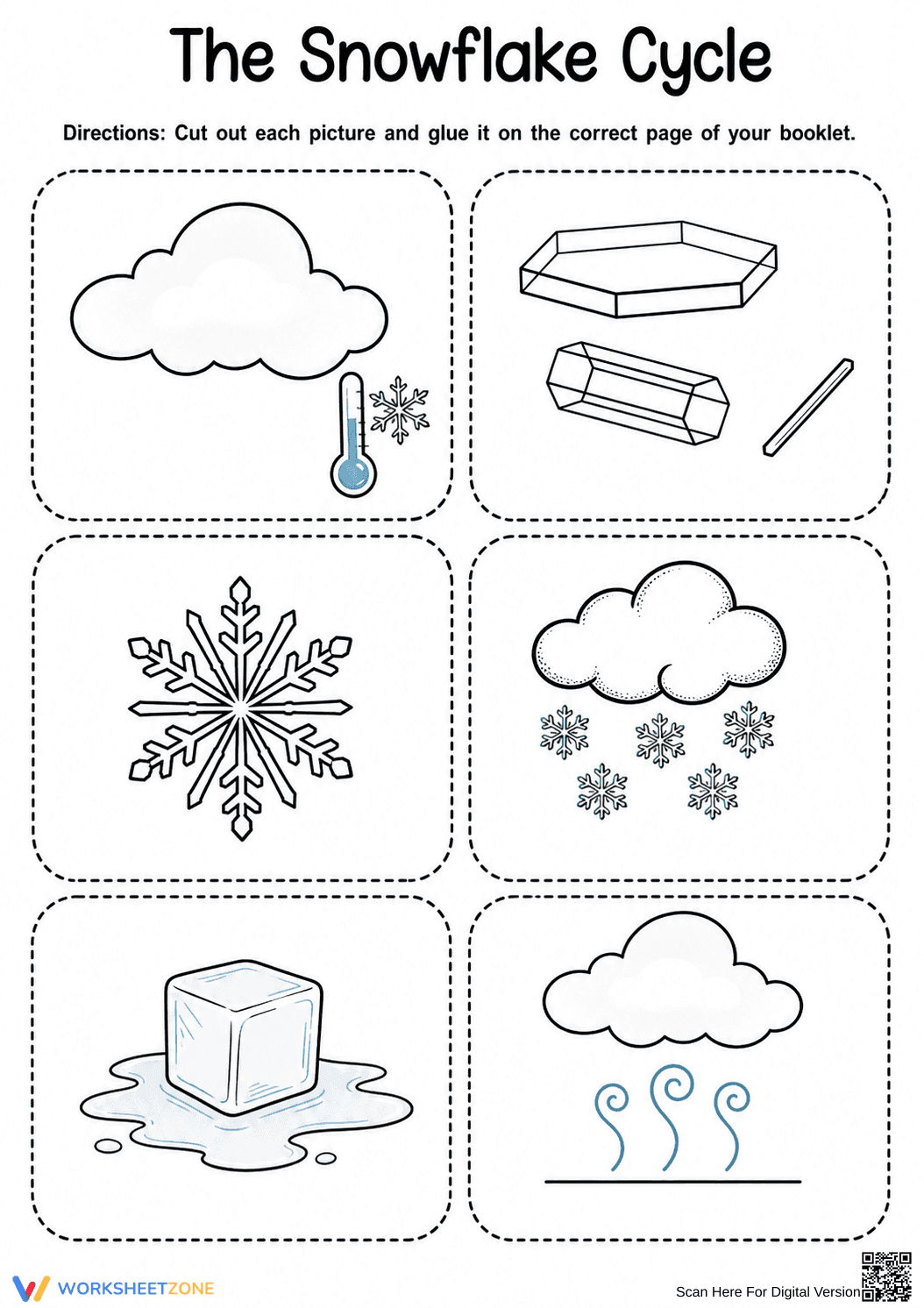
This Grade 2 science worksheet helps students sequence the snowflake cycle by identifying the physical changes water undergoes in freezing temperatures. By cutting and pasting six distinct stages, young learners actively build their understanding of weather patterns and states of matter while practicing essential fine motor skills.
At a Glance
- Grade: 2 · Subject: Science
- Standard:
2-ESS2-3— Identify where water is found and its solid or liquid forms- Skill Focus: Sequencing the snowflake cycle
- Format: 1 page · 6 problems · No answer key · PDF
- Best For: Independent science centers
- Time: 15–20 minutes
This single-page resource features six clear, reproducible illustrations depicting the complete snowflake cycle. Students will find images of a freezing cloud, ice crystals, a fully formed snowflake, falling snow, melting ice, and evaporation. The layout is designed with dashed cut-lines to guide scissor work, making it highly accessible for early elementary students to construct their own cycle booklets.
This resource is designed for immediate classroom implementation with a total teacher prep time of under two minutes.
- Print (1 minute): Generate enough copies of the single-page PDF for your entire class.
- Distribute (1 minute): Hand out the sheets along with scissors, glue, and blank booklets or construction paper.
- Review (3 minutes): Briefly discuss the six stages before students begin their independent cutting and pasting.
Because it requires no complex setup or specialized materials, this activity is an excellent addition to any emergency sub plan.
This activity is aligned to primary standard 2-ESS2-3: Obtain information to identify where water is found on Earth and that it can be solid or liquid. It also supports foundational comprehension of weather patterns and the water cycle. Both standard codes can be copied directly into lesson plans, IEP goals, or district curriculum mapping tools.
Deploy this worksheet during the independent practice phase of a winter weather or water cycle unit. It works exceptionally well as a hands-on science center activity where students can sequence the cards before gluing them down. For a quick formative assessment, observe students as they arrange the melting ice and evaporation stages to ensure they grasp the transition from solid back to gas. Expect most students to complete the cutting, sequencing, and pasting within 15 to 20 minutes.
This resource is primarily designed for second-grade students, though it is easily adaptable for first-grade learners needing concrete visual supports for science concepts. The built-in fine motor practice makes it particularly useful for students developing scissor control and spatial organization. Pair this activity with a read-aloud book about winter weather or a classroom anchor chart detailing the water cycle to reinforce the vocabulary.
Integrating hands-on sequencing tasks into early elementary science instruction significantly improves retention of abstract concepts like the water cycle. According to a recent ScienceDirect TpT Analysis, interactive cut-and-paste activities that require students to physically manipulate chronological events lead to higher engagement and better comprehension of cyclical processes. When students work to master 2-ESS2-3, they must identify where water is found and its solid or liquid forms. By physically arranging the stages of the snowflake cycle, young learners bridge the gap between theoretical weather patterns and observable physical changes. This tactile approach reinforces the specific scientific sequence and supports cognitive development by linking motor skills with academic content. Utilizing structured visual aids ensures foundational earth science principles are firmly established.


