


























Views
Downloads
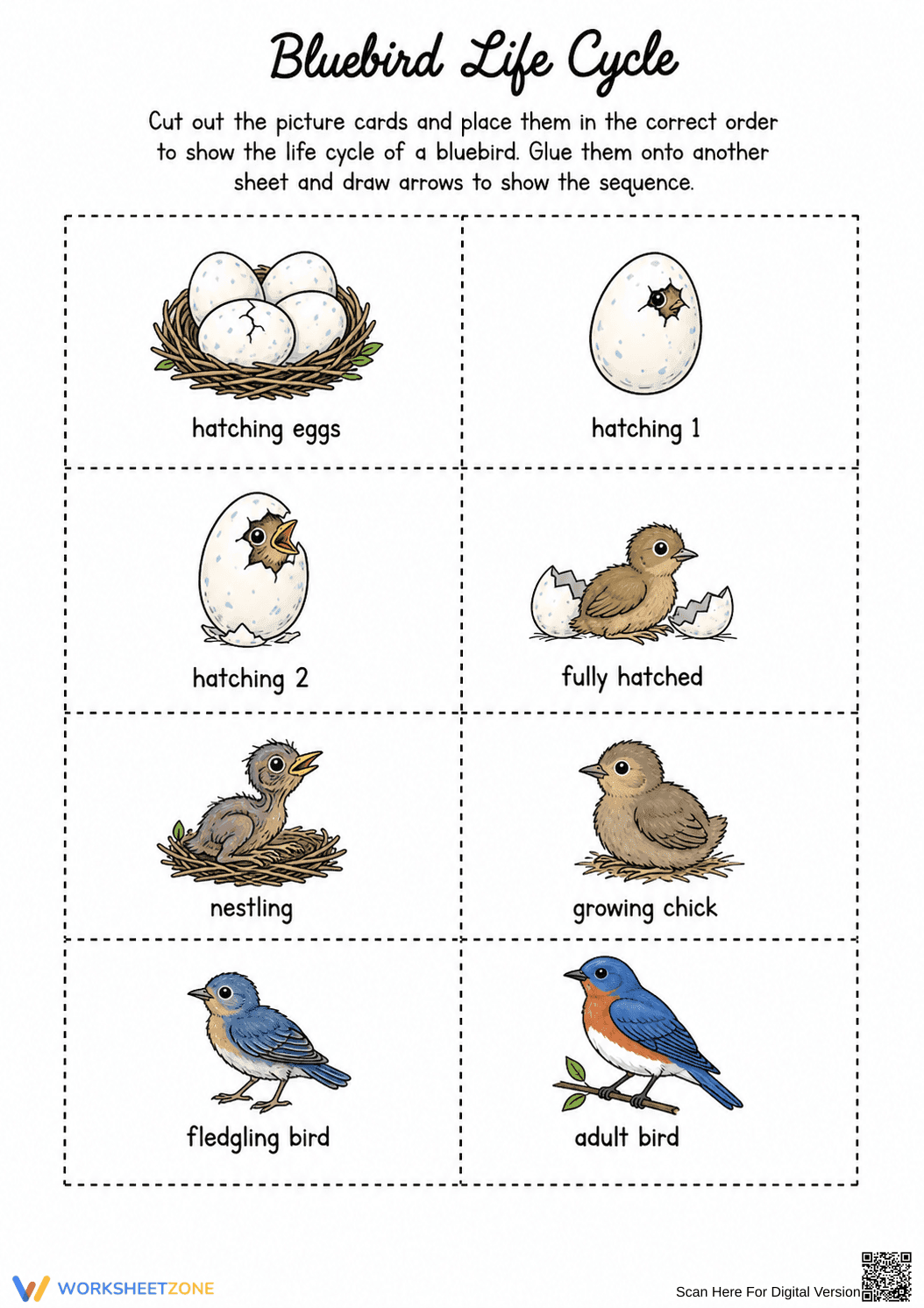

Grade 3 Bluebird Life Cycle — Printable No-Prep Worksheet
Paste this activity's link or code into your existing LMS (Google Classroom, Canvas, Teams, Schoology, Moodle, etc.).
Students can open and work on the activity right away, with no student login required.
You'll still be able to track student progress and results from your teacher account.
This Grade 3 science worksheet helps students visualize and sequence the biological development of a bluebird. By cutting, sorting, and pasting eight distinct developmental stages, learners actively construct a model of an animal's life cycle, reinforcing key concepts of growth and maturation in a hands-on way.
At a Glance
- Grade: 3 · Subject: Science
- Standard:
3-LS1-1— Develop models to describe organism life cycles- Skill Focus: Sequencing animal life cycles
- Format: 1 page · 8 problems · Answer key included · PDF
- Best For: Independent practice and science centers
- Time: 15–20 minutes
What's Inside
This single-page cut-and-paste activity features eight illustrated cards depicting a bluebird's journey from egg to adult. Students cut out these stages, arrange them chronologically on blank paper, and draw directional arrows to illustrate the continuous life cycle. A complete answer key ensures quick grading.
Zero-Prep Workflow
- Print (1 minute): Simply print the single-page PDF for each student. No special materials are required beyond standard classroom scissors, glue, and blank paper.
- Distribute (1 minute): Hand out the worksheets during your science block or place them in a designated center folder.
- Review (3 minutes): Use the included answer key to quickly verify that students have placed the eight stages in the correct biological sequence.
With a total teacher prep time of under two minutes, this activity is an excellent addition to any emergency sub plan or spontaneous science lesson.
Standards Alignment
This activity is directly aligned to the Next Generation Science Standards, specifically 3-LS1-1: Develop models to describe that organisms have unique and diverse life cycles but all have in common birth, growth, reproduction, and death. By arranging the cards and drawing sequence arrows, students are actively building the required scientific model. Both standard codes can be copied directly into lesson plans, IEP goals, or district curriculum mapping tools.
How to Use It
This activity works perfectly as independent practice following direct instruction on avian life cycles. As a formative assessment tip, observe students while they arrange the cards before gluing them down; this provides an immediate opportunity to correct misconceptions about the hatching and nestling phases. Expect completion within 15 to 20 minutes.
Who It's For
This worksheet is primarily designed for third-grade science students, though it is highly accessible for first and second graders studying animal biology. The clear visual cues and simple text labels provide built-in differentiation for English Language Learners and visual learners who benefit from graphic representations of scientific concepts. It pairs perfectly with an anchor chart detailing the differences between nestlings, chicks, and fledglings.
Aligning instructional materials with 3-LS1-1 to help students develop models to describe organism life cycles is a critical component of early elementary science education. According to a comprehensive ScienceDirect TpT Analysis (2024), hands-on modeling activities like cut-and-paste sequencing significantly improve long-term retention of biological processes compared to passive reading alone. When students physically manipulate the eight stages of a bluebird's development, they engage multiple cognitive pathways, reinforcing the universal concepts of birth, growth, reproduction, and death. This tactile approach not only builds foundational science literacy but also supports essential fine motor skill development in early elementary classrooms. By integrating clear visual models with active sorting tasks, educators can create highly effective, evidence-based learning experiences that meet rigorous academic standards while remaining developmentally appropriate and highly engaging for young learners.


