


























Views
Downloads
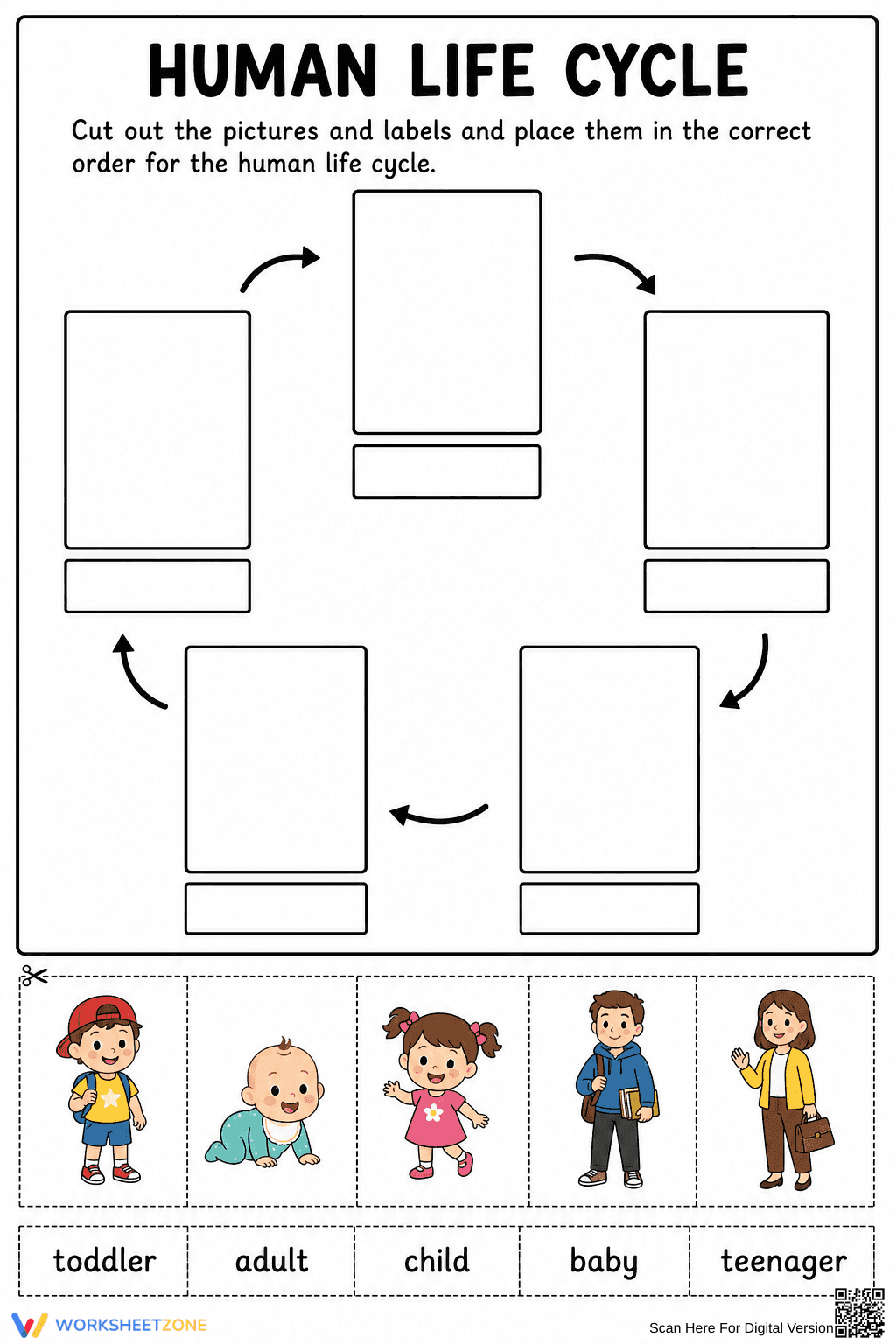

Essential Human Life Cycle Worksheet | Grade 1 Science
Paste this activity's link or code into your existing LMS (Google Classroom, Canvas, Teams, Schoology, Moodle, etc.).
Students can open and work on the activity right away, with no student login required.
You'll still be able to track student progress and results from your teacher account.
This human life cycle worksheet provides a hands-on approach for students to master the chronological stages of human development. By engaging in a tactile sequencing activity, learners identify and order five distinct life phases from infancy to adulthood. This resource ensures students grasp the biological concept of growth and change through active participation.
At a Glance
- Grade: 1 · Subject: Science
- Standard:
3-LS1-1— Develop models to describe that organisms have unique and diverse life cycles- Skill Focus: Human life cycle sequencing
- Format: 1 page · 5 problems · Answer key included · PDF
- Best For: Early elementary life science centers
- Time: 15–20 minutes
The worksheet consists of a single-page PDF featuring a circular flow diagram with five empty slots. At the bottom of the page, students find five illustrated panels and corresponding text labels: baby, toddler, child, teenager, and adult. The layout is designed for high-contrast printing, ensuring the visual cues are clear for young learners as they cut, sort, and paste their way to understanding human biology.
Zero-Prep Workflow
- Print: Select the single-page PDF and print enough copies for your class in approximately 30 seconds.
- Distribute: Provide each student with the worksheet, scissors, and glue; setup takes about 1 minute.
- Review: Use the included answer key to quickly check student work or facilitate a whole-class discussion on growth in under 1 minute.
Total teacher preparation time is under three minutes, making this an ideal resource for busy mornings, science centers, or unexpected sub plans.
Standards Alignment
This resource is primarily aligned with 3-LS1-1, which requires students to develop models to describe that organisms have unique and diverse life cycles but all have in common birth, growth, reproduction, and death. It also supports foundational sequencing skills necessary for early elementary science literacy. Both standard codes can be copied directly into lesson plans, IEP goals, or district curriculum mapping tools.
How to Use It
Use this worksheet during the "Explore" phase of a science lesson after reading a book about growing up. It serves as an excellent formative assessment to gauge if students can distinguish between the toddler and child stages. Expect students to complete the activity in approximately 15 to 20 minutes, depending on their fine motor proficiency. It can also be used as a quiet independent activity for early finishers.
Who It's For
This activity is tailored for first-grade students but is highly effective for kindergarteners needing fine motor practice or second graders reviewing life science basics. It pairs naturally with an anchor chart showing the growth of a plant or animal to highlight similarities across different species. It is also suitable for homeschool environments and science enrichment programs.
The Human Life Cycle Cut and Paste Worksheet is a targeted instructional tool designed to meet the 3-LS1-1 standard by providing a concrete model of biological progression. Research from Fisher & Frey (2014) emphasizes that gradual release of responsibility is most effective when students engage in hands-on manipulation of concepts before moving to abstract reasoning. By requiring students to physically sequence the five stages—baby, toddler, child, teenager, and adult—this resource bridges the gap between visual recognition and conceptual understanding of life science. The 5-task structure is optimized for the working memory capacity of early elementary learners, ensuring that the cognitive load remains focused on the biological sequence rather than complex instructions. This printable PDF serves as a reliable evidence-based artifact for student portfolios, demonstrating mastery of life cycle patterns and foundational scientific vocabulary in a classroom-ready format.


