


























Views
Downloads

Frog Life Cycle Printable Worksheet | Grade 1-2 Science
Paste this activity's link or code into your existing LMS (Google Classroom, Canvas, Teams, Schoology, Moodle, etc.).
Students can open and work on the activity right away, with no student login required.
You'll still be able to track student progress and results from your teacher account.
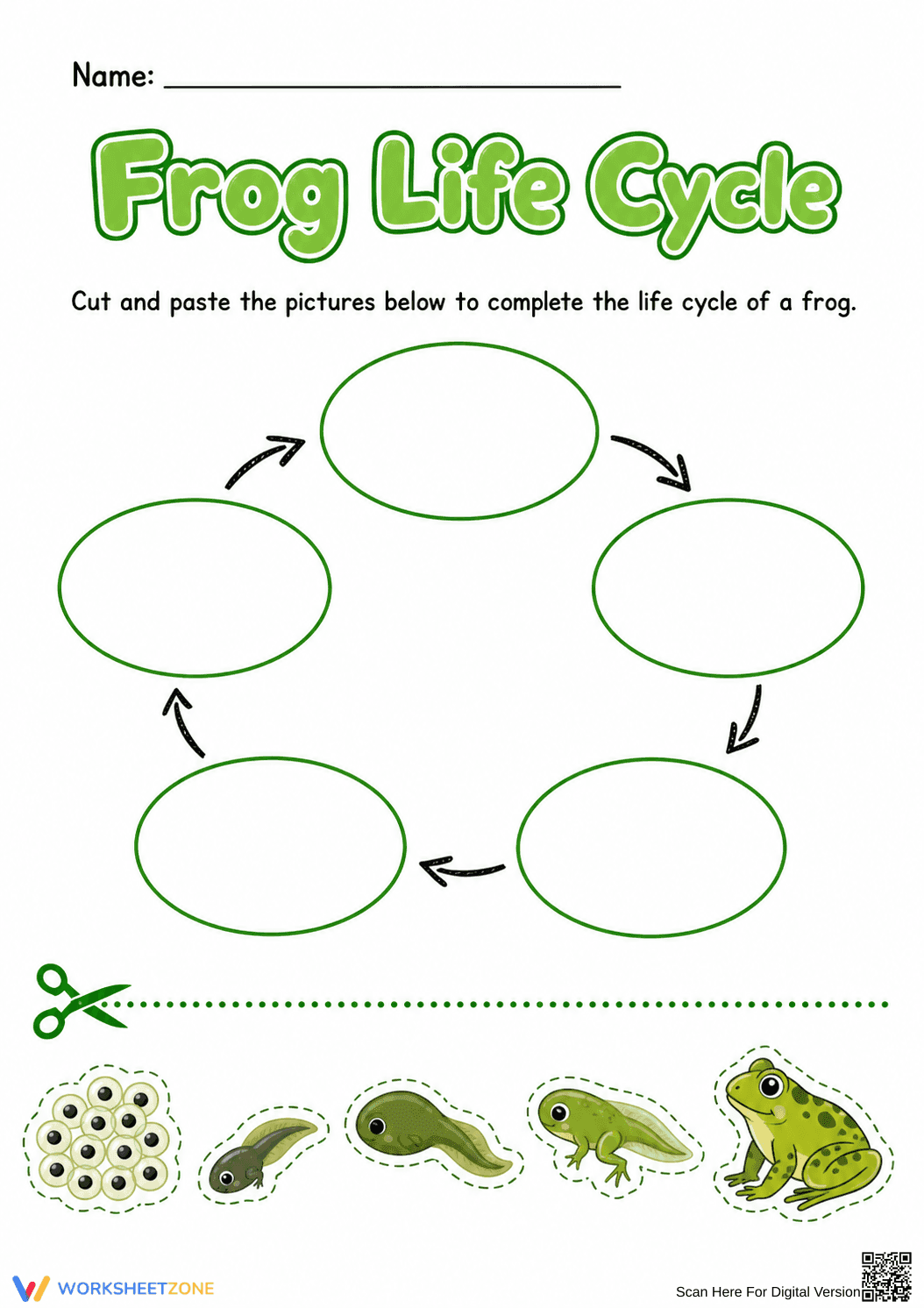
This Grade 1-2 science worksheet provides a hands-on approach to understanding biological growth through a frog life cycle sequencing task. Students identify and arrange the five key stages of amphibian development to demonstrate their understanding of how organisms change over time. This activity transforms abstract biological concepts into a concrete, tactile learning experience that improves retention and scientific vocabulary.
At a Glance
- Grade: 1-2 · Subject: Science
- Standard:
3-LS1-1— Develop models to describe that organisms have unique and diverse life cycles- Skill Focus: Sequencing life cycle stages
- Format: 1 page · 5 problems · Answer key included · PDF
- Best For: Science centers and independent practice
- Time: 15–20 minutes
What's Inside
This single-page PDF features a circular life cycle diagram with five empty ovals and five corresponding high-quality illustrations at the bottom. The worksheet includes clear cutting lines and a logical flow indicated by directional arrows. Students will work with images representing eggs, a tadpole, a tadpole with legs, a froglet, and an adult frog. A full-color answer key is provided for quick grading or student self-correction.
Zero-Prep Workflow
- Print (30 seconds): Select the page and print enough copies for your small group or whole class.
- Distribute (1 minute): Provide students with scissors and glue sticks; no additional teacher setup is required.
- Review (5 minutes): Use the included answer key to check for accuracy during a quick wrap-up or as part of a science journal entry.
Standards Alignment
This resource is primarily aligned with 3-LS1-1: "Develop models to describe that organisms have unique and diverse life cycles but all have in common birth, growth, reproduction, and death." It also supports early literacy by requiring students to follow multi-step directions and interpret visual information.
How to Use It
Use this worksheet as a formative assessment after a direct instruction lesson on amphibians. It works exceptionally well in a dedicated science center where students can work independently or in pairs. Teachers should observe students as they arrange the pieces before gluing; look for the common misconception of placing the froglet before the tadpole with legs to gauge instructional needs. Completion typically takes 15 to 20 minutes.
Who It's For
This activity is designed for Grade 1 and Grade 2 students, particularly those who benefit from kinesthetic and visual learning modalities. It is highly effective for English Language Learners (ELLs) as it relies on pictorial representation to convey complex biological sequences. Pair this worksheet with a non-fiction text about pond habitats or a live classroom observation of tadpoles for a comprehensive science unit.
The Frog Life Cycle Cut-and-Match Activity is a foundational tool for early elementary science, specifically designed to meet the criteria of 3-LS1-1. This standard requires students to develop models that describe the unique and diverse life cycles of organisms, including birth, growth, reproduction, and death. By physically manipulating the five distinct stages—eggs, tadpole, tadpole with legs, froglet, and adult frog—students engage in kinesthetic learning that reinforces chronological sequencing and biological progression. This worksheet provides a clear visual framework for young learners to internalize the cyclical nature of amphibian life. The inclusion of specific vocabulary and high-quality illustrations ensures that students can accurately identify and communicate the transformations occurring within the ecosystem, building a bridge toward more complex life science observations.


