


























Views
Downloads

Essential Plant Life Cycle Worksheet | Grade 1 Science
Paste this activity's link or code into your existing LMS (Google Classroom, Canvas, Teams, Schoology, Moodle, etc.).
Students can open and work on the activity right away, with no student login required.
You'll still be able to track student progress and results from your teacher account.
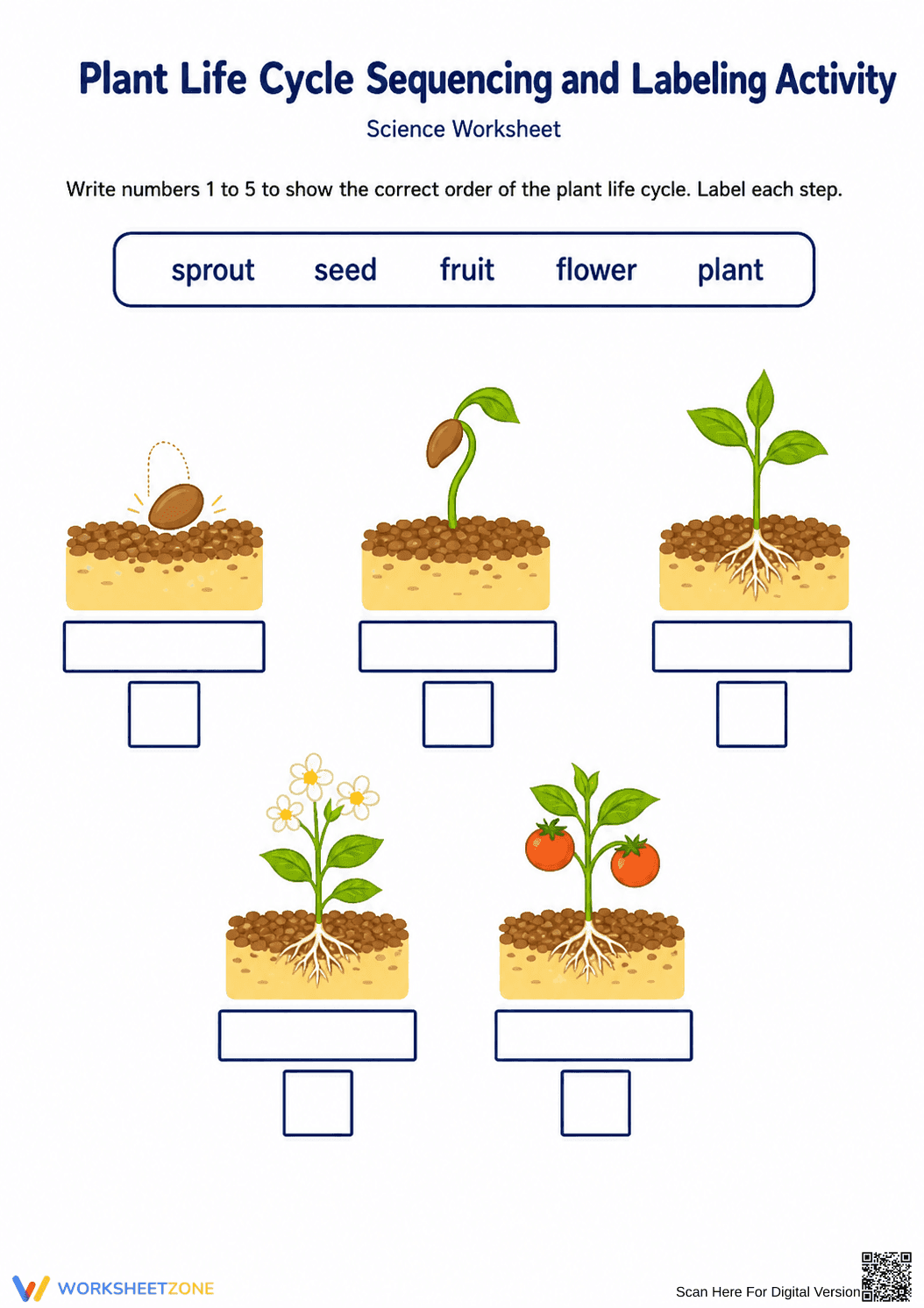
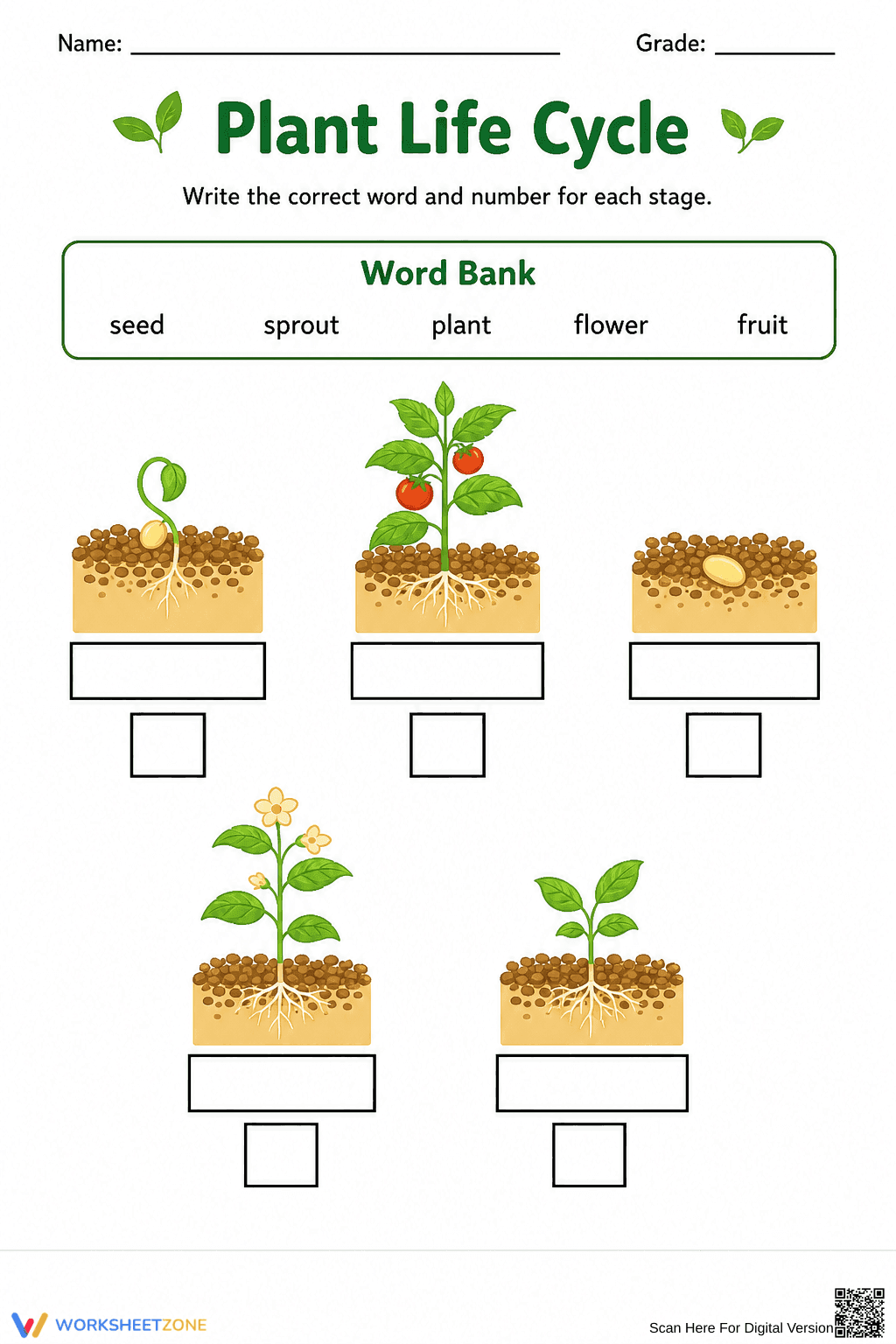
This Grade 1 science worksheet guides students through the biological journey of a plant from seed to fruit. By sequencing five distinct growth stages and applying scientific vocabulary, learners build a foundational understanding of life science patterns. It transforms abstract biological concepts into a concrete, hands-on ordering activity that ensures student mastery.
At a Glance
- Grade: 1 · Subject: Science
- Standard:
1-LS1-1— Use materials to design a solution to a human problem by mimicking how plants/animals use their parts to survive, grow, and meet their needs.- Skill Focus: Sequencing and labeling growth stages
- Format: 2 pages · 10 problems · Answer key included · PDF
- Best For: Introduction to life cycles and botany
- Time: 15–20 minutes
The download includes two high-quality pages featuring clear, colorful illustrations of a tomato plant's development. Each page contains a word bank with five essential terms: seed, sprout, plant, flower, and fruit. Students are provided with dedicated boxes for both numerical sequencing (1-5) and text labeling, ensuring a multi-modal approach to learning.
Zero-Prep Workflow
- Print: Select the single-page PDF and print enough copies for your class (30 seconds).
- Distribute: Hand out the sheets for independent work or as a center activity (1 minute).
- Review: Use the included answer key for a rapid whole-class review or individual grading (1 minute).
Total teacher preparation time is under 3 minutes, making this an ideal resource for sub plans or morning work.
Standards Alignment
This activity aligns with 1-LS1-1, focusing on how plants use their parts (seeds, roots, flowers) to grow and survive. It also supports CCSS.ELA-LITERACY.RI.1.3 by requiring students to describe the connection between a series of scientific steps. Both standard codes can be copied directly into lesson plans, IEP goals, or district curriculum mapping tools.
How to Use It
Use this worksheet as a formative assessment after a read-aloud about gardening or plant biology. It works exceptionally well during the "Explain" phase of a 5E lesson cycle. Teachers should observe if students can distinguish between the 'sprout' and 'plant' stages, as this indicates a nuanced understanding of botanical development. Expected completion time is 15 to 20 minutes.
Who It's For
This resource is ideal for first-grade students, English Language Learners (ELLs) who benefit from visual labeling, and homeschooling parents seeking structured science activities. It pairs naturally with a classroom seed-planting experiment or a visual anchor chart depicting the needs of living things.
Research from Fisher & Frey (2014) emphasizes that visual sequencing and labeling are critical scaffolds for early learners developing domain-specific vocabulary. By requiring students to both number the chronological order and apply the correct scientific term, this worksheet reinforces the "gradual release of responsibility" model. The dual-task structure (sequencing plus labeling) ensures that students are not merely memorizing a pattern but are actively connecting visual evidence to scientific nomenclature. According to the RAND AIRS 2024 report on elementary science literacy, early exposure to life cycle patterns significantly improves long-term retention of biological concepts. This worksheet provides the necessary repetition and visual clarity to meet these pedagogical goals. It serves as a reliable tool for establishing the foundational knowledge required for more complex NGSS standards in later elementary grades, making it a staple for any Grade 1 science curriculum.


