


























Views
Downloads
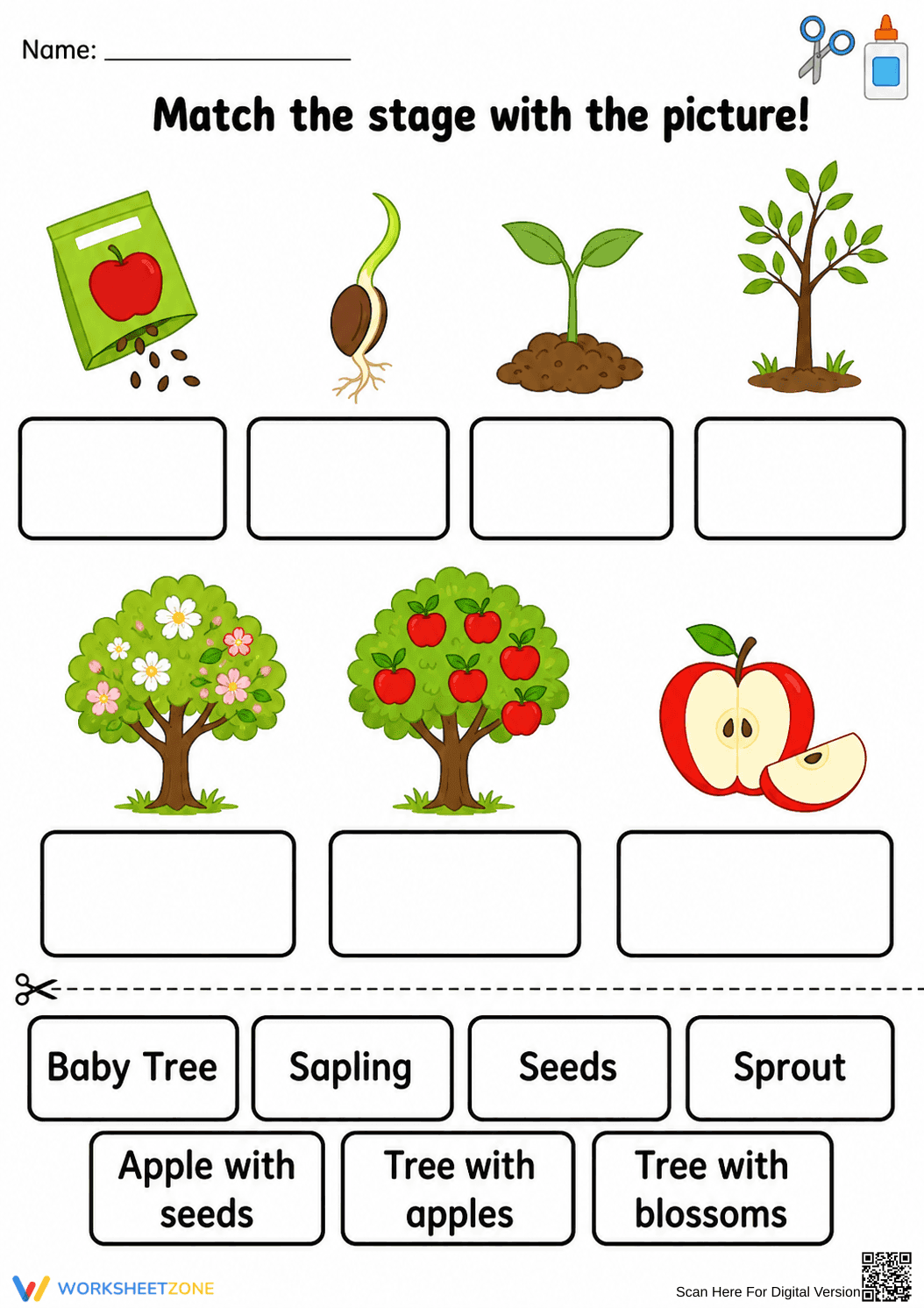

Grade 1 Apple Life Cycle — Printable No-Prep Worksheet
Paste this activity's link or code into your existing LMS (Google Classroom, Canvas, Teams, Schoology, Moodle, etc.).
Students can open and work on the activity right away, with no student login required.
You'll still be able to track student progress and results from your teacher account.
This hands-on science worksheet helps young learners master the stages of plant growth by matching vocabulary to visual representations. Students will cut and paste labels to identify the sequence of an apple tree's development, building foundational knowledge of life cycles while practicing essential fine motor skills.
At a Glance
- Grade: 1 · Subject: Science
- Standard:
1-LS3-1— Observe and identify stages of plant growth and development- Skill Focus: Life Cycle Sequencing
- Format: 1 page · 7 problems · PDF
- Best For: Independent practice or science centers
- Time: 15–20 minutes
This single-page resource features seven distinct stages of an apple tree's life cycle, from seed to mature fruit-bearing tree. Students are provided with a word bank of cut-out labels at the bottom of the page, including terms like "sapling," "sprout," and "blossoms," which they must match to the corresponding illustrations.
Zero-Prep Workflow
- Print (1 min): Simply print the PDF. No special materials required beyond scissors and glue.
- Distribute (1 min): Hand out to students during your science block or place in a center.
- Review (3 mins): Quickly check student work visually as they paste the labels in the correct sequence.
With under two minutes of teacher prep time, this worksheet is an excellent addition to emergency sub plans or busy science weeks.
Aligned to primary standard 1-LS3-1: Make observations to construct an evidence-based account that young plants and animals are like, but not exactly like, their parents. By sequencing the growth stages, students build the observational foundation needed to understand plant development. Both standard codes can be copied directly into lesson plans, IEP goals, or district curriculum mapping tools.
Use this worksheet as an independent practice activity after a whole-group read-aloud about apples or autumn harvests. It also functions perfectly as a hands-on science center station. While students work, teachers can use formative assessment by observing whether children correctly sequence the "sprout" and "sapling" stages before the mature tree.
This resource is designed for Kindergarten and first-grade students developing their understanding of biological life cycles. The visual supports make it highly accessible for English Language Learners and students who benefit from multimodal learning. Pair this activity with a physical apple-tasting lesson or a classroom seed-planting demonstration.
Integrating hands-on sequencing tasks with visual vocabulary significantly enhances early childhood science comprehension and retention. According to Fisher & Frey (2014), combining fine motor skills like cutting and pasting with content-area vocabulary helps solidify conceptual understanding and cognitive mapping in young learners. This specific worksheet directly targets the foundational elements of 1-LS3-1 by having students observe and identify stages of plant growth and development, ensuring they recognize how organisms change over time from seed to mature plant. By requiring students to physically manipulate the vocabulary labels and match them to accurate biological illustrations, the activity bridges the gap between abstract science concepts and concrete understanding. Providing this type of structured, multimodal practice allows early childhood educators to effectively build essential biological concepts while keeping students actively engaged and supporting diverse learning needs in the classroom.


