


























Views
Downloads

Essential Wise Mind Worksheet | Grade 9-12 Social Skills
Paste this activity's link or code into your existing LMS (Google Classroom, Canvas, Teams, Schoology, Moodle, etc.).
Students can open and work on the activity right away, with no student login required.
You'll still be able to track student progress and results from your teacher account.
This Essential Wise Mind worksheet facilitates emotional regulation by helping students bridge the gap between logic and emotion. By identifying the characteristics of the Reasonable Mind and Emotional Mind, learners develop the self-awareness needed to access their Wise Mind during stressful events. This tool transforms abstract mindfulness concepts into concrete, actionable reflection for high school students.
At a Glance
- Grade: 9–12 · Subject: Social Skills
- Standard:
CCSS.ELA-LITERACY.W.11-12.10— Write routinely over extended time frames for reflection and self-analysis- Skill Focus: Emotional Regulation & Mindfulness
- Format: 2 pages · 2 tasks · No answer key · PDF
- Best For: High school SEL or counseling sessions
- Time: 15–20 minutes
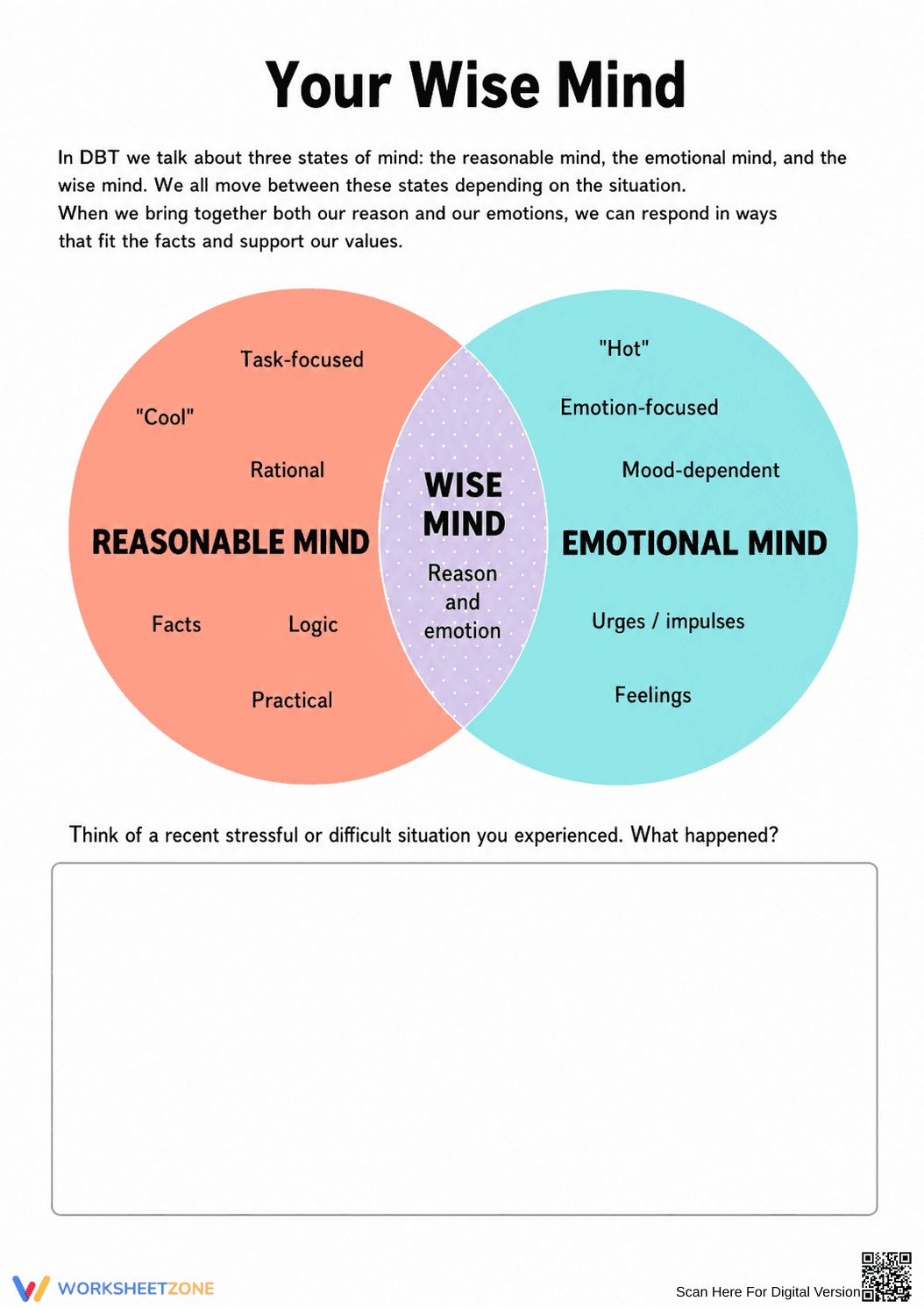
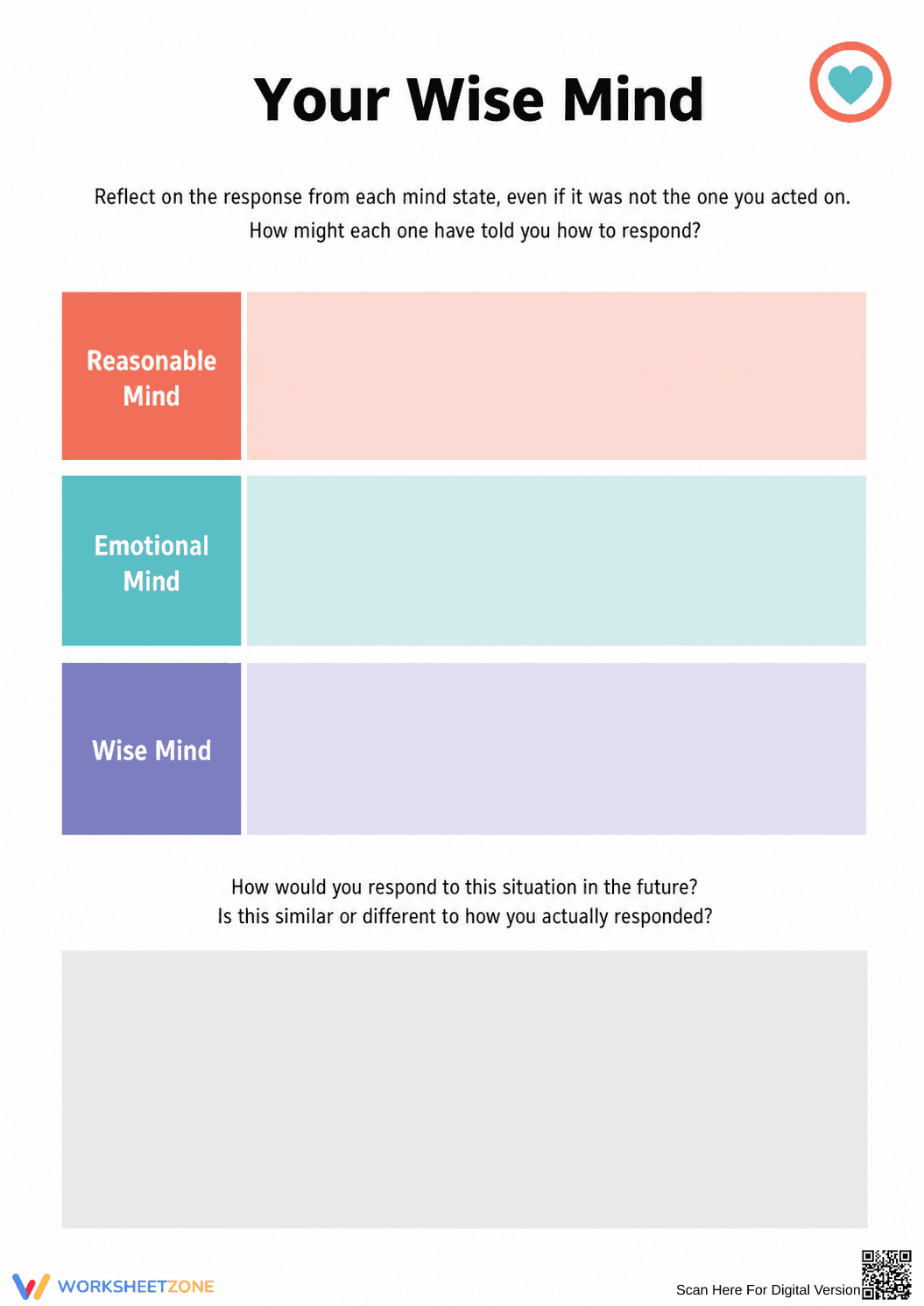
What's Inside: The resource consists of a 2-page PDF designed for immediate use. Page one features a visual Venn diagram illustrating the intersection of the "Cool" Reasonable Mind and the "Hot" Emotional Mind. It includes a dedicated space for situational description. Page two provides a structured reflection table where students analyze how each mind state would respond to their specific conflict, followed by a future-action planning prompt.
Zero-Prep Workflow: This resource is designed for maximum efficiency in high-pressure educational or therapeutic environments. First, print the 2-page document (30 seconds). Second, distribute the sheets to students during an SEL block or individual counseling session (1 minute). Third, facilitate a brief review of the Venn diagram definitions before allowing students to work through the reflection prompts independently (15 minutes). Total teacher preparation time is under 2 minutes, making it an ideal sub plan or crisis-intervention tool.
Standards Alignment: The primary alignment is `CCSS.ELA-LITERACY.W.11-12.10`, which requires students to write routinely over extended time frames for a range of tasks, purposes, and audiences. This worksheet specifically addresses the purpose of self-reflection and behavioral analysis. This standard code can be copied directly into lesson plans, IEP goals, or district curriculum mapping tools.
How to Use It: Use this worksheet as a formative assessment after introducing Dialectical Behavior Therapy (DBT) concepts. It is particularly effective during the "during instruction" phase to ground theoretical mindfulness in personal experience. Teachers should observe if students can distinguish between "facts" (Reasonable Mind) and "urges" (Emotional Mind) during the writing process. Expect completion within 20 minutes.
Who It's For: This tool is intended for high school students, college learners, or adults working on emotional intelligence. It serves as an excellent companion to a mindfulness anchor chart or a direct instruction lesson on coping strategies. It is highly beneficial for students with IEP goals related to self-regulation or social-emotional development.
This worksheet leverages the Wise Mind framework, a core component of Dialectical Behavior Therapy (DBT) used to treat emotional dysregulation. By aligning with CCSS.ELA-LITERACY.W.11-12.10, the activity ensures that students engage in the rigorous self-analysis necessary for cognitive maturity. Research from Fisher & Frey (2014) emphasizes the importance of structured reflection in developing metacognitive skills, particularly when students are asked to evaluate their own internal states. Furthermore, the use of visual organizers like Venn diagrams has been shown to improve the retention of complex psychological concepts. By providing a clear path from emotional urges to balanced decision-making, this resource supports the development of executive function. This standalone summary confirms that the worksheet meets high-school level demands for reflective writing and behavioral self-management through 2 targeted tasks.


