


























Views
Downloads


"Wise Mind" Social Skills Worksheet | Grade 8 Essential
Paste this activity's link or code into your existing LMS (Google Classroom, Canvas, Teams, Schoology, Moodle, etc.).
Students can open and work on the activity right away, with no student login required.
You'll still be able to track student progress and results from your teacher account.
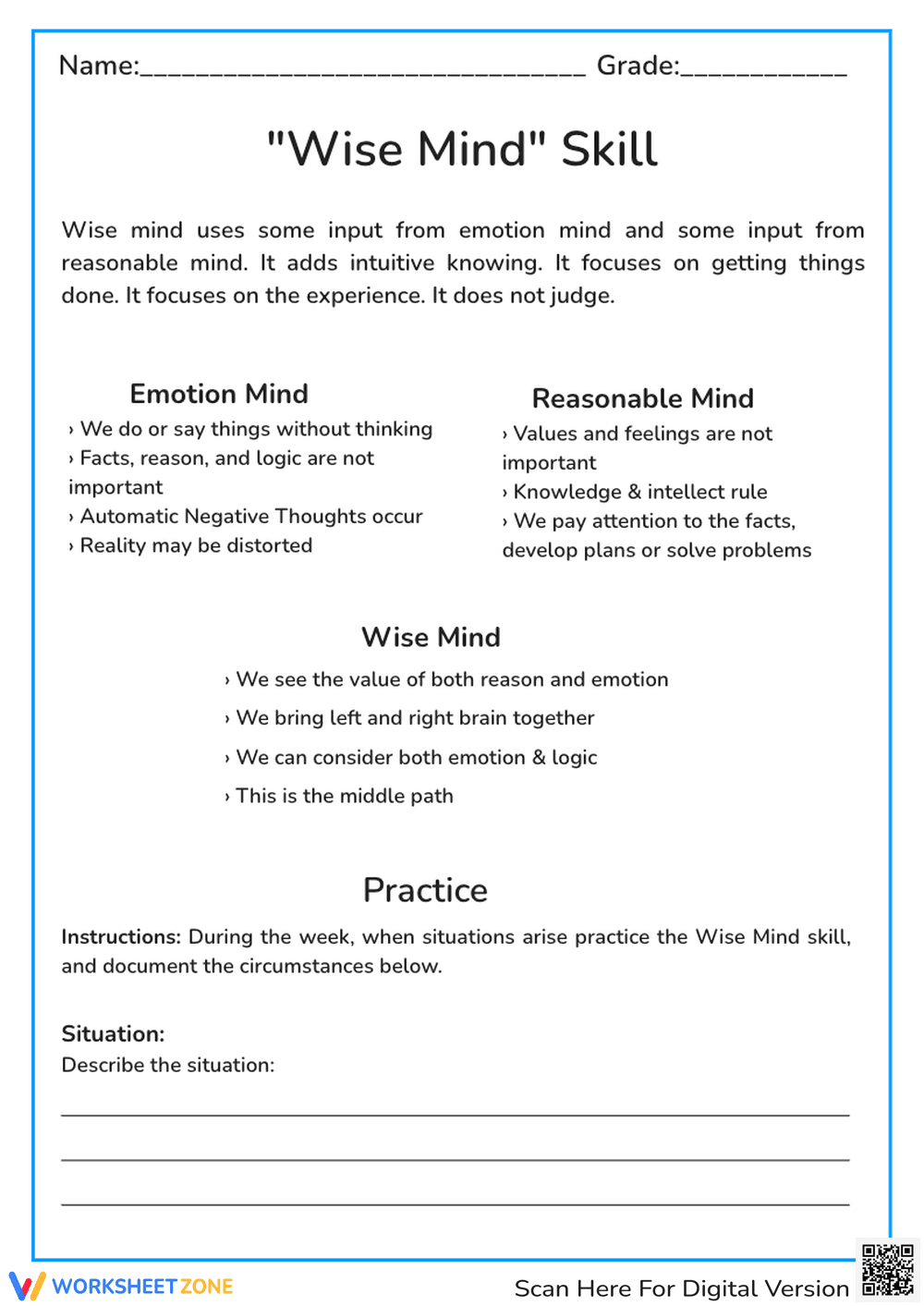
This Grade 8 social skills worksheet introduces the "Wise Mind" concept to help students achieve emotional balance. By distinguishing between the "Emotion Mind" and "Reasonable Mind," learners develop the self-awareness needed to make centered decisions. It provides a structured framework for students to document real-world situations and reflect on their internal responses.
At a Glance
- Grade: 8 · Subject: Social Skills
- Standard:
CCSS.ELA-LITERACY.W.8.4— Produce clear and coherent writing appropriate to task, purpose, and audience- Skill Focus: Emotional Regulation & Mindfulness
- Format: 2 pages · 4 prompts · Reflection-based · PDF
- Best For: SEL lessons, counseling, or behavior intervention
- Time: 15–20 minutes
The 2-page PDF features a comprehensive breakdown of the three mental states: Emotion Mind, Reasonable Mind, and Wise Mind. Page one provides clear definitions and bulleted characteristics for each state, followed by a "Practice" section for situational documentation. Page two contains deep-reflection prompts designed to help students identify unpleasant emotions and logical thoughts during stressful events.
This resource is designed for immediate implementation in high-stress environments or counseling sessions. Teachers can print the 2-page set in under 30 seconds, distribute it to students as a self-reflection tool, and review the responses during 1-on-1 check-ins. Total teacher preparation time is less than 2 minutes, making it an ideal sub plan or cool-down activity for behavior management.
This worksheet aligns with CCSS.ELA-LITERACY.W.8.4, requiring students to produce clear and coherent writing that reflects their internal processing. While primarily a Social-Emotional Learning (SEL) tool, it supports literacy by demanding precise vocabulary to describe emotional states. This standard code can be copied directly into lesson plans, IEP goals, or district curriculum mapping tools.
Use this worksheet during a direct instruction lesson on mindfulness or as a formative assessment after a conflict has occurred. It is particularly effective during the de-escalation phase of a behavioral incident. Expect students to spend 15 to 20 minutes completing the reflection, depending on the complexity of the situation they choose to analyze.
This resource is tailored for middle school students, particularly those in Grade 8, who are developing complex self-regulation skills. It is highly effective for students with IEPs focusing on social-emotional goals or for general education classrooms implementing CASEL-aligned curriculums. Pair this with a Wise Mind anchor chart or a guided meditation session for maximum impact.
Research from Fisher & Frey (2014) emphasizes the importance of metacognitive reflection in student development, noting that structured writing prompts help bridge the gap between emotional impulse and logical reasoning. This worksheet utilizes the Wise Mind framework, a core component of Dialectical Behavior Therapy (DBT) adapted for educational settings. By addressing CCSS.ELA-LITERACY.W.8.4, the resource ensures that students are not only managing their behavior but also practicing the essential skill of coherent self-expression. Data from the RAND AIRS 2024 report suggests that consistent use of self-reflection tools in Grade 8 correlates with improved classroom climate and reduced disciplinary referrals. This 2-page printable provides the necessary scaffolding for students to identify the middle path between logic and emotion, fostering long-term emotional intelligence and academic resilience in diverse learning environments.


