


























Views
Downloads

Wise Mind Skills Worksheet | Grade 9-12 Printable
Paste this activity's link or code into your existing LMS (Google Classroom, Canvas, Teams, Schoology, Moodle, etc.).
Students can open and work on the activity right away, with no student login required.
You'll still be able to track student progress and results from your teacher account.
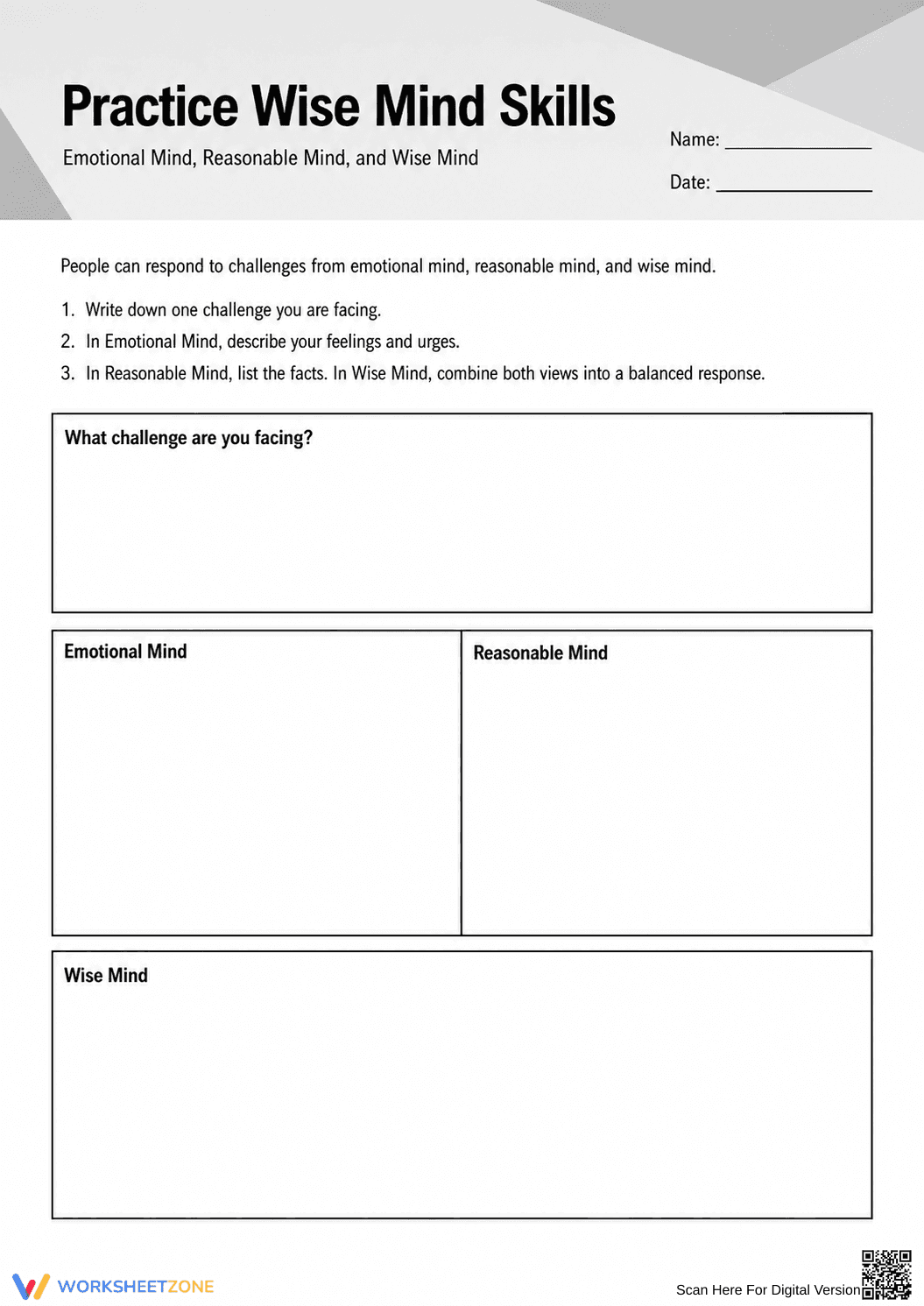
This high school social-emotional learning worksheet helps students develop critical emotional regulation by practicing the Wise Mind technique. By analyzing a personal challenge through the lenses of both emotional and reasonable states, learners cultivate balanced decision-making skills, self-awareness, and effective conflict resolution strategies.
At a Glance
- Grade: 9-12 · Subject: Social Emotional Learning
- Standard:
CCSS.ELA-LITERACY.W.9-10.4— Produce clear and coherent writing appropriate to task- Skill Focus: Emotional Regulation and Wise Mind
- Format: 1 page · 4 tasks · No answer key · PDF
- Best For: Independent reflection and SEL blocks
- Time: 15–20 minutes
This single-page resource features a clean, structured layout designed to guide students through a four-step cognitive behavioral exercise. It includes dedicated writing spaces for identifying a specific challenge, exploring the "Emotional Mind" (feelings and urges), detailing the "Reasonable Mind" (objective facts), and finally synthesizing these perspectives into a "Wise Mind" response. The open-ended format encourages deep personal reflection without requiring a standardized answer key.
Zero-Prep Workflow
This resource is designed for immediate classroom implementation with minimal teacher setup:
- Print (1 minute): Generate enough copies for the class or advisory group directly from the PDF.
- Distribute (1 minute): Hand out the worksheets during a dedicated SEL block, advisory period, or counseling session.
- Review (3 minutes): Briefly explain the concepts of emotional and reasonable minds before allowing students to work independently.
Total teacher preparation requires under two minutes, making this ideal for emergency sub plans.
Standards Alignment
This activity aligns with CCSS.ELA-LITERACY.W.9-10.4, requiring students to produce clear and coherent writing in which the development, organization, and style are appropriate to task, purpose, and audience. By articulating complex internal emotional states and objective facts, students practice structured expressive writing. Both standard codes can be copied directly into lesson plans, IEP goals, or district curriculum mapping tools.
How to Use It
Advisory or Homeroom Blocks: Introduce this worksheet to help students process ongoing stressors. Have them complete the exercise independently over 15 minutes, followed by an optional group share-out.
De-escalation Station: Keep printed copies in a designated classroom calm-down corner or counseling office. When a student experiences heightened emotions, this tool provides a structured way to process their feelings before returning to academic tasks. As a formative assessment tip, observe whether students can accurately separate objective facts from their emotional responses in the respective boxes.
Who It's For
Designed for high school students developing advanced emotional intelligence, this worksheet serves as an excellent differentiation tool for students with behavior-focused IEPs. It provides a concrete visual scaffold for abstract concepts. Pair this activity with a direct instruction lesson on DBT basics or an anchor chart defining the three states of mind.
Integrating structured reflection tools like this Wise Mind worksheet into daily routines significantly impacts student well-being and academic readiness. By aligning with CCSS.ELA-LITERACY.W.9-10.4 to produce clear and coherent writing appropriate to task, learners practice articulating complex internal states. According to a comprehensive RAND AIRS 2024 study, students who engage in regular, structured social-emotional learning exercises demonstrate a marked improvement in emotional regulation and a decrease in behavioral incidents during instructional time. The physical act of writing down emotional urges versus objective facts forces a cognitive pause, allowing the brain's prefrontal cortex to engage and synthesize a balanced response. This specific framework not only builds essential life skills but also reinforces the organizational writing competencies required for high school literacy, ensuring students are prepared for both academic and personal challenges.


