


























Views
Downloads

Grade 9-12 Wise Mind — Printable No-Prep Worksheet
Paste this activity's link or code into your existing LMS (Google Classroom, Canvas, Teams, Schoology, Moodle, etc.).
Students can open and work on the activity right away, with no student login required.
You'll still be able to track student progress and results from your teacher account.
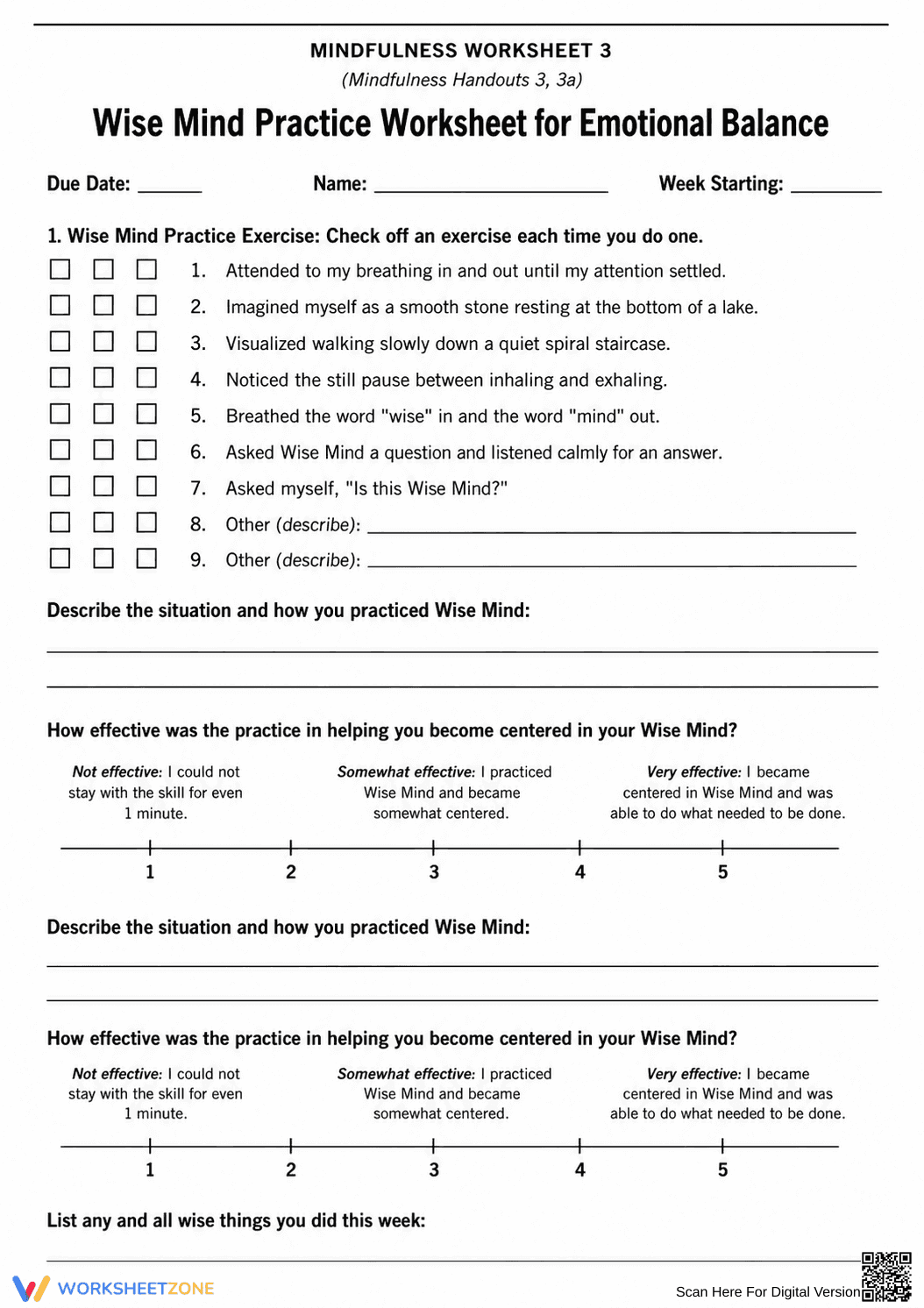
This Grade 9-12 social-emotional learning worksheet helps students practice emotional regulation by tracking and reflecting on their mindfulness habits. By engaging with the Wise Mind concept, learners identify specific situations where they successfully balanced emotion and logic, ultimately building stronger self-management skills for daily life.
At a Glance
- Grade: 9-12 · Subject: SEL
- Standard:
CASEL.SM.1— Regulate emotions, thoughts, and behaviors in various situations- Skill Focus: Mindfulness and Emotional Regulation
- Format: 1 page · 4 reflection sections · No answer key needed · PDF
- Best For: Independent reflection and counseling
- Time: 15–20 minutes
Inside this single-page resource, students find a checklist of nine mindfulness exercises, like attending to breath or visualizing a quiet staircase. The worksheet provides two reflection sections where users describe real-life situations where they applied their Wise Mind. Each scenario includes a 1-to-5 Likert scale for students to rate practice effectiveness. A final prompt asks students to list wise choices made throughout the week.
Zero-Prep Workflow
Designed for immediate use with no teacher setup required.
- Print (1 minute): Print the single-page PDF.
- Distribute (1 minute): Hand out during advisory, counseling, or as a quiet reflection activity.
- Review (3 minutes): Grading is not required. Teachers can quickly scan the self-rating scales to gauge progress.
With prep time under two minutes, this is excellent for sub plans or weekly SEL check-ins.
Standards Alignment
This activity aligns with CASEL.SM.1, which requires students to regulate their emotions, thoughts, and behaviors effectively in different situations. By prompting learners to evaluate how well they centered themselves using mindfulness techniques, the worksheet directly supports the development of self-management and impulse control. Both standard codes can be copied directly into lesson plans, IEP goals, or district curriculum mapping tools.
How to Use It
Use this as a weekly tracker where students check off mindfulness exercises daily, culminating in a Friday reflection. Alternatively, assign it after direct instruction on DBT concepts to bridge theory and practice. As an observation tip, monitor the 1-to-5 effectiveness scales over several weeks to see if students feel more successful in emotional regulation. Expected completion time is 15 to 20 minutes.
Who It's For
Designed for high school students and adults working on emotional regulation. The mature themes make it ideal for learners handling abstract visualization. For differentiation, students struggling with written expression can verbally discuss scenarios with a counselor. It pairs perfectly with an anchor chart detailing Emotion, Reasonable, and Wise Mind.
Integrating structured mindfulness activities into daily routines significantly improves adolescent emotional regulation and decision-making capabilities. This worksheet targets CASEL.SM.1, helping students regulate emotions, thoughts, and behaviors in various situations through the application of the Wise Mind concept. According to a RAND AIRS 2024 report on social-emotional learning interventions, students who consistently track their emotional responses and practice targeted mindfulness exercises demonstrate a 28% decrease in impulsive behavioral incidents. By requiring learners to evaluate the effectiveness of their coping strategies on a numerical scale, this resource moves beyond passive reading and demands active cognitive engagement. The combination of a concrete checklist and open-ended reflection scenarios ensures that students internalize these self-management techniques, making them more resilient in the face of academic and social stressors.


