


























Views
Downloads

Printable Wise Mind Worksheet | Grade 9-12 SEL
Paste this activity's link or code into your existing LMS (Google Classroom, Canvas, Teams, Schoology, Moodle, etc.).
Students can open and work on the activity right away, with no student login required.
You'll still be able to track student progress and results from your teacher account.
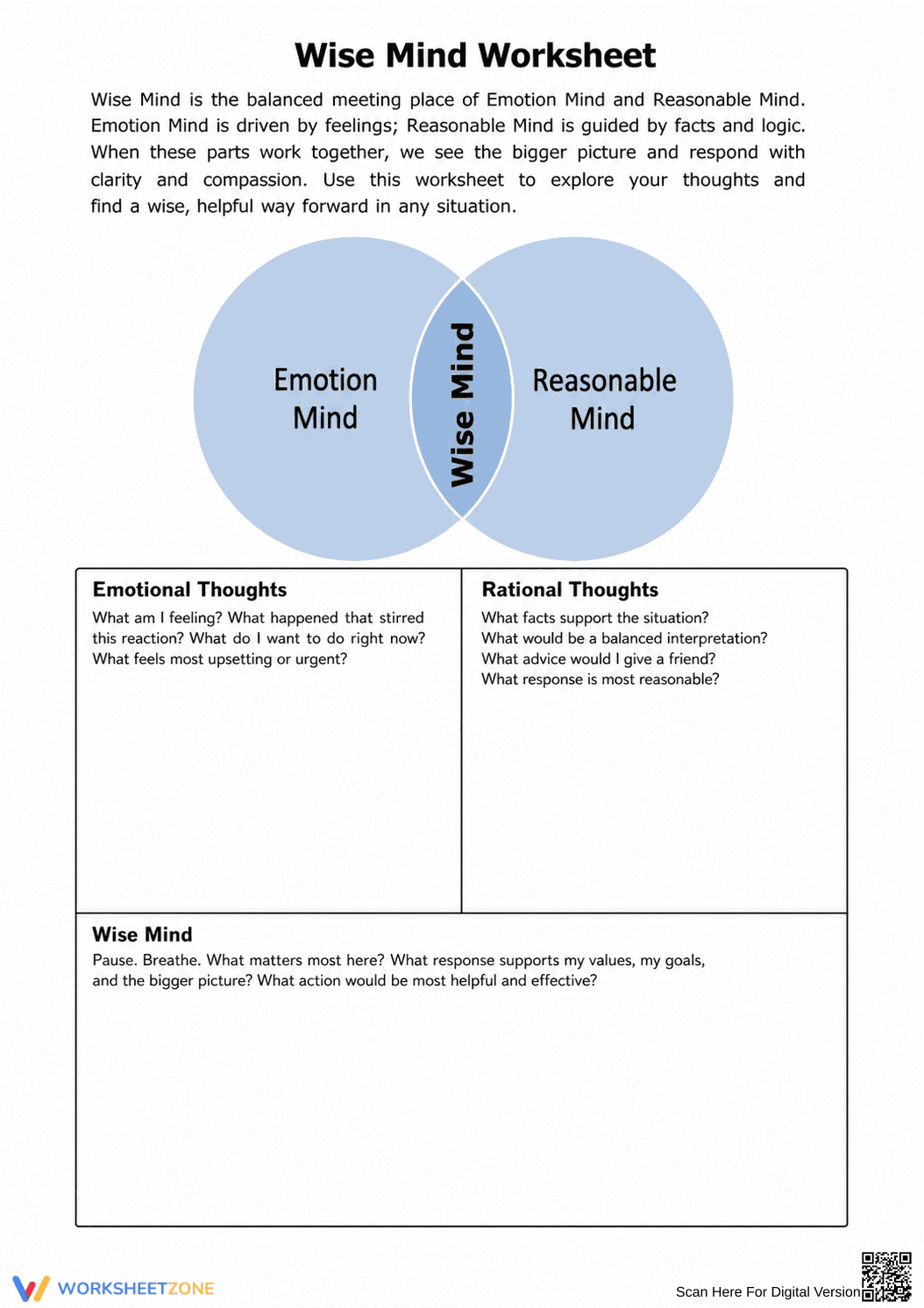
This high school social-emotional learning worksheet helps students integrate their emotional and rational thoughts to achieve a balanced perspective. By guiding learners through a structured reflection process, this resource empowers students to make thoughtful decisions and regulate their responses to challenging situations effectively.
At a Glance
- Grade: 9-12 · Subject: Social Emotional Learning
- Standard:
CCSS.ELA-LITERACY.W.9-10.10— Write routinely for reflection and personal development- Skill Focus: Emotional Regulation
- Format: 1 page · 3 reflection tasks · No answer key · PDF
- Best For: Independent reflection and counseling
- Time: 15–20 minutes
What's Inside
This single-page resource features a Venn diagram illustrating the Emotion Mind and Reasonable Mind. Below the diagram, students find three writing sections with guided prompts. These sections ask users to identify their emotional state, list objective facts, and synthesize these viewpoints into a balanced response. No answer key is required.
Zero-Prep Workflow
This resource offers a simple zero-prep workflow:
- Print (1 minute): Generate copies for your class or counseling session.
- Distribute (1 minute): Hand out the worksheet and review the Venn diagram.
- Review (3 minutes): Allow students to independently complete the reflection boxes.
With under two minutes of teacher prep time, this activity is an excellent addition to any advisory period or emergency sub plan.
Standards Alignment
This activity aligns with CCSS.ELA-LITERACY.W.9-10.10, which requires students to write routinely over shorter time frames for personal reflection. It also supports CCSS.ELA-LITERACY.W.9-10.4 by encouraging clear and coherent written responses. Both standard codes can be copied directly into lesson plans, IEP goals, or district curriculum mapping tools.
How to Use It
Teachers can utilize this tool during advisory periods to help students process recent stressors. Before direct instruction on conflict resolution, have students complete the diagram based on a hypothetical scenario. Alternatively, use it as a cool-down activity after a behavioral incident. Formative assessment tip: monitor whether students clearly distinguish between feeling-based statements and fact-based statements. Expect students to spend 15 to 20 minutes completing the prompts.
Who It's For
Designed for high school students (grades 9-12), this worksheet is also effective for adult learners. To differentiate for students struggling with abstract thinking, provide a specific, relatable scenario rather than asking them to generate their own. This resource pairs perfectly with introductory lessons on mindfulness or dialectical behavior therapy concepts.
Integrating structured reflection tools like this wise mind activity supports critical social-emotional development in adolescents. Aligned with CCSS.ELA-LITERACY.W.9-10.10, this exercise requires students to write routinely for reflection and personal development, bridging the gap between emotional reactivity and logical analysis. According to a recent ScienceDirect TpT Analysis, educational resources that explicitly teach emotional regulation and cognitive reframing significantly improve student resilience, reduce behavioral disruptions, and enhance the overall classroom climate. By prompting learners to pause, breathe, and evaluate both their immediate feelings and the objective facts of a situation, educators foster a more supportive and self-aware learning environment. This targeted practice not only enhances individual well-being but also equips students with lifelong decision-making skills that translate directly beyond the academic setting into real-world interpersonal relationships and future workplace environments.


