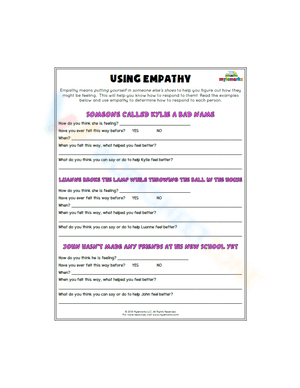
Why Emotional Regulation Worksheets?
A single emotional regulation worksheet handed out after a rough recess rarely changes behavior on its own. What moves the needle is repetition: the same feelings check-in or coping-strategy menu used at the same point in the day, week after week, until naming an emotion becomes as automatic as lining up for lunch. For teachers building morning meeting routines or closing out a chaotic transition period, worksheets work best as a recurring habit rather than a one-off intervention.
Think of the worksheet as a low-prep entry point into self-management, one of the five competencies in the CASEL framework. CASEL defines self-management as the ability to manage emotions, thoughts, and behaviors across different situations, including stress management and impulse control. A daily or several-times-a-week worksheet routine gives students repeated, low-stakes practice at exactly that skill.
Matching Worksheet Type to Grade Band
Not every emotional regulation worksheet works for every age group. Early elementary students generally respond better to visual tools such as emotion thermometers or color-coded feelings scales, where a student points to or colors in how big their feeling is rather than writing a paragraph about it. These visual formats reduce the literacy demand and let younger students participate even when they lack the vocabulary to describe what they are feeling.
Older students, particularly in upper elementary through high school, benefit more from reflective writing prompts: short response worksheets that ask what triggered a feeling, what the student's body did in response, and what strategy they tried. This shift from pointing to writing mirrors the growing capacity for metacognition in older students, and it gives secondary teachers a tool that does not feel babyish or out of place in an advisory period or homeroom block.
Using Worksheets to Support IEP and 504 Goals
For students with IEPs or 504 plans that include self-regulation or behavior goals, worksheets can double as informal progress documentation. A special education teacher might keep a simple binder or folder of completed check-ins showing how often a student independently identified an emotion or selected a coping strategy without adult prompting. This is not a substitute for formal progress monitoring, but it gives case managers a quick, concrete artifact to reference in a meeting.
Because the worksheets are typically short and visual, they also tend to require less writing stamina than other SEL materials, which matters for students who have processing or fine-motor goals alongside their behavior goals.
Classroom Implementation
Keep the routine low-prep and predictable. Choose one or two worksheet formats, laminate a reusable version for daily check-ins, and reserve a fresh paper copy for moments that need documentation, such as a post-conflict reflection. Common implementation points include:
- Morning meeting, as a quick two-minute emotional check-in before instruction starts
- Immediately after recess or PE, when dysregulation is common
- Following a conflict between students, before returning to the group
- At the start of a small-group counseling or intervention block
Avoid introducing a new worksheet format every week. Consistency, not novelty, is what allows students to internalize the self-management skill the worksheet is meant to build.
Frequently Asked Questions
1. What is an emotional regulation worksheet and how is it different from a general SEL worksheet?
An emotional regulation worksheet focuses specifically on identifying and managing emotions and impulses, the self-management piece of SEL. A general SEL worksheet might instead target social awareness, relationship skills, or decision-making, so the two overlap but are not interchangeable.
2. What age or grade level are emotional regulation worksheets best suited for?
They work across K-12 when the format is matched to the grade band: visual scales and emotion thermometers for early elementary, and reflective writing prompts for upper elementary through high school.
3. How often should teachers use emotional regulation worksheets in the classroom?
Frequent, brief use, such as a daily or several-times-a-week check-in, builds the habit more effectively than occasional longer sessions.
4. Can emotional regulation worksheets be used for students with IEPs or 504 plans?
Yes. They can support self-regulation or behavior goals and provide an informal record of a student's progress that case managers can reference alongside formal progress monitoring.
5. Do emotional regulation worksheets actually improve behavior and academic outcomes?
Research on broader school-based SEL programs, including the 2011 Durlak et al. meta-analysis of over 270,000 K-12 students, links consistent self-management practice to academic gains and reduced conduct problems, supporting worksheet-based routines as part of that practice.















 Interactive Worksheet Maker
 Quiz Maker
 Word Search Maker
 Crossword Puzzle Maker
 Word Scramble Generator
 Sentence Scramble Generator
 Handwriting Worksheet Generator
 Name Tracing Generator
 Fill In The Blank Generator