


























Views
Downloads
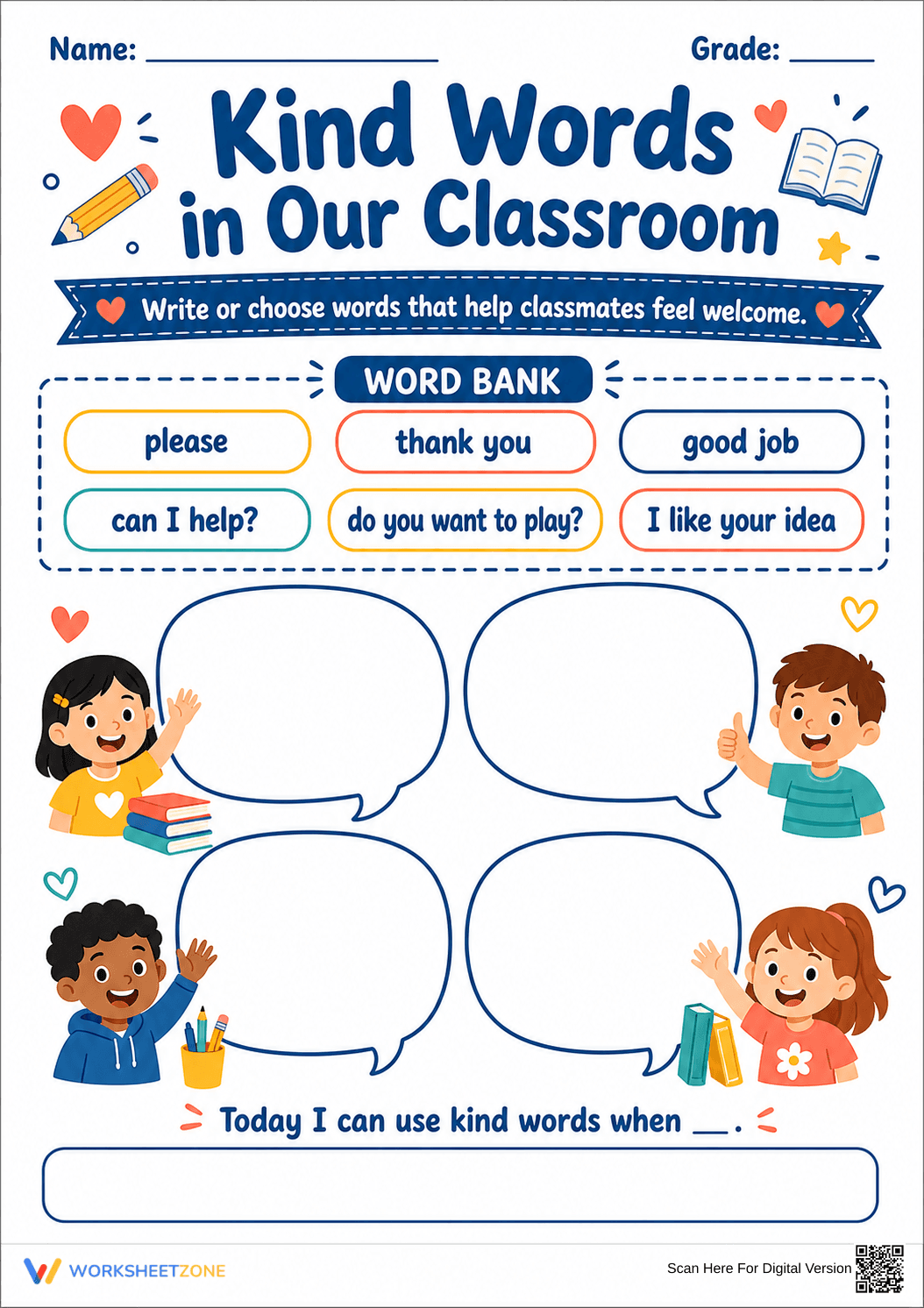

Printable Kind Words Worksheet | Grade 1 SEL
Paste this activity's link or code into your existing LMS (Google Classroom, Canvas, Teams, Schoology, Moodle, etc.).
Students can open and work on the activity right away, with no student login required.
You'll still be able to track student progress and results from your teacher account.
This Grade 1 social-emotional learning worksheet helps students practice positive communication by identifying and writing kind words. By using a provided word bank and relatable speech bubbles, young learners build classroom community and develop essential peer interaction skills.
At a Glance
- Grade: 1 · Subject: SEL
- Standard:
CCSS.ELA-LITERACY.SL.1.1— Participate in collaborative conversations with peers- Skill Focus: Positive communication
- Format: 1 page · 5 problems · No answer key needed · PDF
- Best For: Morning work or SEL blocks
- Time: 10–15 minutes
This single-page resource features a clear layout designed for early readers and writers. It includes a six-phrase word bank with polite expressions like "please," "thank you," and "can I help?" Students fill in four speech bubbles attached to cheerful character illustrations, applying the vocabulary to realistic peer scenarios. A final fill-in-the-blank prompt encourages personal reflection on when they can use kind words during their school day.
This worksheet requires zero teacher setup, making it an ideal print-and-go solution:
- Print (1 minute): Generate the PDF and print a class set. The high-contrast design prints beautifully in color or grayscale.
- Distribute (1 minute): Hand out to students during morning meeting or a dedicated social-emotional learning block.
- Review (3 minutes): Read the word bank aloud together, then let students work independently or in pairs.
With under two minutes of total prep time, this activity is highly suitable for emergency sub plans or quick transitions.
This resource aligns with CCSS.ELA-LITERACY.SL.1.1, requiring students to participate in collaborative conversations with diverse partners about grade 1 topics and texts with peers and adults in small and larger groups. By practicing the specific vocabulary needed for positive interactions, students build the foundational skills required for effective collaboration. Both standard codes can be copied directly into lesson plans, IEP goals, or district curriculum mapping tools.
Deploy this worksheet during the first weeks of school to establish expectations, or use it as a mid-year refresher on peer respect. It works exceptionally well as an independent morning work task right after a read-aloud about friendship. As a formative assessment tip, observe which phrases students select from the word bank; this provides insight into their current social vocabulary and comfort level with peer engagement. Expected completion time ranges from 10 to 15 minutes.
This activity is designed for Grade 1 students, though it serves as excellent review for Grade 2 or a guided activity for Kindergarten. The visual word bank provides built-in differentiation for emerging readers and English Language Learners, offering concrete spelling support. Pair this worksheet with a classroom anchor chart detailing "Words We Use" or a direct instruction lesson on active listening.
Integrating explicit instruction on positive communication directly impacts classroom climate and overall student wellbeing. This resource specifically targets CCSS.ELA-LITERACY.SL.1.1, helping students participate in collaborative conversations with peers by equipping them with a functional, everyday vocabulary of kind phrases. According to a comprehensive RAND AIRS 2024 report on social-emotional learning interventions, providing structured opportunities to practice peer-to-peer communication significantly reduces behavioral disruptions and increases academic engagement in early elementary settings. By offering a concrete word bank alongside relatable visual prompts, this worksheet effectively bridges the gap between abstract behavioral expectations and actionable student language. Teachers can utilize this evidence-based approach to foster a highly supportive environment where young learners feel confident and equipped to initiate play, offer assistance, and express gratitude effectively throughout the school day.


