


























Views
Downloads

Essential Nonverbal Communication Worksheet | Grade 7-8
Paste this activity's link or code into your existing LMS (Google Classroom, Canvas, Teams, Schoology, Moodle, etc.).
Students can open and work on the activity right away, with no student login required.
You'll still be able to track student progress and results from your teacher account.
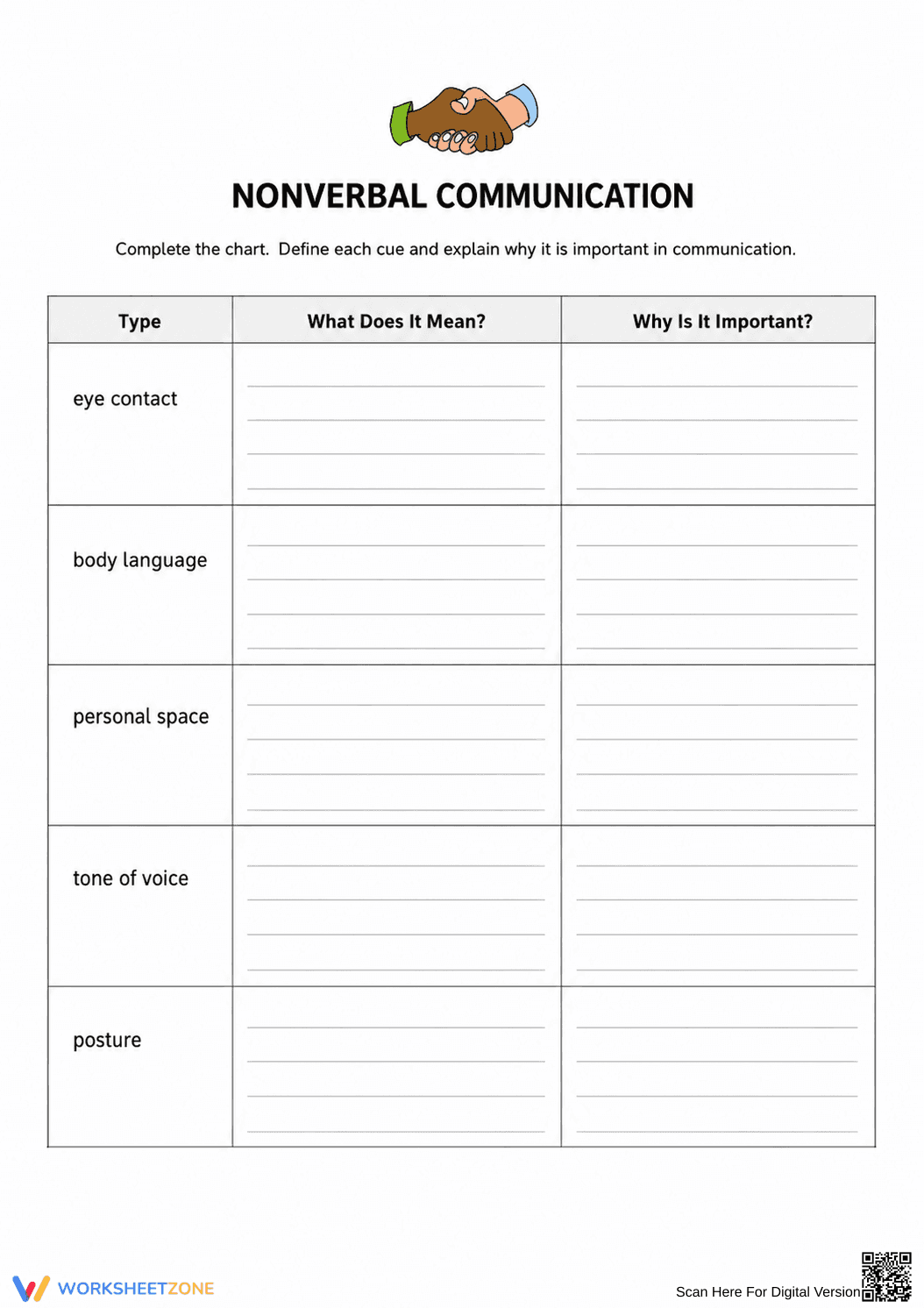
This Grade 7 and Grade 8 nonverbal communication worksheet provides a structured framework for students to analyze how we send messages without speaking. By defining specific cues and explaining their social significance, learners develop the self-awareness necessary for effective interpersonal interactions and collaborative academic discussions.
At a Glance
- Grade: 7-8 · Subject: Social Skills
- Standard:
CCSS.ELA-LITERACY.SL.7.1— Engage effectively in collaborative discussions by interpreting nonverbal cues and social signals- Skill Focus: Identifying and interpreting nonverbal cues
- Format: 2 pages · 10 tasks · Answer key included · PDF
- Best For: Social-emotional learning and communication units
- Time: 15–20 minutes
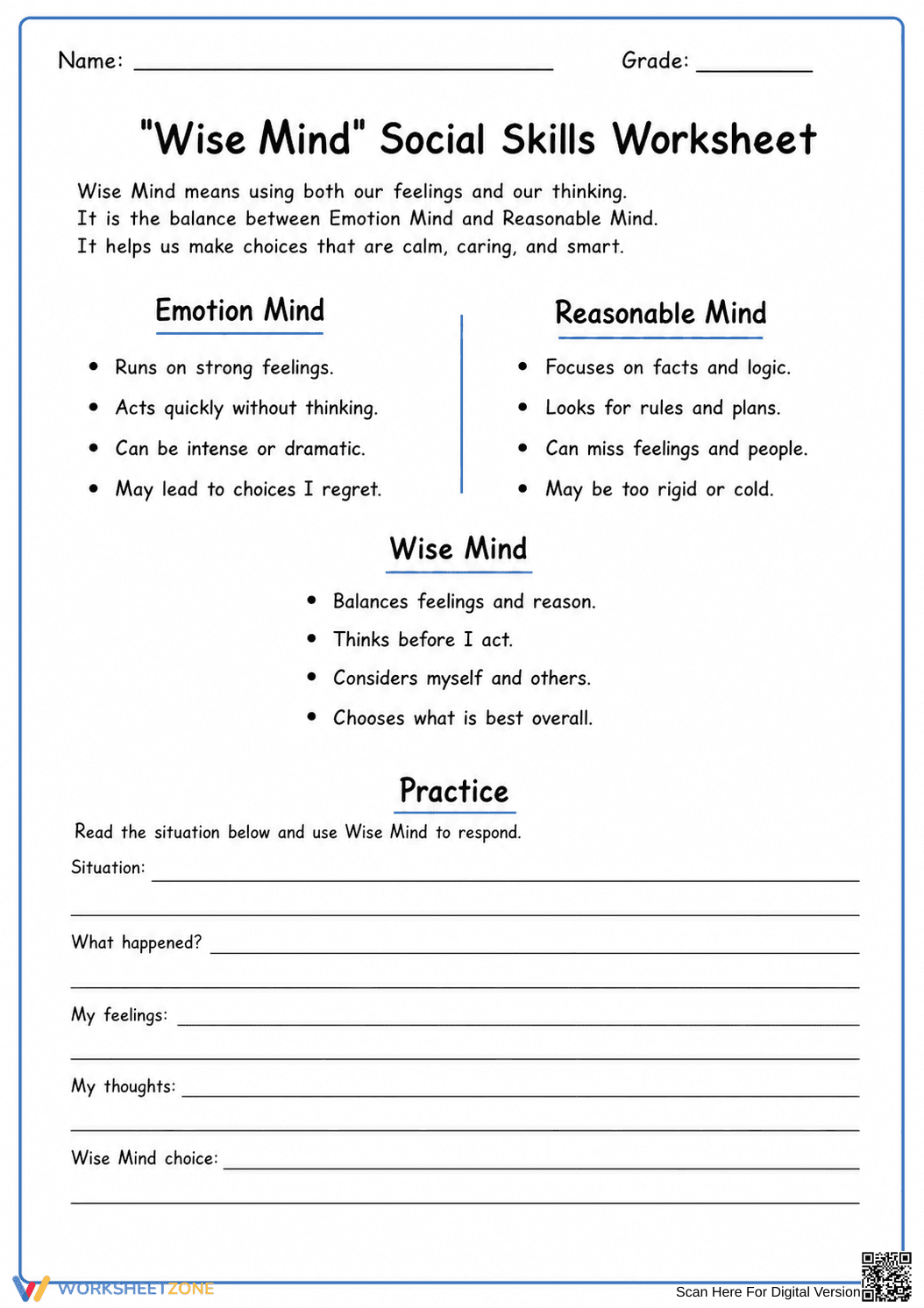
What's Inside: This two-page PDF includes a "Wise Mind" social skills guide and a "Nonverbal Communication" graphic organizer. The first page introduces the balance between emotion and reason, while the second features a 5-row table focusing on eye contact, body language, personal space, tone of voice, and posture. Students provide functional definitions and explain why each cue is important for successful communication.
The zero-prep workflow for this resource is designed for maximum efficiency in busy classrooms. First, print the single-page student sheet in less than 1 minute. Second, distribute the worksheet during a communication unit or as a social skills warm-up in 30 seconds. Third, review the completed tables using the provided answer key to facilitate a whole-class discussion on social norms for 5 to 10 minutes. Total teacher preparation time is under 2 minutes, making it an excellent option for substitute plans.
Standards Alignment: This resource is primarily aligned with `CCSS.ELA-LITERACY.SL.7.1`, which requires students to engage effectively in collaborative discussions. Understanding nonverbal cues is a prerequisite for the sub-standard of responding to others' ideas and maintaining focus on the topic.
How to Use It: Use this worksheet as a formative assessment after a direct instruction lesson on body language. It works exceptionally well as a "think-pair-share" activity where students first complete the definitions independently and then compare their "Why Is It Important?" answers with a partner. Teachers should observe if students can articulate the difference between the physical action and the social message being sent. Expect completion in 15 to 20 minutes.
Who It's For: This resource is tailored for middle school students in general education English Language Arts, as well as those in specialized social skills groups or speech therapy. It pairs naturally with a video-based lesson on social cues or an anchor chart depicting various facial expressions. It is particularly helpful for students who require explicit instruction in reading social environments.
According to research by Fisher & Frey (2014), explicit instruction in the components of oral and nonverbal communication is vital for middle schoolers as they transition into more complex social and academic environments. This worksheet addresses the need for students to move beyond simple recognition to an understanding of the functional impact of cues like eye contact and personal space. By requiring students to explain the "why" behind the cue, the resource aligns with evidence-based practices that favor metacognitive reflection over rote memorization. The inclusion of an answer key ensures that even non-specialist educators can provide accurate feedback on social norms. Utilizing the `CCSS.ELA-LITERACY.SL.7.1` framework, this tool bridges the gap between basic social skills and the high-level communication demands of the Common Core standards, ensuring students are prepared for both classroom collaboration and real-world interpersonal success.


