


























Views
Downloads

Essential Communication Techniques Worksheet | Grade 5
Paste this activity's link or code into your existing LMS (Google Classroom, Canvas, Teams, Schoology, Moodle, etc.).
Students can open and work on the activity right away, with no student login required.
You'll still be able to track student progress and results from your teacher account.
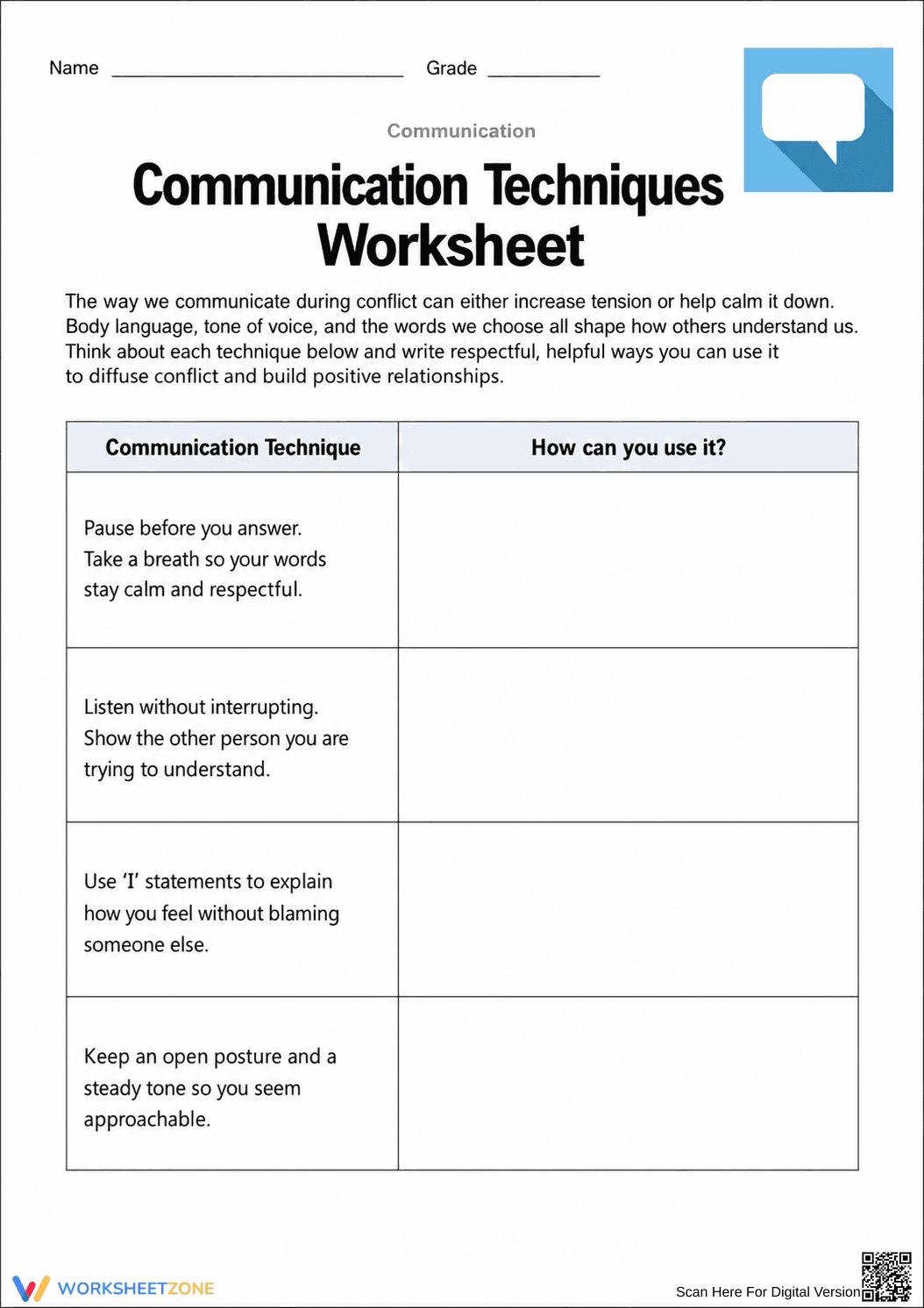
This Grade 5 communication techniques worksheet helps students master conflict resolution through four specific interpersonal strategies. By analyzing real-world applications for I-statements and active listening, learners develop the emotional intelligence needed to de-escalate tension and build positive relationships. It provides a structured framework for students to practice respectful dialogue in various social contexts.
At a Glance
- Grade: 5 · Subject: Communication Skills
- Standard:
CCSS.ELA-LITERACY.SL.5.1— Engage effectively in collaborative discussions and build on others' ideas- Skill Focus: Conflict De-escalation
- Format: 1 page · 4 tasks · Open-ended response · PDF
- Best For: Social-emotional learning and small group counseling
- Time: 15–20 minutes
This single-page PDF features a clean, two-column layout designed for immediate student engagement. The left column defines four core communication techniques: pausing before answering, active listening, using "I" statements, and maintaining open body language. The right column provides ample writing space for students to generate their own "how-to" examples, making the abstract concepts concrete and personal.
The workflow for this resource is designed for maximum efficiency. First, print the single-page PDF (30 seconds). Next, distribute the worksheet during a morning meeting or social-emotional learning block (1 minute). Finally, facilitate a 5-minute peer-share session where students compare their "I" statement examples. Total teacher preparation time is under 2 minutes, making it an ideal sub-plan or transition activity.
This resource aligns with `CCSS.ELA-LITERACY.SL.5.1`, which requires students to engage effectively in a range of collaborative discussions. By reflecting on how to use "I" statements and active listening, students prepare to meet the standard's demand for building on others' ideas and expressing their own clearly. Both standard codes can be copied directly into lesson plans, IEP goals, or district curriculum mapping tools.
Assign this worksheet during a dedicated Social-Emotional Learning (SEL) block after a direct instruction lesson on conflict. As a formative assessment, observe whether students can differentiate between a "blaming" statement and a functional "I" statement in their written responses. Expected completion time ranges from 15 to 20 minutes depending on the depth of student reflection.
This worksheet is designed for general education students in grades 4-6, but it is also highly effective for small-group counseling sessions or Tier 2 behavioral interventions. It pairs naturally with an anchor chart on "Active Listening" or a short video demonstration of de-escalation techniques to provide a multi-modal learning experience.
According to the RAND AIRS 2024 report on social-emotional learning, explicit instruction in communication techniques like "I" statements significantly reduces classroom conflict and improves peer-to-peer relationship quality. This worksheet addresses the CCSS.ELA-LITERACY.SL.5.1 standard by providing a structured environment for students to practice the verbal and non-verbal skills necessary for collaborative discussion. By requiring students to generate their own application examples, the resource moves beyond rote memorization toward functional mastery of conflict de-escalation. Research from Fisher & Frey (2014) supports this gradual release of responsibility, where students first see a defined technique and then apply it to their own social context. This 1-page printable is a high-utility tool for any educator looking to integrate evidence-based social skills training into their daily routine without increasing administrative burden.


