


























Views
Downloads

Grade 3 Social Skills — Printable No-Prep Worksheet
Paste this activity's link or code into your existing LMS (Google Classroom, Canvas, Teams, Schoology, Moodle, etc.).
Students can open and work on the activity right away, with no student login required.
You'll still be able to track student progress and results from your teacher account.
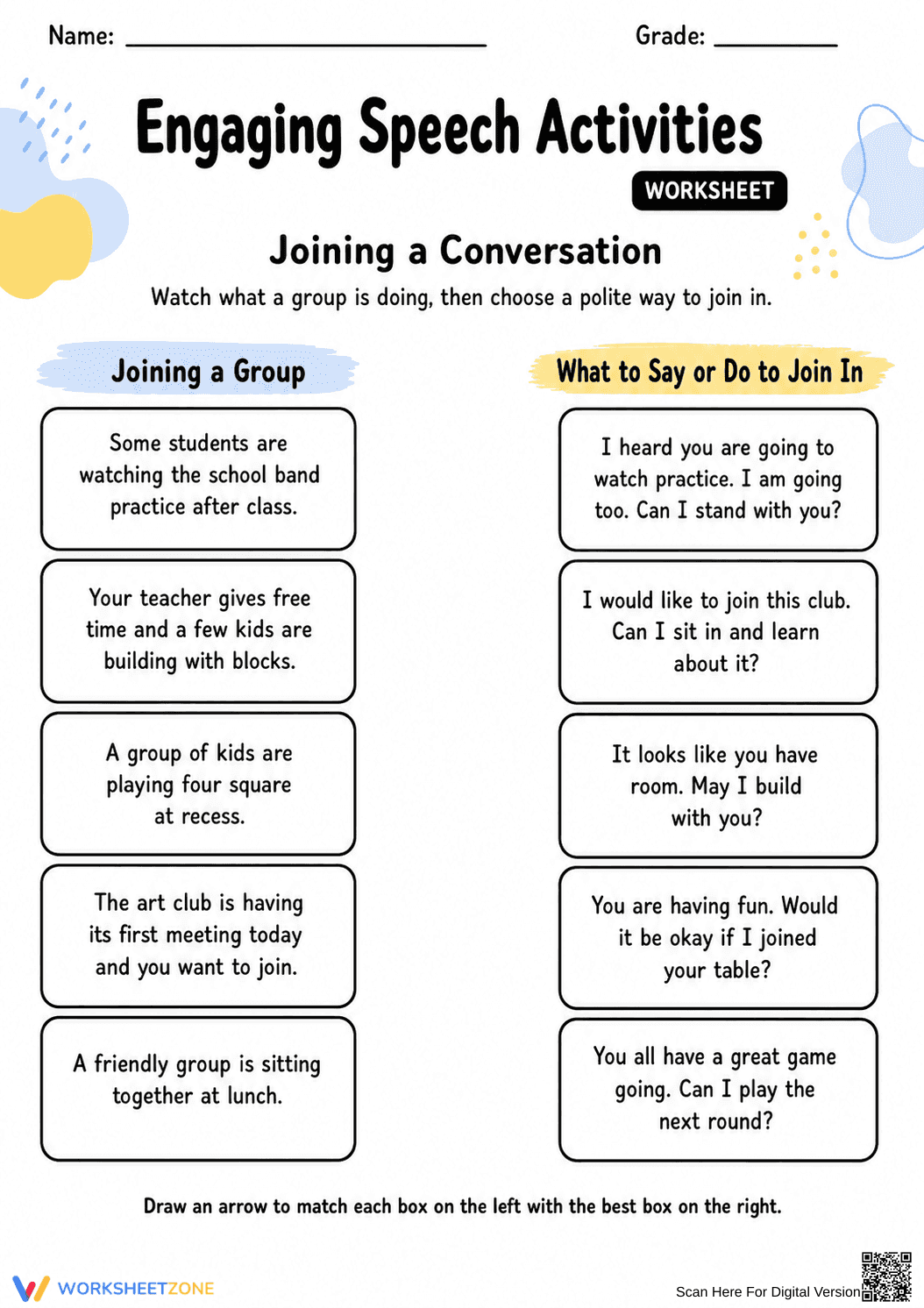
This social skills worksheet helps students master the art of joining a conversation. By matching relatable peer scenarios with polite responses, learners develop pragmatic language skills necessary for successful peer interactions. This targeted practice builds confidence for recess and group work.
At a Glance
- Grade: 3 · Subject: Social Skills
- Standard:
CCSS.ELA-LITERACY.SL.3.1.B— Follow agreed-upon rules for discussions and group work- Skill Focus: Joining conversations
- Format: 1 page · 5 problems · Answer key included · PDF
- Best For: Independent practice or speech therapy
- Time: 10–15 minutes
This single-page resource features a straightforward matching activity designed to reinforce pragmatic language concepts. The left column presents five common school scenarios, like watching band practice. The right column provides five polite conversation starters. Students draw lines connecting the situation to the best verbal response. An answer key is included.
Designed for immediate use, this activity requires minimal setup:
- Print (1 minute): Generate enough copies for your small group or class.
- Distribute (1 minute): Hand out the worksheets and pencils.
- Review (3 minutes): Read instructions aloud and complete the first pair together.
With under two minutes of total prep time, this resource is an excellent addition to emergency sub plans or dedicated social-emotional learning blocks.
This activity aligns with CCSS.ELA-LITERACY.SL.3.1.B: "Follow agreed-upon rules for discussions." It supports broader social-emotional learning frameworks by encouraging empathy. Both standard codes can be copied directly into lesson plans, IEP goals, or district curriculum mapping tools.
Teachers can utilize this worksheet during dedicated social-emotional learning blocks or speech therapy sessions. It works beautifully as an independent follow-up task after a direct instruction lesson on reading social cues. As a formative assessment tip, observe students as they complete the matching task and ask them to role-play scenarios aloud. Expected completion time ranges from 10 to 15 minutes.
This resource is primarily designed for third-grade students, though it remains relevant for upper elementary learners needing explicit social skills instruction. It is valuable for neurodivergent students or individuals working on pragmatic language IEP goals. Pair this worksheet with a visual anchor chart detailing steps for entering a group.
Explicit instruction in pragmatic language, such as the skills practiced in this CCSS.ELA-LITERACY.SL.3.1.B aligned activity, is critical for fostering positive peer relationships. When students learn to follow agreed-upon rules for discussions and group work, they experience greater academic and social success. According to a recent EdReports 2024 analysis, integrating structured social-emotional learning tasks directly into the daily curriculum significantly improves classroom climate and reduces behavioral disruptions. By providing concrete examples of how to politely join a conversation, educators equip learners with the tools they need to navigate complex social environments. This targeted practice helps bridge the gap between theoretical social knowledge and practical application, ensuring students can confidently engage with their peers during unstructured times like recess or lunch. Mastery of these foundational communication skills ultimately supports a more inclusive and collaborative school community.


