


























Views
Downloads

Nonverbal Communication Printable Worksheet | Grade 3-4
Paste this activity's link or code into your existing LMS (Google Classroom, Canvas, Teams, Schoology, Moodle, etc.).
Students can open and work on the activity right away, with no student login required.
You'll still be able to track student progress and results from your teacher account.
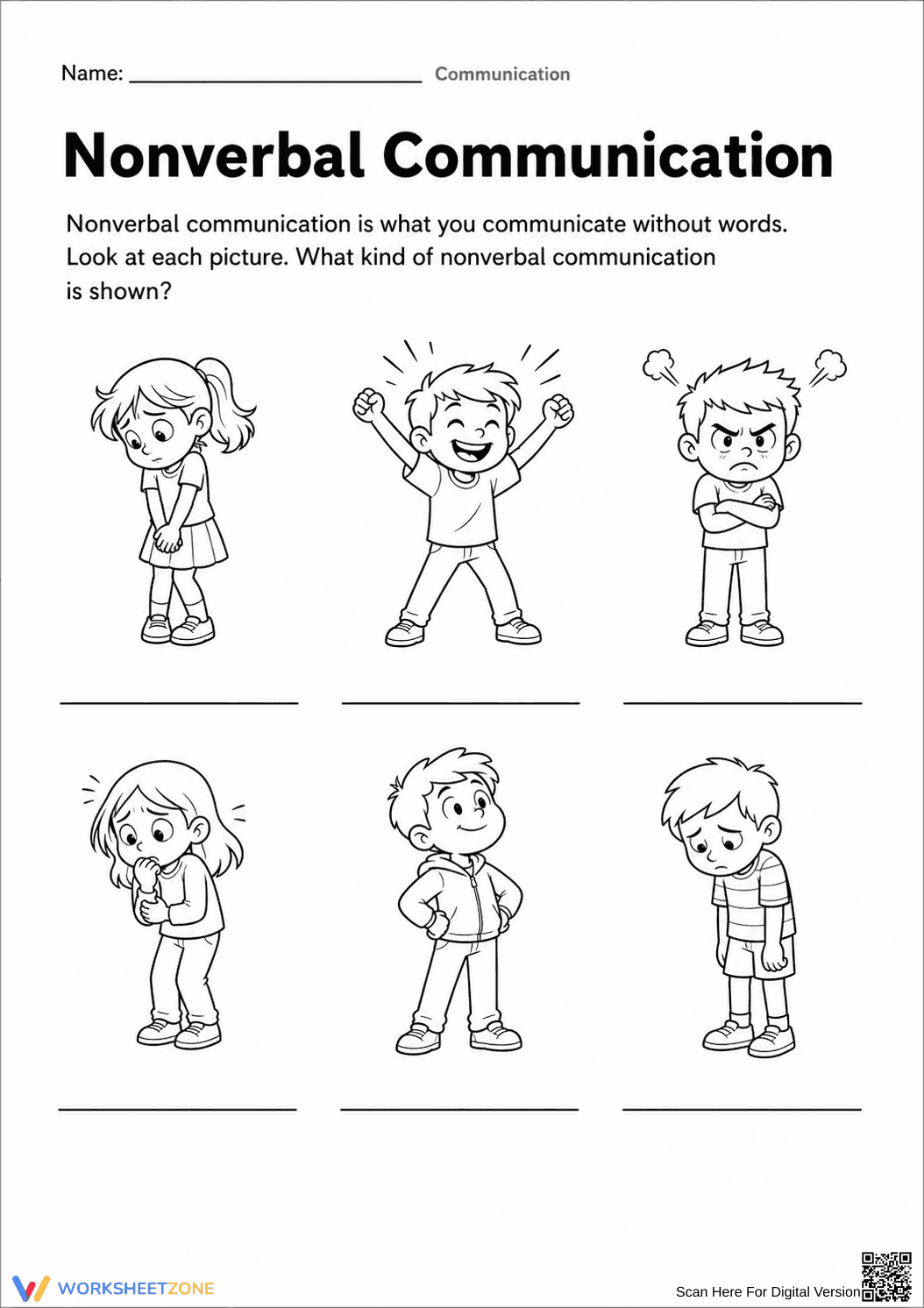
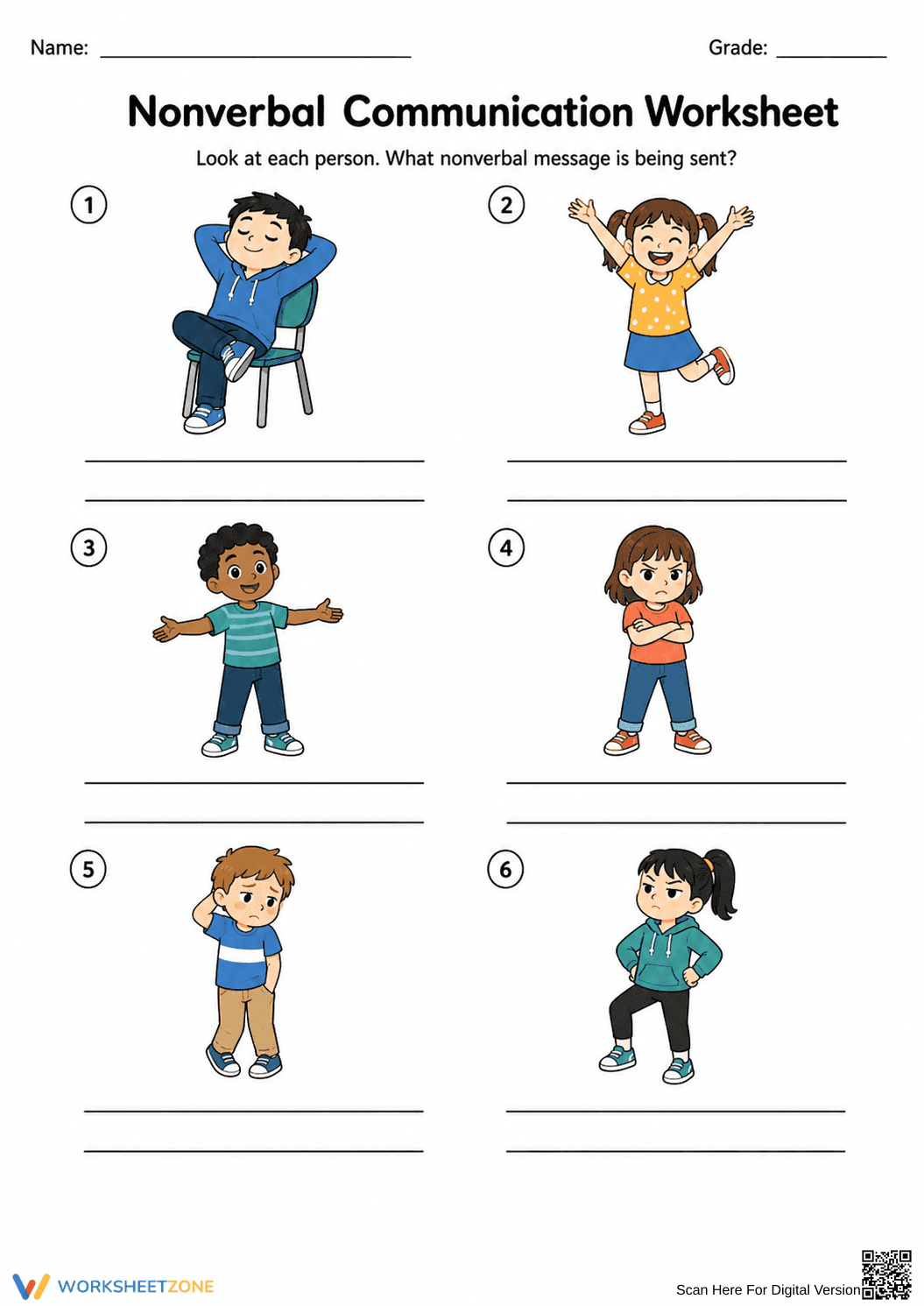
This Grade 3-4 nonverbal communication worksheet helps students identify and interpret social cues through visual analysis. By examining facial expressions and body posture, learners develop the essential ability to understand emotions without spoken words. This resource provides a structured way to build empathy and social awareness in any classroom setting.
At a Glance
- Grade: 3-4 · Subject: Social Skills
- Standard:
CCSS.ELA-LITERACY.SL.4.1— Interpret visual information for effective communication- Skill Focus: Interpreting body language and gestures
- Format: 2 pages · 12 problems · Answer key included · PDF
- Best For: Social-Emotional Learning
- Time: 10–15 minutes
What's Inside
The worksheet features a clear definition of nonverbal communication followed by twelve distinct cartoon illustrations spread across two pages. Each character displays a unique emotional state or physical posture, such as confidence, anger, or embarrassment. Students use the provided blank lines to describe the nonverbal message being sent by the character. A comprehensive answer key is included to facilitate quick grading or self-correction.
Zero-Prep Workflow
This resource is designed for immediate classroom implementation with a total teacher prep time of under 2 minutes. First, print the two-page student worksheet. Second, distribute the copies during a morning meeting or social skills block. Third, review the twelve scenarios as a whole group using the included answer key to spark discussion about social nuances. It serves as an excellent emergency sub plan or transition activity.
Standards Alignment
This activity aligns with CCSS.ELA-LITERACY.SL.4.1, which requires students to engage effectively in a range of collaborative discussions and build on others' ideas. Understanding nonverbal cues is a foundational component of active listening and responding to others' perspectives. Both standard codes can be copied directly into lesson plans, IEP goals, or district curriculum mapping tools.
How to Use It
Use this worksheet during a direct instruction lesson on social-emotional learning to introduce the concept of reading the room. It also functions well as a formative assessment; observe if students can distinguish between similar emotions like relaxed and open versus closed off and defensive. Expect students to complete the identification tasks in approximately 12 minutes, followed by a 5-minute group debrief.
Who It's For
This resource is ideal for general education students, but it is particularly effective for students with IEPs focusing on social pragmatics or English Language Learners (ELLs) who are building their emotional vocabulary. Pair this worksheet with a short video clip of a silent film or a set of emotion anchor charts to reinforce the visual concepts.
Effective communication relies heavily on nonverbal cues, which often convey more meaning than verbal language. Research by Fisher & Frey (2014) emphasizes that explicit instruction in social-emotional skills, including the interpretation of gestures and facial expressions, significantly improves classroom climate and student peer interactions. This worksheet addresses CCSS.ELA-LITERACY.SL.4.1 by providing 12 targeted visual prompts that require students to decode complex social information and interpret visual information for effective communication. By practicing these skills in a low-stakes, printable format, students build the cognitive flexibility needed for real-world social navigation. The inclusion of an answer key ensures that educators can provide immediate feedback, a critical factor in skill acquisition for Grade 3 and Grade 4 learners. This resource bridges the gap between abstract social concepts and concrete visual evidence, making it a staple for any comprehensive communication curriculum.


