


























Views
Downloads

Essential Interpersonal Communication Checklist | Grade 8
Paste this activity's link or code into your existing LMS (Google Classroom, Canvas, Teams, Schoology, Moodle, etc.).
Students can open and work on the activity right away, with no student login required.
You'll still be able to track student progress and results from your teacher account.
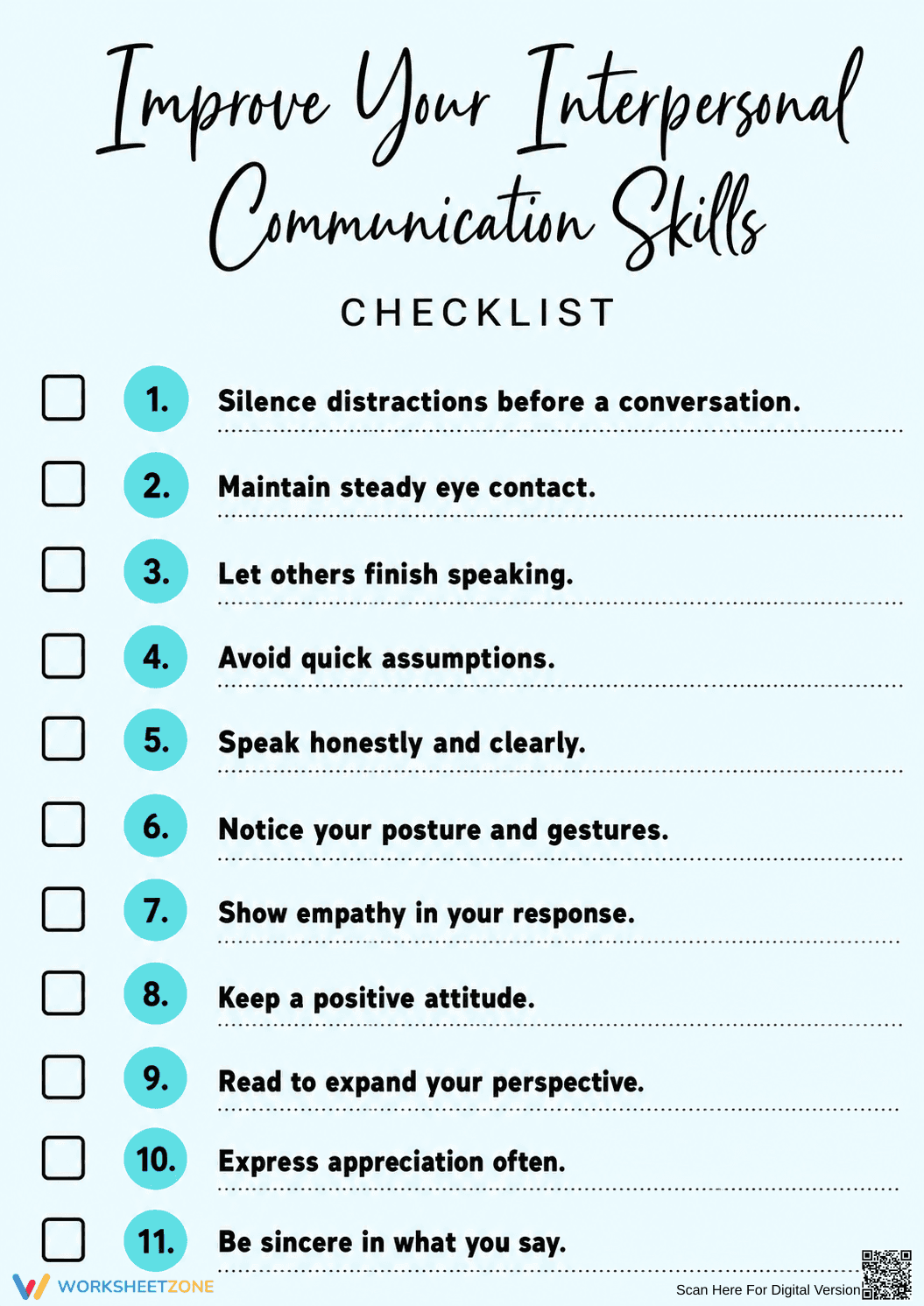
Mastering interpersonal communication is a foundational skill that empowers students to build stronger relationships and collaborate effectively. This checklist provides 11 actionable strategies to help learners monitor their own social behaviors and improve their conversational impact. By focusing on specific cues like eye contact and active listening, students gain the confidence needed for successful peer interactions.
At a Glance
- Grade: 8 · Subject: Communication Skills
- Standard:
CCSS.ELA-LITERACY.SL.8.1— Engage effectively in collaborative discussions by practicing active listening and empathy- Skill Focus: Interpersonal Communication
- Format: 1 page · 11 problems · Self-assessment · PDF
- Best For: Social-emotional learning and collaborative group work
- Time: 10–15 minutes
What's Inside
This single-page PDF features a clean, professional layout designed for high readability. It contains 11 numbered checklist items covering non-verbal communication, active listening, and emotional intelligence. Each item includes a dedicated checkbox for student self-tracking. The worksheet functions as a self-contained guide, requiring no additional materials or prior instruction to be effective.
Zero-Prep Workflow
This resource is designed for immediate classroom implementation with minimal teacher oversight:
- Print (30 seconds): Download the PDF and print copies for your entire class or small group.
- Distribute (1 minute): Hand out the checklist before a group project or discussion-based lesson.
- Review (5 minutes): Have students self-reflect on their interactions at the end of the period.
Total teacher prep time is under 2 minutes, making this an ideal resource for busy educators or unexpected sub plans.
Standards Alignment
This resource aligns with CCSS.ELA-LITERACY.SL.8.1. It specifically addresses the need for students to follow rules for collegial discussions and acknowledge new information expressed by others. Both standard codes can be copied directly into lesson plans, IEP goals, or district curriculum mapping tools.
How to Use It
Use this worksheet as a formative assessment tool during a Socratic Seminar. Before the activity, have students select two specific skills to focus on. Afterward, they can use the checklist to evaluate their performance. This provides a concrete data point for teacher observations. Expected completion time is 10 to 15 minutes.
Who It's For
This worksheet is designed for middle and high school students, particularly those in Grade 8, who are navigating increasingly complex social dynamics. It is an excellent resource for general education classrooms, speech-language pathology sessions, and counseling groups. Pair this checklist with a video model of effective communication for a comprehensive learning experience.
According to Fisher & Frey (2014), explicit instruction in speaking and listening skills is vital for academic and social success. This worksheet targets CCSS.ELA-LITERACY.SL.8.1 by providing students with a concrete framework for interpersonal communication. By breaking down complex social interactions into 11 observable behaviors—such as maintaining eye contact and practicing empathy—the resource supports the development of metacognitive awareness in social settings. Research indicates that structured self-assessment tools help students internalize soft skills that are often overlooked in traditional curricula. This checklist serves as a bridge between theoretical social-emotional learning and practical application in the classroom or workplace. Educators can use this tool to document student progress in collaborative environments, ensuring that communication goals are met with measurable evidence. The clear, actionable language makes it an ideal resource for diverse learners seeking to improve their relational effectiveness.


