


























Views
Downloads
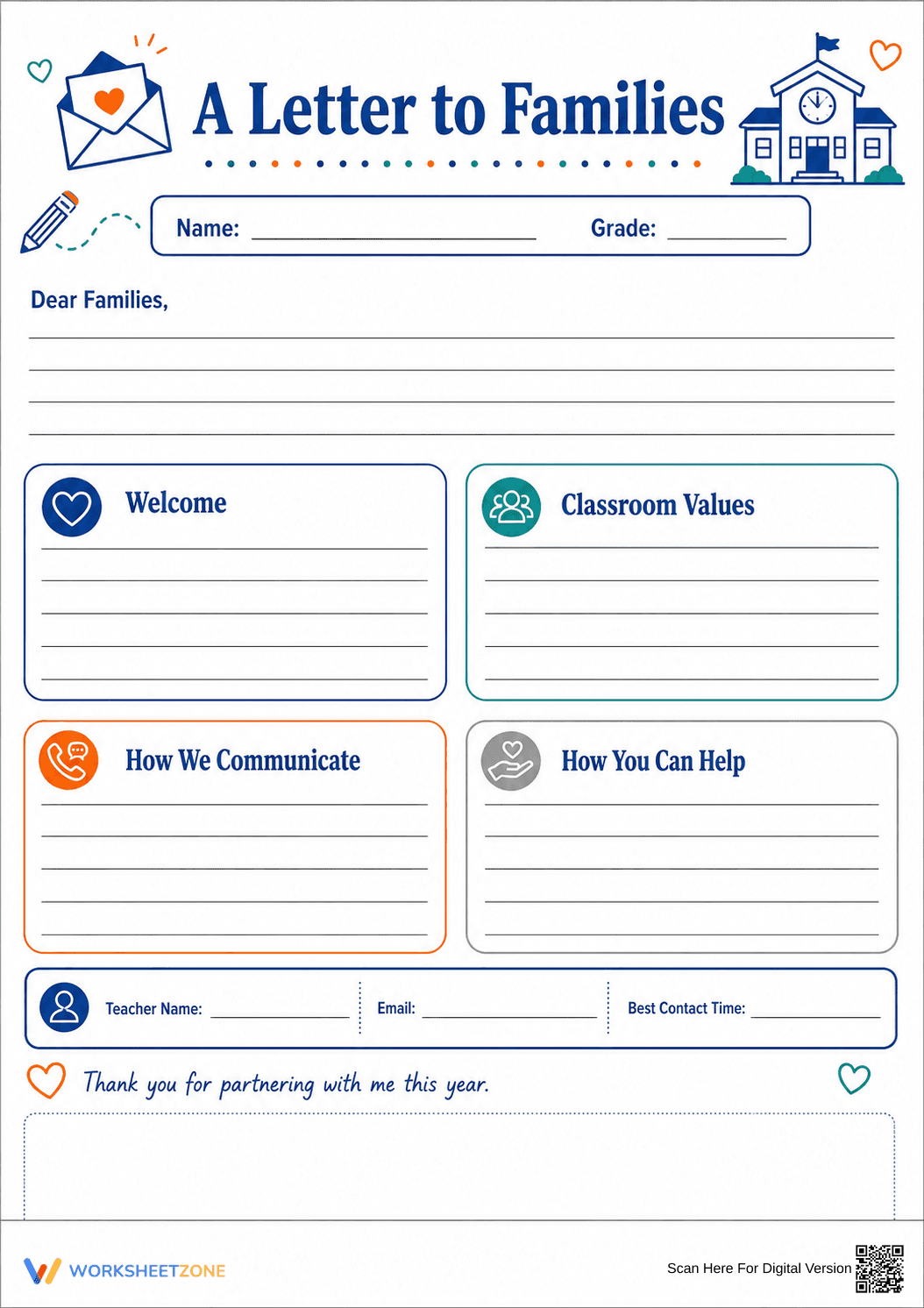

Essential Teacher Letter to Parents | K-5 Printable
Paste this activity's link or code into your existing LMS (Google Classroom, Canvas, Teams, Schoology, Moodle, etc.).
Students can open and work on the activity right away, with no student login required.
You'll still be able to track student progress and results from your teacher account.
This professional teacher letter template streamlines the essential process of building home-school partnerships. By providing structured prompts for classroom values and communication protocols, it ensures families receive clear, welcoming information during the first week of school. This resource helps educators establish a positive tone and clear expectations immediately.
At a Glance
- Grade: K-5 · Subject: Professional Communication
- Standard:
CCSS.ELA-LITERACY.SL.1.1— Participate in collaborative conversations with diverse partners about grade-level topics- Skill Focus: Parent-Teacher Communication
- Format: 1 page · 4 sections · Answer key N/A · PDF
- Best For: Back to School Night or First Week
- Time: 5–10 minutes
What's Inside
This 1-page PDF features a clean, professional layout with four distinct sections: Welcome, Classroom Values, How We Communicate, and How You Can Help. It includes dedicated fields for teacher name, email, and best contact times. The design incorporates warm icons like hearts and school buildings to maintain a friendly yet organized aesthetic for family distribution.
Zero-Prep Workflow
- Print: Generate copies of the single-page template for your entire class roster in under 1 minute.
- Distribute: Hand-write or type your specific classroom details into the four provided modules.
- Review: Share the letters during Back to School Night or place them in student take-home folders for immediate family engagement.
Total teacher preparation time is targeted at under 2 minutes per class set.
Standards Alignment
The primary standard addressed is `CCSS.ELA-LITERACY.SL.1.1`, which focuses on participating in collaborative conversations with diverse partners. While typically student-facing, this teacher-led communication facilitates the adult partnership necessary for student success in these standards. Both standard codes can be copied directly into lesson plans, IEP goals, or district curriculum mapping tools.
How to Use It
Use this template as a primary handout during your first formal meeting with parents to provide a tangible reference for your classroom culture. It also serves as an excellent formative tool for identifying family needs; observe which parents respond to the "How You Can Help" section to gauge initial engagement levels. Expected completion time for filling out the template is 10 minutes.
Who It's For
This resource is designed for K-5 elementary teachers seeking a polished, consistent way to introduce themselves to families. It is particularly helpful for first-year teachers or those looking to refresh their "Meet the Teacher" materials. Pair this with a student-led classroom tour or a "Getting to Know You" student survey for a complete orientation package.
Effective home-school communication is a cornerstone of student achievement, as highlighted by Fisher & Frey (2014) in their research on instructional frameworks. This template aligns with the `CCSS.ELA-LITERACY.SL.1.1` standard by fostering the collaborative environment required for diverse partners to support student learning. Research from the NAEP consistently shows that students whose families are informed about classroom values and communication channels demonstrate higher engagement and better academic outcomes. By providing a structured format for sharing contact information and classroom expectations, this resource reduces the administrative burden on teachers while maximizing the clarity of information shared with the community. Utilizing a standardized communication tool ensures that all families, regardless of their previous experience with the school system, receive the same high-quality introduction to the learning environment, supporting equity and transparency in the classroom.


