




























Views
Downloads
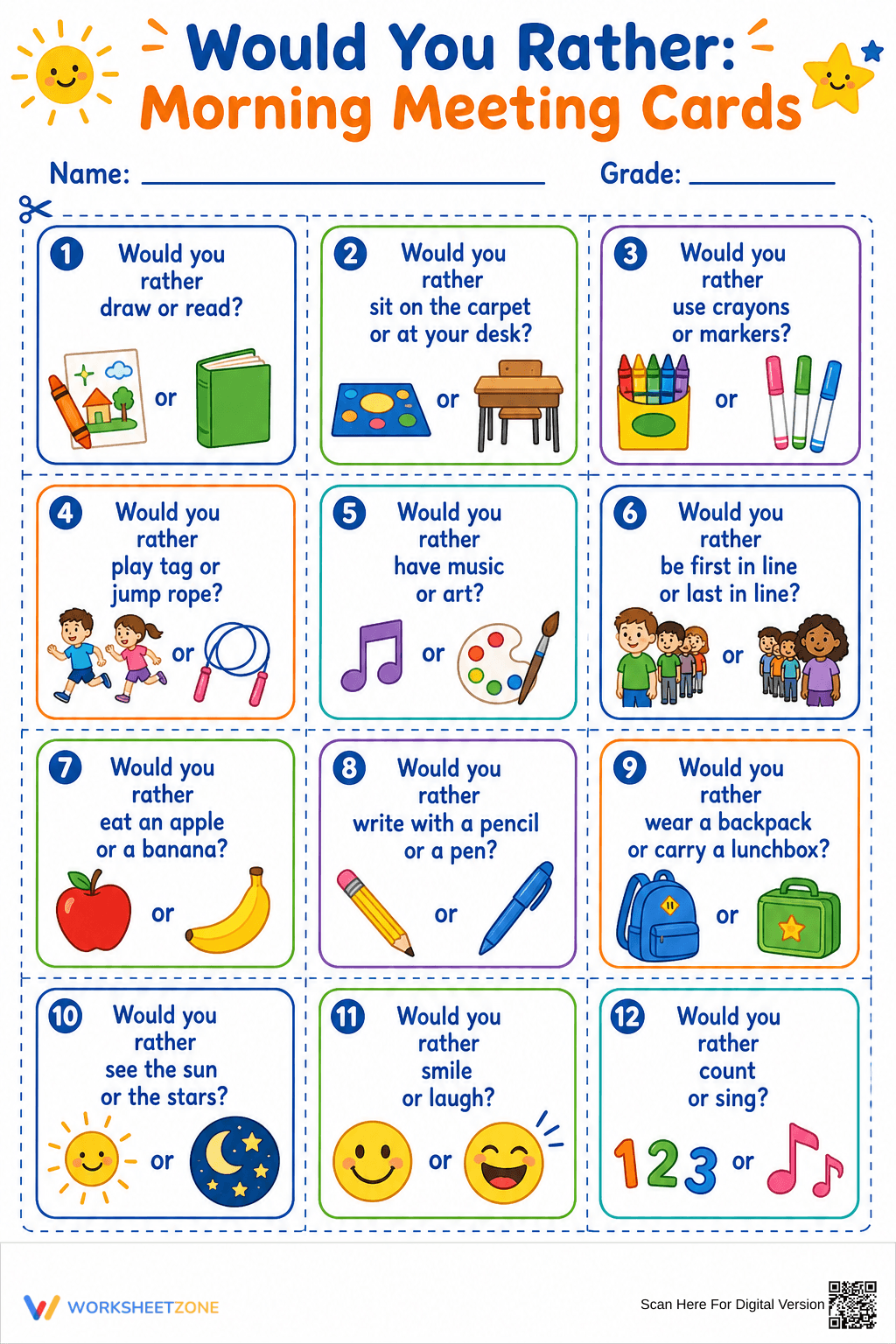

Essential Morning Meeting Would You Rather Cards | K-4

Paste this activity's link or code into your existing LMS (Google Classroom, Canvas, Teams, Schoology, Moodle, etc.).
Students can open and work on the activity right away, with no student login required.
You'll still be able to track student progress and results from your teacher account.
These discussion cards facilitate student engagement and oral language development during morning meetings or classroom transitions. Students practice expressing personal preferences and listening to their peers through 12 engaging "Would You Rather" prompts. By using these cards, teachers create a low-stakes environment for students to build confidence in their speaking and listening abilities.
At a Glance
- Grade: K-4 · Subject: ELA / Speaking & Listening
- Standard:
CCSS.ELA-LITERACY.SL.1.1— Participate in collaborative conversations with diverse partners about grade-level topics- Skill Focus: Oral Communication & Social-Emotional Learning
- Format: 1 page · 12 problems · Answer key included · PDF
- Best For: Morning meeting icebreakers and transitions
- Time: 5–15 minutes
Inside this resource, you will find 12 cut-out cards on a single printable page. Each card features a clear "Would You Rather" question paired with vibrant, supportive illustrations to assist early readers and English Language Learners. The layout includes dashed lines for easy cutting and a clean, bright design that fits perfectly into any elementary classroom aesthetic.
Zero-Prep Workflow
- Print: Send the single PDF sheet to the printer (30 seconds).
- Distribute: Cut along the dashed lines to create individual cards (1 minute).
- Review: Draw a card during your morning circle or use them as a quick filler activity (30 seconds).
Total teacher preparation time is under 2 minutes, making this an ideal resource for busy mornings or as a reliable addition to emergency substitute plans.
This resource is aligned with CCSS.ELA-LITERACY.SL.1.1: Participate in collaborative conversations with diverse partners about grade 1 topics and texts with peers and adults in small and larger groups. This resource supports the foundational speaking and listening skills required for academic discourse and social integration. Both standard codes can be copied directly into lesson plans, IEP goals, or district curriculum mapping tools.
Use these cards as a "Turn and Talk" activity during the morning meeting greeting phase to build community. Alternatively, use them as quick transition fillers when lining up for lunch or recess. Teachers can observe how students justify their choices to assess their ability to provide reasons for their opinions and follow conversational norms. Expected completion time ranges from 5 to 15 minutes depending on group size.
This resource is designed for elementary students in grades K-4, particularly those developing social-emotional skills or early literacy. The visual supports make it highly accessible for students with diverse learning needs. It pairs naturally with a "Daily Feelings" anchor chart or a direct instruction lesson on active listening and respectful disagreement.
This resource targets CCSS.ELA-LITERACY.SL.1.1, focusing on the plain-English skill of participating in collaborative conversations. By providing structured prompts with visual scaffolding, the worksheet reduces the cognitive load for early learners, allowing them to focus on the social and linguistic demands of peer interaction. According to Fisher & Frey (2014), structured oral language practice is a critical component of the gradual release of responsibility, moving students from teacher-led modeling to independent communication. The 12 distinct prompts ensure variety and sustained engagement across multiple sessions. This tool is specifically designed to meet the needs of diverse learners in the K-4 classroom, providing a low-stakes environment for practicing turn-taking and active listening. The visual cues on each card support vocabulary acquisition and comprehension for students at various reading levels, ensuring equitable access to the classroom community.


