


























1 / 3
0
Views
0
Downloads

0.0
0
Save
0 Likes
Share
Master Quadratic Transformation with Practice
0 Views
0 Downloads
Paste this activity's link or code into your existing LMS (Google Classroom, Canvas, Teams, Schoology, Moodle, etc.).
Students can open and work on the activity right away, with no student login required.
You'll still be able to track student progress and results from your teacher account.
Information
Description
What It Is:
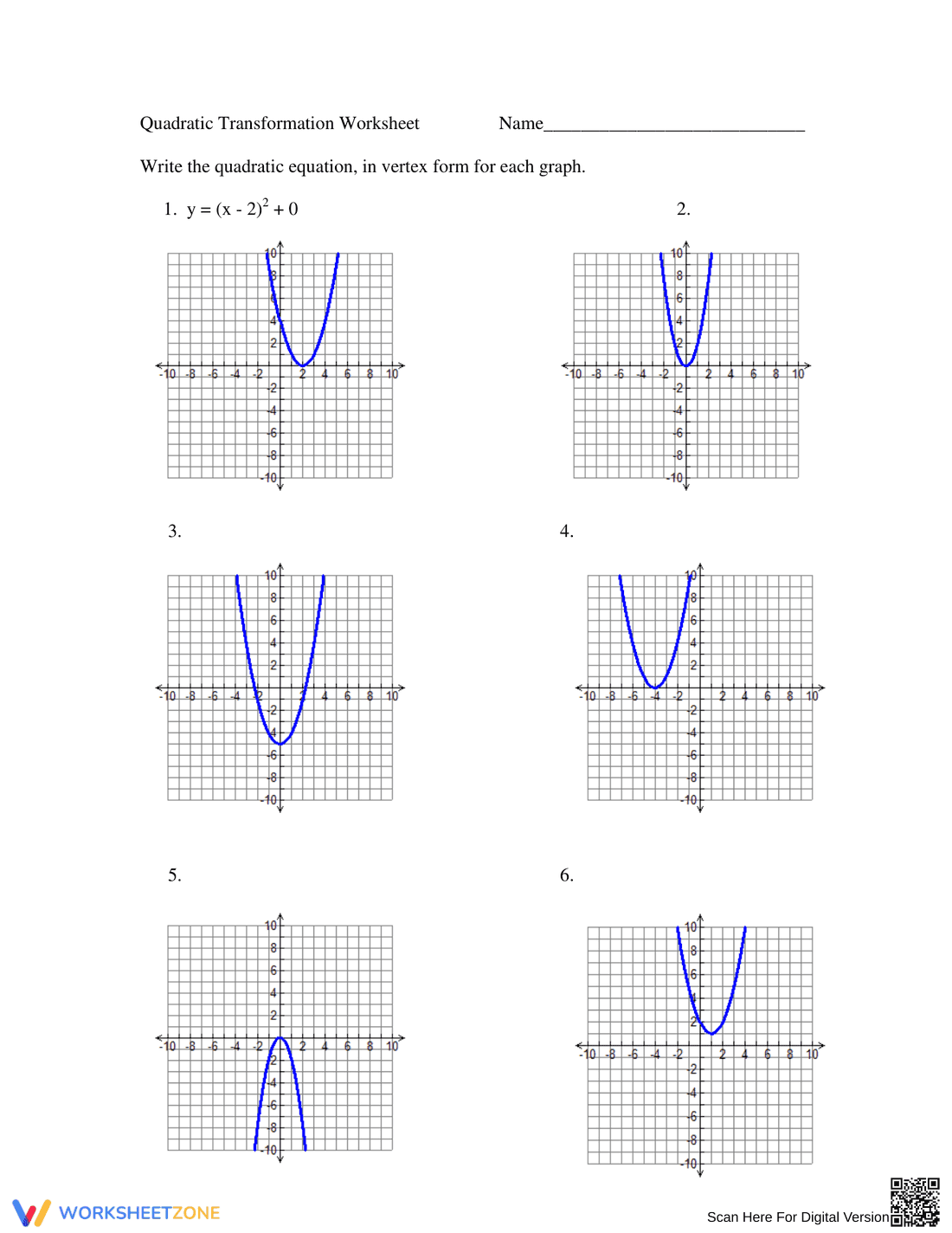
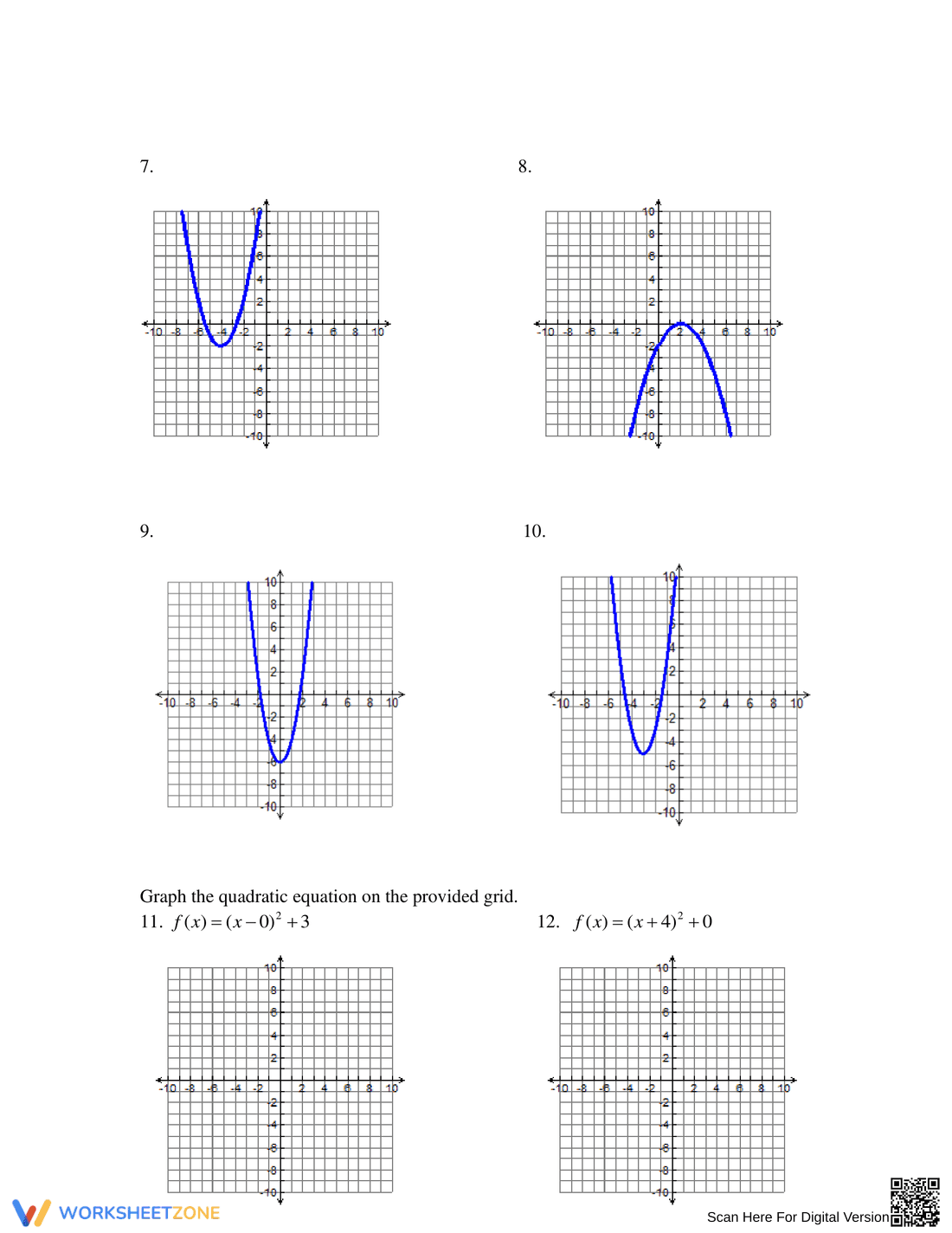
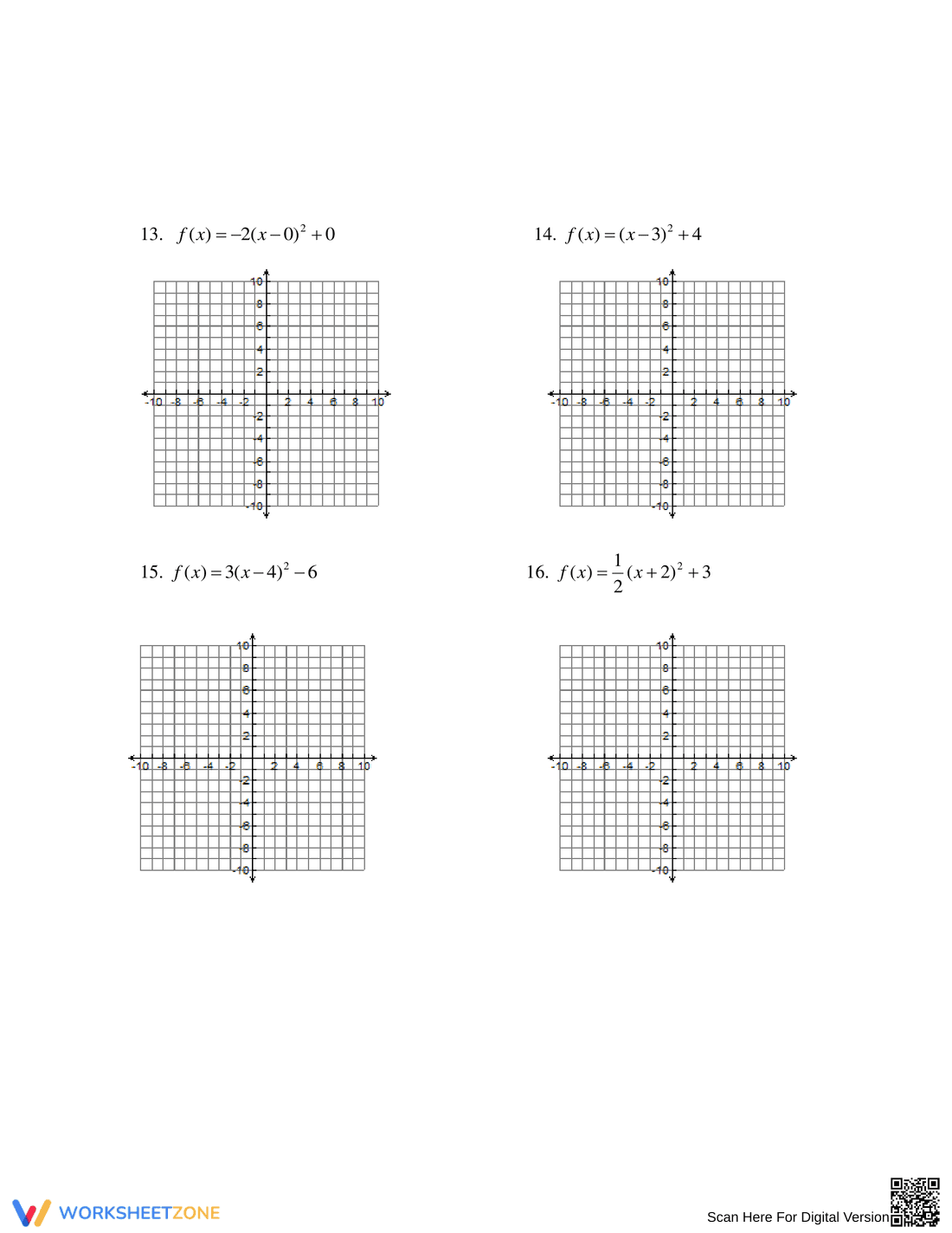
This is a quadratic transformation worksheet. The worksheet contains six different graphs of parabolas plotted on coordinate planes. The task is to write the quadratic equation in vertex form for each of the given graphs. The first question provides an example: y = (x - 2)^2 + 0.
Grade Level Suitability:
This worksheet is suitable for high school students, specifically grades 9-11, who are learning about quadratic functions and their transformations. It requires understanding of vertex form and how to identify the vertex from a graph.
Why Use It:
This worksheet helps students practice identifying key features of quadratic functions from their graphs and translating those features into the vertex form of the equation. It reinforces the relationship between the graphical representation and the algebraic representation of quadratic functions.
How to Use It:
Students should analyze each graph to determine the coordinates of the vertex. Then, they should substitute these coordinates into the vertex form of a quadratic equation: y = a(x - h)^2 + k, where (h, k) is the vertex. The value of 'a' appears to be 1 or -1, based on the example and graph shapes.
Target Users:
The target users are high school students studying algebra or pre-calculus, as well as teachers looking for practice problems on quadratic transformations. It can also be used for test preparation or review.
This is a quadratic transformation worksheet. The worksheet contains six different graphs of parabolas plotted on coordinate planes. The task is to write the quadratic equation in vertex form for each of the given graphs. The first question provides an example: y = (x - 2)^2 + 0.
Grade Level Suitability:
This worksheet is suitable for high school students, specifically grades 9-11, who are learning about quadratic functions and their transformations. It requires understanding of vertex form and how to identify the vertex from a graph.
Why Use It:
This worksheet helps students practice identifying key features of quadratic functions from their graphs and translating those features into the vertex form of the equation. It reinforces the relationship between the graphical representation and the algebraic representation of quadratic functions.
How to Use It:
Students should analyze each graph to determine the coordinates of the vertex. Then, they should substitute these coordinates into the vertex form of a quadratic equation: y = a(x - h)^2 + k, where (h, k) is the vertex. The value of 'a' appears to be 1 or -1, based on the example and graph shapes.
Target Users:
The target users are high school students studying algebra or pre-calculus, as well as teachers looking for practice problems on quadratic transformations. It can also be used for test preparation or review.


