


























Views
Downloads



Factoring Trinomials Worksheet | Grade 9 Printable Math
Paste this activity's link or code into your existing LMS (Google Classroom, Canvas, Teams, Schoology, Moodle, etc.).
Students can open and work on the activity right away, with no student login required.
You'll still be able to track student progress and results from your teacher account.
Factoring quadratic trinomials is a cornerstone of Algebra 1. This worksheet guides students through the process of factoring expressions in the form x² + bx + c by finding integer pairs that satisfy both sum and product requirements. Students will build confidence through scaffolded sections before tackling mixed reviews and challenge problems.
At a Glance
- Grade: 9 · Subject: Mathematics
- Standard:
CCSS.MATH.CONTENT.HSA.SSE.A.3.A— Factor a quadratic expression to reveal the zeros of the function it defines- Skill Focus: Factoring Trinomials (a = 1)
- Format: 4 pages · 20 problems · Answer key included · PDF
- Best For: Independent practice and algebraic skill building
- Time: 30–45 minutes
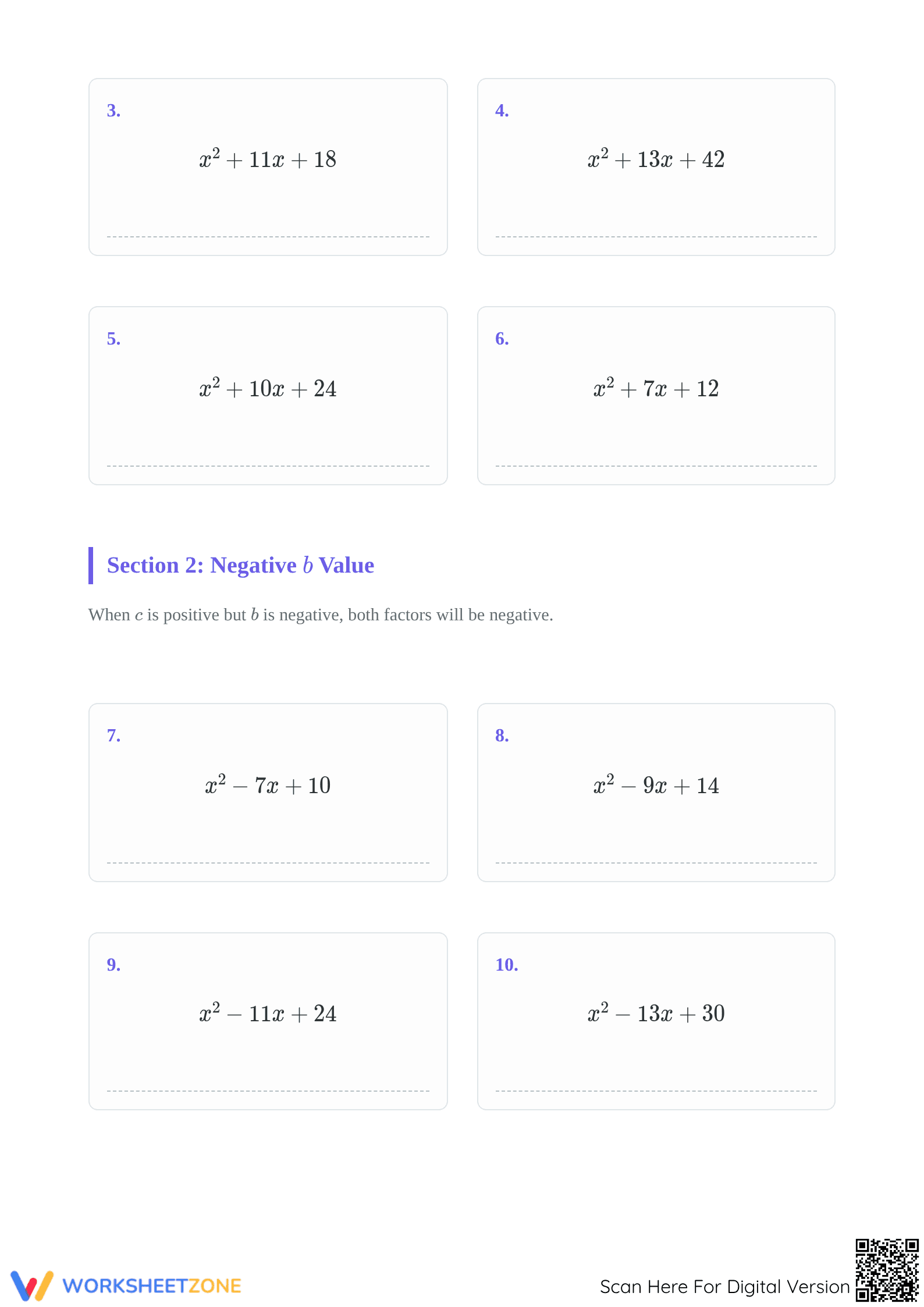
This comprehensive 4-page PDF contains 20 problems organized into instructional tiers. It begins with an "Essential Concept" anchor box that provides a clear worked example and the fundamental rule for factoring. The worksheet is divided into sections covering all-positive terms, negative b-values, negative c-values, and a mixed review section. It concludes with two higher-order challenge problems and includes a full answer key.
Skill Progression
- Guided Practice: The first section features 6 problems with all positive terms, allowing students to focus on the core "sum and product" mechanic without sign complexity.
- Supported Practice: Sections 2 and 3 introduce negative values for coefficients, requiring students to apply integer operation rules to find the correct factor pairs.
- Independent Practice: The final sections provide a mixed review of all sign combinations followed by challenge problems that test mastery with larger constants.
This gradual-release model follows the structured instructional approach, starting with a clear example and moving toward unassisted problem-solving.
Standards Alignment
The primary standard addressed is CCSS.MATH.CONTENT.HSA.SSE.A.3.A — Choose and produce an equivalent form of an expression to reveal and explain properties of the quantity represented by the expression. This worksheet specifically targets sub-standard A: "Factor a quadratic expression to reveal the zeros of the function it defines." Both standard codes can be copied directly into lesson plans, IEP goals, or district curriculum mapping tools.
How to Use It
This resource is ideal for the independent practice phase of a lesson on quadratic equations. Use the first page for guided practice immediately following direct instruction to check for initial understanding. Alternatively, assign the packet as a formative assessment to evaluate student ability to manage signs while factoring. Expect most students to complete the primary 18 problems within 30 minutes, with the challenge problems serving as a natural extension for early finishers.
Who It's For
This worksheet is designed for Grade 9 Algebra students but serves as an excellent remediation tool for high schoolers struggling with higher-level polynomial operations. The included scaffolding makes it appropriate for general education classrooms as well as students with IEP goals focused on procedural fluency. It pairs naturally with a quadratic graphing lesson or a factoring anchor chart.
Standard CCSS.MATH.CONTENT.HSA.SSE.A.3.A requires students to transform quadratic expressions to uncover essential mathematical properties, a skill EdReports (2024) identifies as critical for college readiness. Research from Fisher & Frey (2014) emphasizes procedural fluency in factoring is best achieved through structured practice addressing common misconceptions like integer sign errors. This worksheet provides that exact structure by isolating variables and signs before mixed review. Focusing on trinomials where the leading coefficient is one, students master the fundamental logic of factor pairs before advancing to complex decomposition methods. This targeted approach ensures the underlying relationship between coefficients and factors is solidified, which ScienceDirect TpT Analysis suggests is a primary predictor of success in subsequent STEM coursework. The 20 problems offer repetition for mastery, while the challenge section provides cognitive demand for deep conceptual understanding.


