


























Views
Downloads
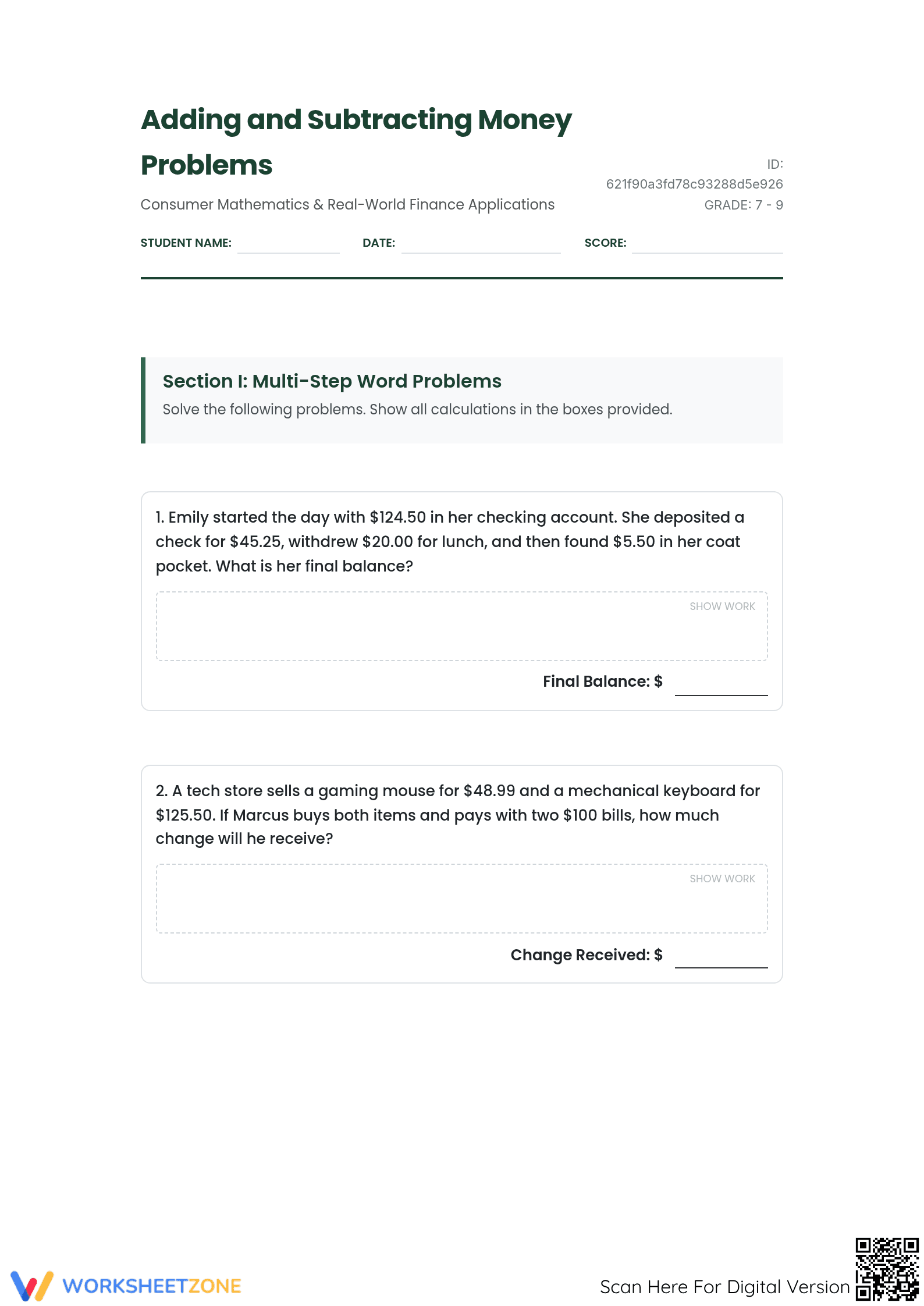
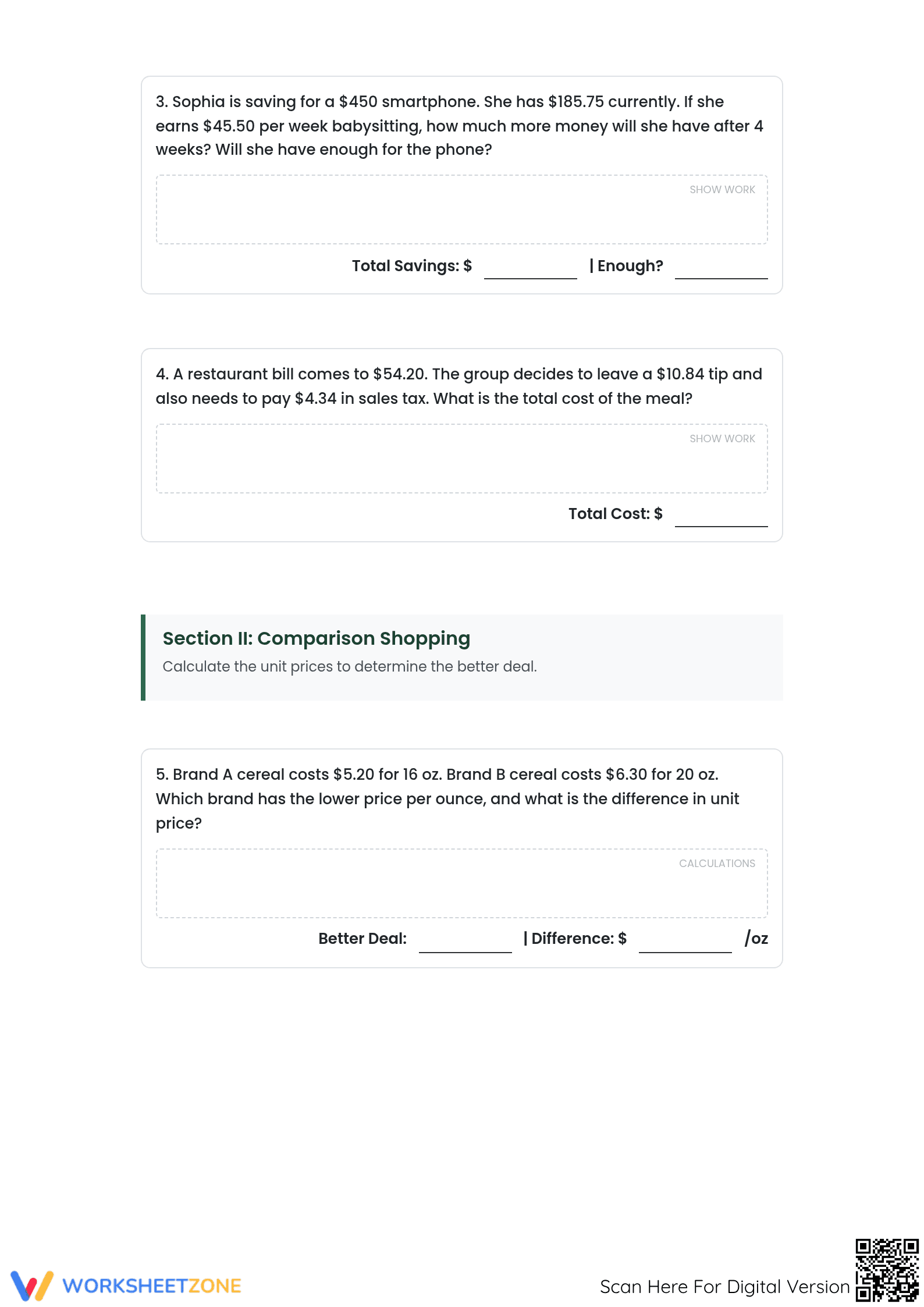
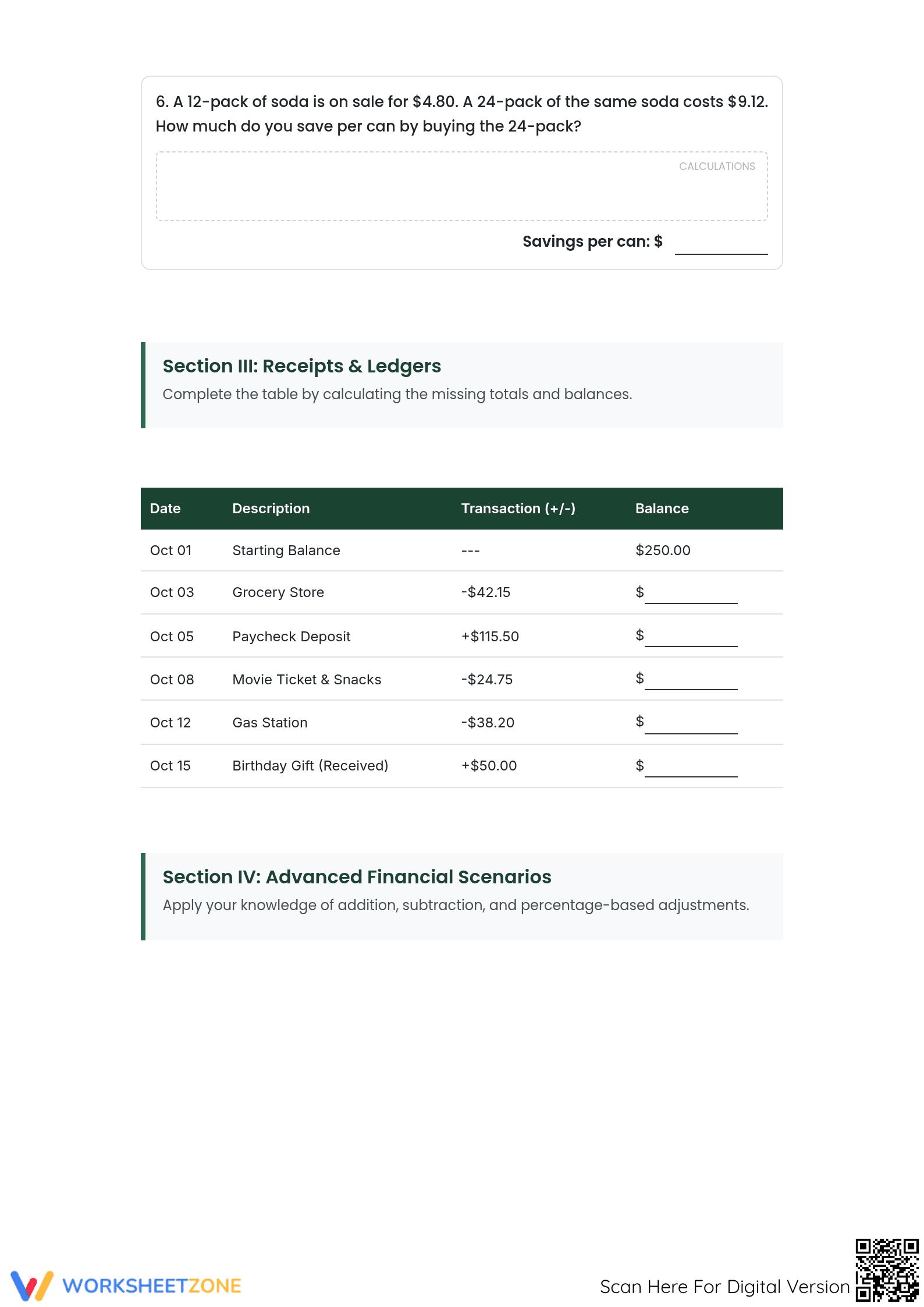
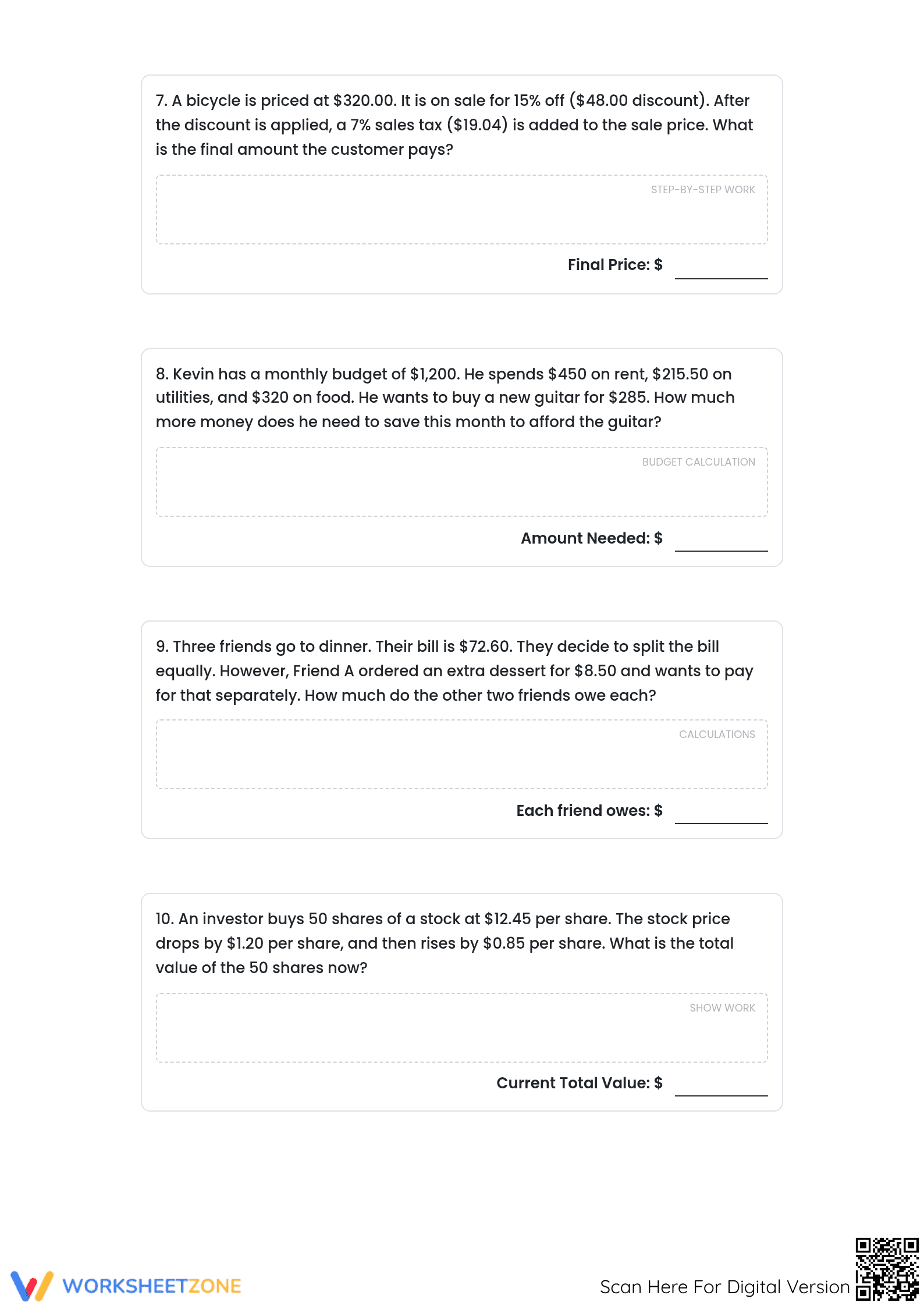

Grade 7 Money Problems: CCSS.MATH.7.EE.B.3 Aligned Worksheet
Paste this activity's link or code into your existing LMS (Google Classroom, Canvas, Teams, Schoology, Moodle, etc.).
Students can open and work on the activity right away, with no student login required.
You'll still be able to track student progress and results from your teacher account.
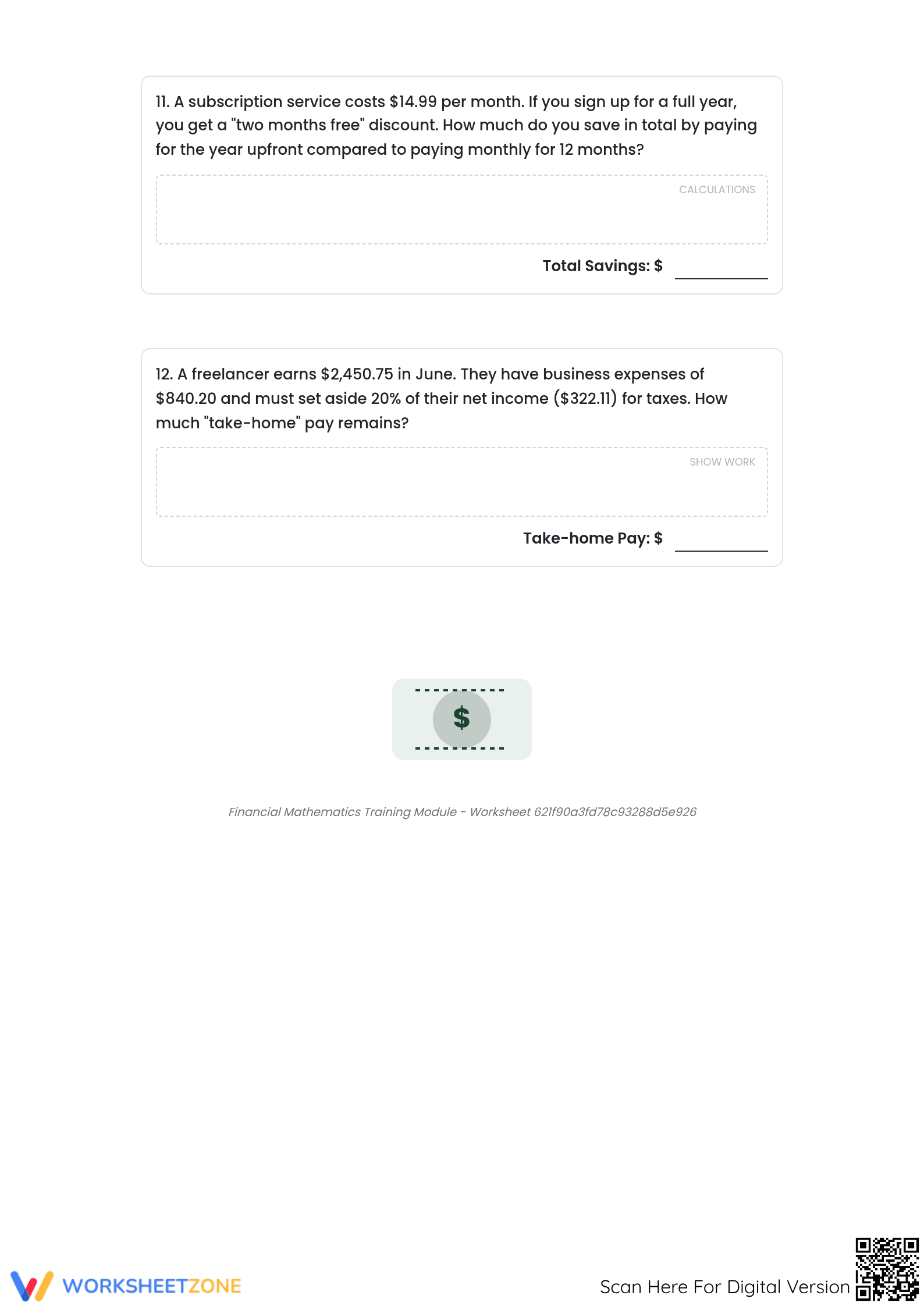
This comprehensive worksheet helps Grade 7 students apply mathematical concepts to authentic financial situations. Through a series of multi-step word problems, learners will practice calculating discounts, taxes, unit prices, and budgets. The exercises are designed to build proficiency in solving real-world money problems, a critical life skill.
At a Glance
- Grade: 7–9 · Subject: Math
- Standard:
CCSS.MATH.CONTENT.7.EE.B.3— Solve multi-step, real-life problems with rational numbers in any form.- Skill Focus: Consumer Math Word Problems
- Format: 5 pages · 12 problems · Answer key included · PDF
- Best For: Application practice, formative assessment, financial literacy unit
- Time: 35–50 minutes
What's Inside
This five-page packet contains 12 distinct problems organized into four sections: Multi-Step Word Problems, Comparison Shopping, Receipts & Ledgers, and Advanced Financial Scenarios. Tasks range from simple balance calculations to complex problems involving percentages and budgeting. A complete answer key is provided for easy grading or student self-checking.
Evidence of Mastery
The worksheet provides clear evidence of mastery for standard CCSS.MATH.7.EE.B.3. Each of the 12 problems requires students to deconstruct a real-world scenario, apply the correct operations with decimals and percentages, and calculate a precise answer. The tasks progress in complexity, starting with two-step problems and building to scenarios requiring multiple calculations (e.g., discount then tax). A teacher can use student performance on this worksheet as direct evidence for standards-based gradebooks or to inform IEP progress monitoring on applied mathematics goals.
Standards Alignment
This resource is directly aligned to Common Core standard CCSS.MATH.CONTENT.7.EE.B.3, which requires students to "Solve multi-step real-life and mathematical problems posed with positive and negative rational numbers in any form (whole numbers, fractions, and decimals), using tools strategically." The worksheet also supports CCSS.MATH.CONTENT.7.RP.A.3 by having students solve multi-step ratio and percent problems. Both standard codes can be copied directly into lesson plans, IEP goals, or district curriculum mapping tools.
How to Use It
Use this worksheet after a direct instruction lesson on percentages and multi-step equations. It serves as an ideal independent practice or a partner activity. For formative assessment, observe which part of the problem-solving process students struggle with: identifying the operation, setting up the calculation, or executing the arithmetic. The full packet can be assigned as a summative quiz for a financial literacy unit, with an expected completion time of 35 to 50 minutes.
Who It's For
This worksheet is designed for middle school students (Grades 7-9) working on applying math skills to financial contexts. The real-world scenarios are engaging for this age group. For students needing support, pair this worksheet with an anchor chart of "clue words" for operations (e.g., "deposit" = add, "discount" = subtract). For an extension, have students create their own multi-step money problem.
This worksheet provides targeted practice for CCSS.MATH.CONTENT.7.EE.B.3, focusing on solving multi-step, real-world problems with rational numbers. Developing this procedural fluency in a consumer context is critical for financial literacy. The RAND AIRS 2024 study on effective math interventions emphasizes that students need repeated opportunities to apply skills in varied, authentic contexts to achieve mastery and transfer. The 12 problems in this packet offer exactly that, moving from simple transactions to complex scenarios involving discounts, taxes, and budgeting. This progression helps students build a robust understanding of how mathematics applies to everyday financial decisions, a key predictor of long-term economic well-being. By grounding abstract operations in concrete, relatable situations, this resource helps solidify both conceptual understanding and procedural skill.


