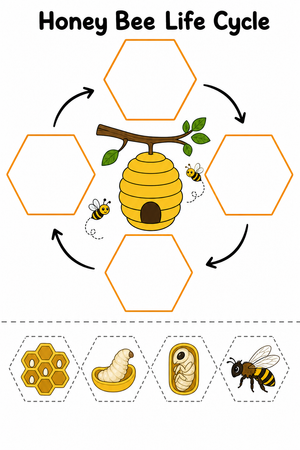
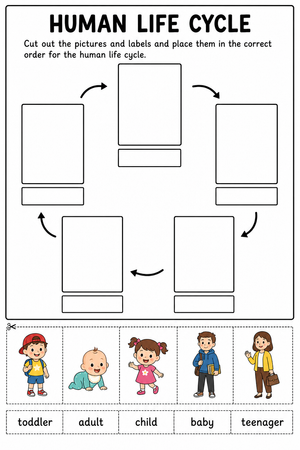
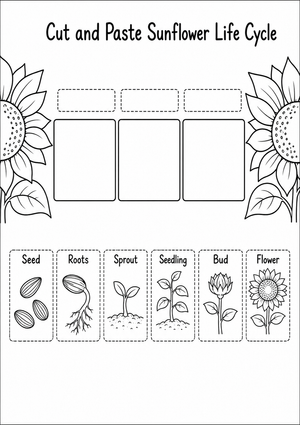
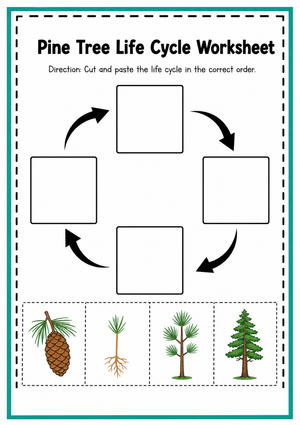
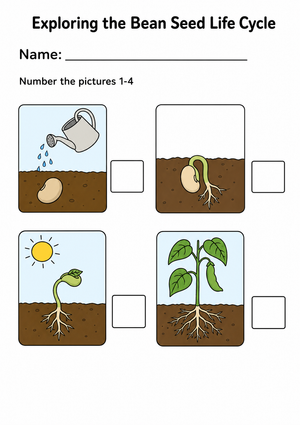
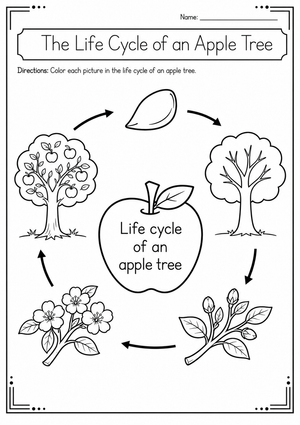
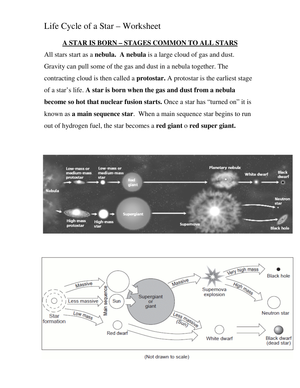
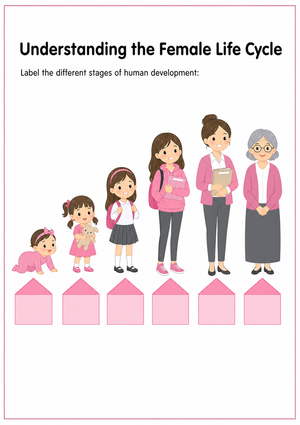
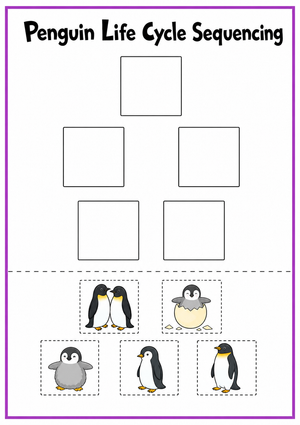
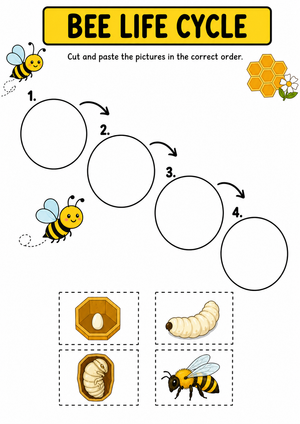
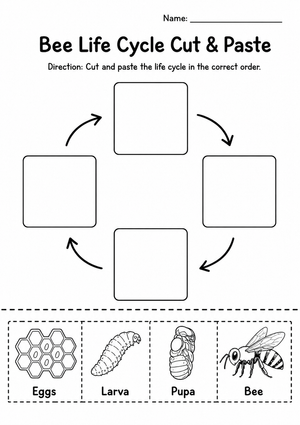
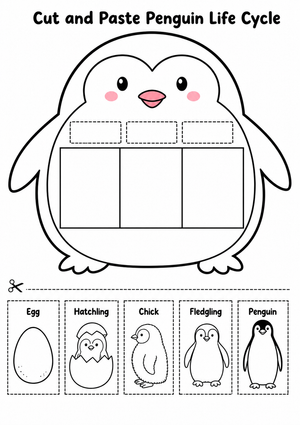
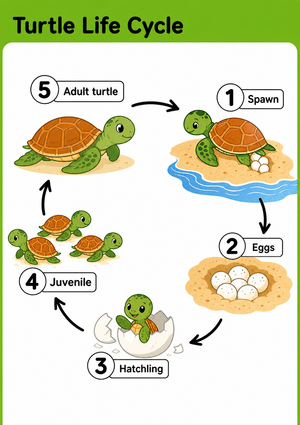
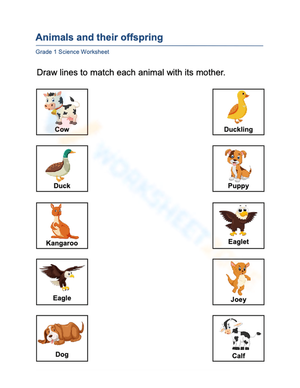
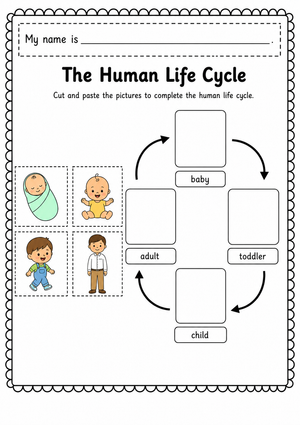
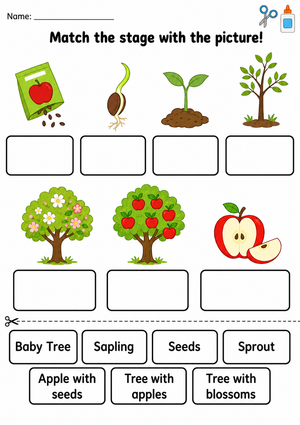
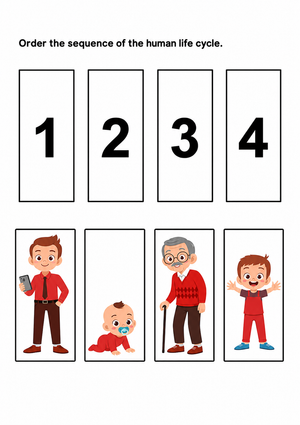
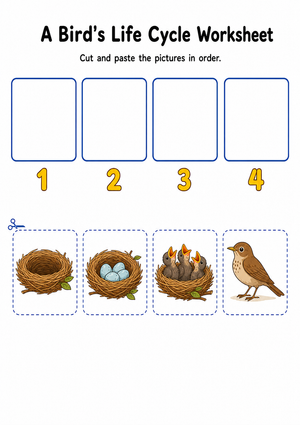
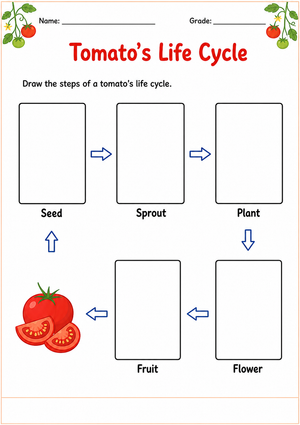
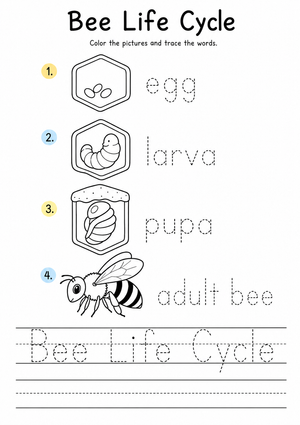
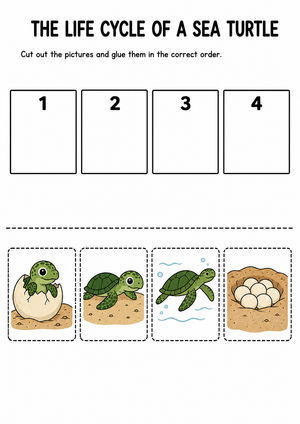
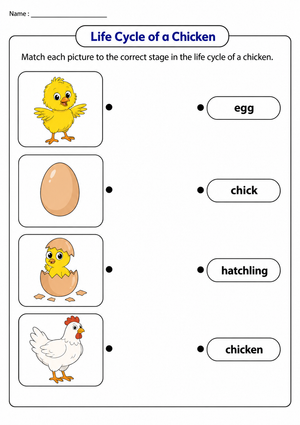
These life cycle printable worksheets for kindergarten give teachers a hands-on entry point into one of early science's most visually rich concepts — the idea that a living thing doesn't stay fixed, but moves through ordered, repeating stages. The set covers butterfly, frog, chicken, apple, and pumpkin cycles through cut-and-paste sequencing, vocabulary matching, labeling, and blank recall templates that ask students to recreate a cycle from memory.
What's Inside the Set
Each organism gets its own worksheet built around a different task type, so the set doesn't feel repetitive even when students work through multiple rounds in the same week.
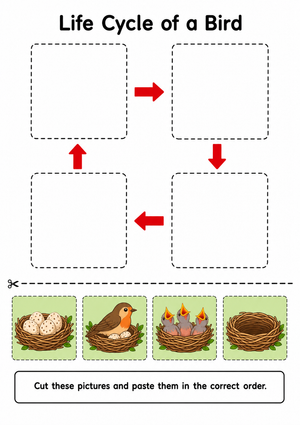
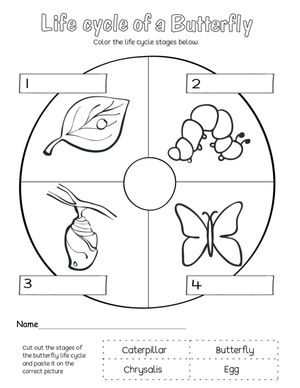
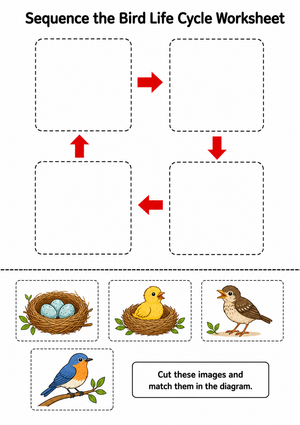
- Cut-and-paste sequencing: Students cut illustrated stage cards and arrange them in order before gluing — the right starting point for students new to the concept of ordered biological stages.
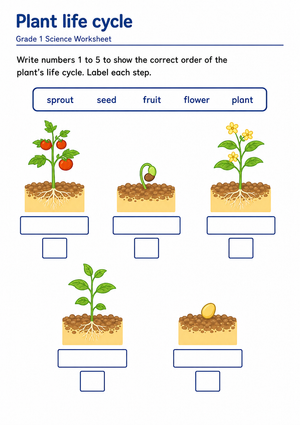
- Labeling tasks: Stage names (egg, caterpillar, chrysalis, adult; seed, sprout, seedling, plant) appear in a word bank. Students write or trace the correct term beneath each illustration.
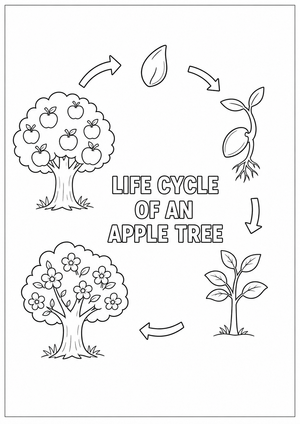
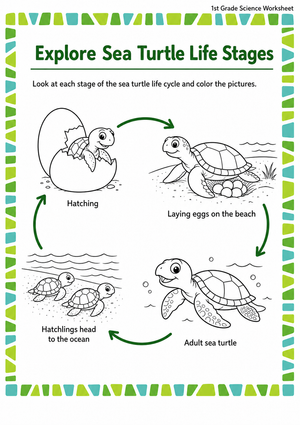
- Arrow diagrams: A handful of worksheets include blank arrows connecting the stages, asking students to recognize that the cycle returns to its starting point — not a linear end.
- Vocabulary matching: Stage names pair with their illustrations, building specific terminology — tadpole, froglet, chrysalis, germinate — that reappears in first-grade science units.
- Blank recall templates: Students redraw a familiar cycle from memory into empty boxes. The cognitive demand is noticeably higher than ordering pre-printed cards, so these work best after students have practiced the sequence at least once with support.
Mistakes Students Make That These Worksheets Surface
The most consistent error in kindergarten life cycle work is scrambling the middle stages while correctly anchoring the first and last. In the butterfly cycle, most students place the egg first and the adult last without hesitation — but the caterpillar-to-chrysalis sequence trips them up repeatedly, especially when a worksheet illustration shows a fat, late-stage caterpillar that doesn't look visually distinct from the chrysalis in color or shape. Addressing this before students cut anything prevents a lot of incorrect gluing that's hard to undo.
A second error is structural. Students who complete the butterfly cycle first often carry its four-stage logic into every other organism. When they reach the chicken cycle, some look for a metamorphosis stage that doesn't exist — they'll sequence the egg correctly, then search for a "transformation" picture, and when they can't find one, they guess wrong out of confusion rather than ignorance. Two minutes of explicit comparison ("chickens hatch and keep growing bigger — they don't change shape the way butterflies do") prevents most of this before it starts.
There's also a terminology trap worth flagging. Chrysalis applies to butterfly pupae; cocoon applies to moths. Students hear both terms at home and in picture books and use them interchangeably, and some worksheets on the market inadvertently reinforce the confusion through inconsistent labeling. These worksheets use chrysalis throughout the butterfly materials, so teachers should plan to address the distinction directly rather than waiting for students to absorb it on their own.
Fitting These Worksheets Into Your Weekly Routine
Life cycle printable worksheets for kindergarten slot naturally into three points in the school week. The first is as a follow-up to read-aloud — spend 10 minutes with a text like The Very Hungry Caterpillar or a nonfiction frog book, then send students to their seats to complete the matching cut-and-paste while the sequence is still fresh. The second is science center rotation: laminate a set of stage cards for a sorting center so students can practice the order without glue, giving the teacher time to see who gets it and who doesn't before the formal worksheet becomes an assessment artifact. The third spot is Friday review — one blank recall template with no word bank, no picture prompts, just empty boxes. It tells you exactly what stuck from the week.
For cut-and-paste tasks specifically: give each student a small tray, a paper plate, or a folded piece of construction paper to rest their cut pieces in before gluing. Students who skip this step spend 30 seconds gluing and three minutes hunting for the chrysalis card that slid under someone else's chair. The tray takes five seconds to distribute and eliminates almost all the lost-piece frustration.
If the class has a live observation running — a butterfly habitat, a bean-sprouting cup, a tank with tadpoles — pair that observation with the corresponding worksheet on the same day. The concrete experience and the representational task reinforce each other in a way that either alone doesn't achieve as reliably.
Standard Alignment
These resources connect most directly to NGSS K-LS1-1, which asks students to use observations to describe patterns of what plants and animals need to survive. Life cycle sequencing supports this standard by prompting students to think about what an organism looks like and requires at each stage — a caterpillar needs leaves; a chrysalis needs time and protection; an adult butterfly feeds on nectar. The explicit sequencing standard (1-LS3-1, focused on parent-offspring resemblance and growth patterns) arrives formally in first grade, so these life cycle printable worksheets for kindergarten serve dual purposes: they address grade-level science content while building the conceptual readiness students need for what comes next. Teachers in districts following the NSTA early childhood science guidelines will also find that the observation and investigation emphasis in these tasks aligns with the investigative goals outlined in that framework.
Adapting the Set for Mixed-Ability Groups
For students still developing fine motor control, pre-cut the stage cards so the cognitive work — sequencing and labeling — stays the focus. Alternatively, keep the scissors work but limit early tasks to three-stage cycles (seed → seedling → plant) before introducing the four-stage butterfly or frog sequences. Three steps is a meaningful reduction in working memory load at this age, and students who master it cleanly are ready to move to four stages within the same unit.
Students who sequence accurately and quickly move to the blank recall templates, which ask them to draw each stage rather than cut a pre-made illustration. This shifts the task from recognition to production — a genuinely harder demand. For students ready for an additional stretch, ask them to dictate or write one sentence about what the organism needs at each stage. That single addition turns these life cycle printable worksheets for kindergarten into a genuine cross-curricular task, layering science vocabulary and early writing into a single activity without requiring a separate worksheet.
Frequently Asked Questions
Which organisms work best for kindergarten life cycle instruction?
Butterfly, frog, chicken, apple, and pumpkin cycles are the most classroom-tested at this level. They share two useful traits: visually distinct differences between stages, and enough real-world familiarity that students arrive with some prior knowledge. Avoid starting with organisms whose middle stages look nearly identical — save those for after students have internalized what a stage sequence even means, using a clearer example first.
How do these worksheets work with pre-readers?
Run labeling and vocabulary-matching tasks as teacher-directed whole-group activities first, completing the written portions together before students work independently. Students who can't yet decode stage names can still point to the correct picture during group discussion, which tells you they understand the concept even when the written output is incomplete. The cut-and-paste sequencing tasks require no reading at all and are genuinely accessible to pre-readers from the start.
How do these worksheets function as assessment evidence?
The cut-and-paste versions show process — you can observe how a student sequences in real time and address errors before they get glued down. The blank recall templates work as summative evidence: a student who can draw and label all four butterfly stages without any prompts has internalized both the sequence and the vocabulary. Both formats produce a physical artifact suitable for a portfolio or a parent conference conversation about where a student stands in early science reasoning.












 Interactive Worksheet Maker
 Quiz Maker
 Word Search Maker
 Crossword Puzzle Maker
 Word Scramble Generator
 Sentence Scramble Generator
 Handwriting Worksheet Generator
 Name Tracing Generator
 Fill In The Blank Generator