




























Views
Downloads
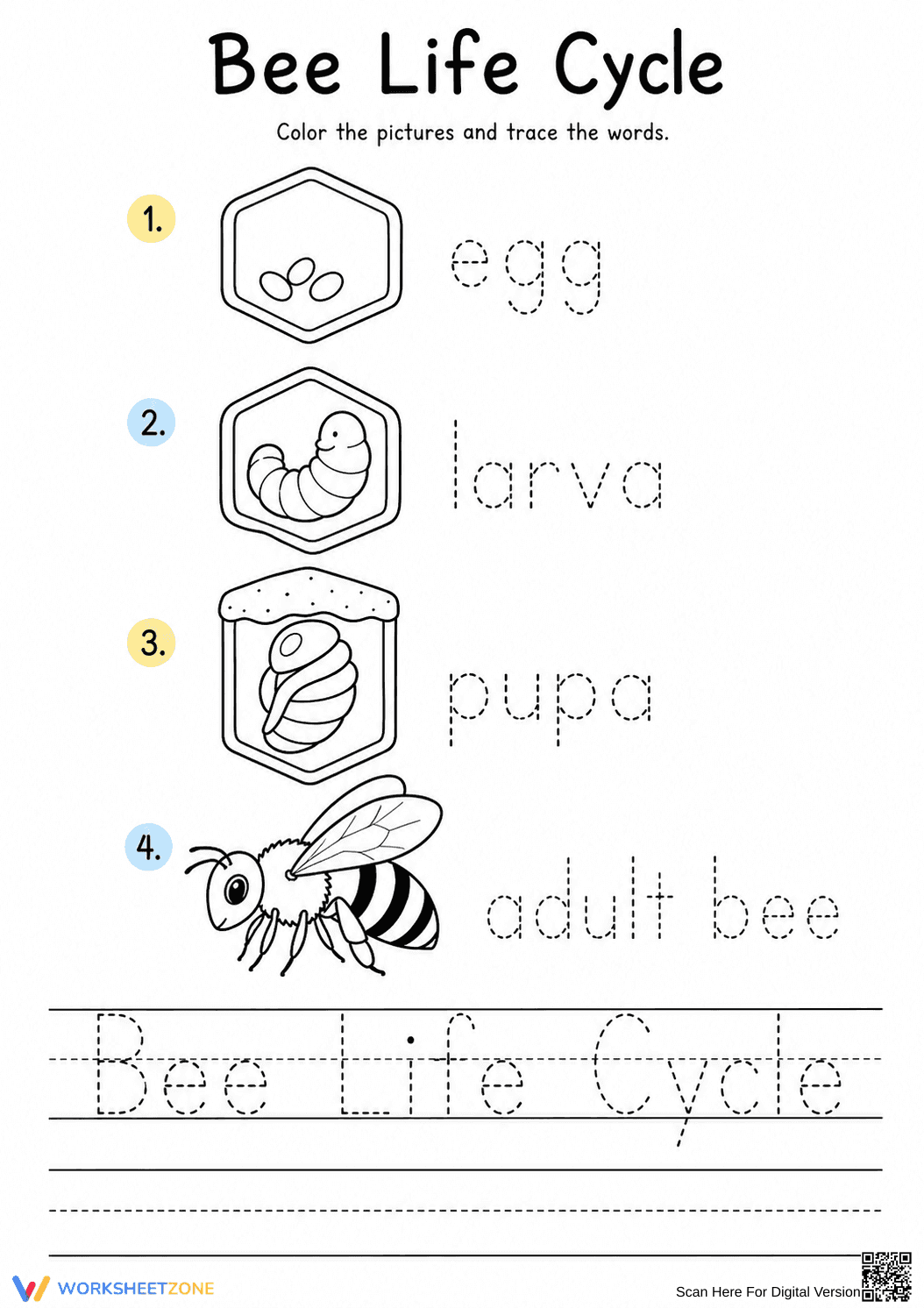

Printable Bee Life Cycle Tracing Worksheet | Grade 1

Paste this activity's link or code into your existing LMS (Google Classroom, Canvas, Teams, Schoology, Moodle, etc.).
Students can open and work on the activity right away, with no student login required.
You'll still be able to track student progress and results from your teacher account.
This foundational science worksheet introduces early learners to the honey bee life cycle while reinforcing essential fine motor skills. Students observe the four stages of development—egg, larva, pupa, and adult—and complete a handwriting tracing activity to build vocabulary and letter formation confidence.
At a Glance
- Grade: 1 · Subject: Science
- Standard:
1-LS3-1— Observe how young animals change and grow- Skill Focus: Life cycles and handwriting
- Format: 1 page · 5 tasks · No answer key needed · PDF
- Best For: Morning work or science centers
- Time: 10–15 minutes
This single-page resource features an easy-to-color diagram illustrating the honey bee's life. The visual model includes four stages with simple labels. Below the diagram, a guided tracing section provides dashed letters for the phrase "Bee Life Cycle," offering targeted handwriting practice. The black-and-white design doubles as a coloring page, keeping students engaged.
This resource requires zero teacher preparation:
- Print (1 minute): The black-and-white PDF format is optimized for quick, low-ink copying for the entire class.
- Distribute (1 minute): Hand out the sheets along with crayons and pencils. No special materials or complex instructions are needed.
- Review (3 minutes): Briefly discuss the four stages shown in the diagram before students begin tracing and coloring.
With a total prep time of under two minutes, this worksheet is an excellent addition to emergency sub plans or spontaneous science extensions.
This activity aligns with 1-LS3-1, prompting students to make observations to construct an evidence-based account that young animals are like, but not exactly like, their parents. By observing differences between the larva, pupa, and adult bee, students build foundational knowledge. Both standard codes can be copied directly into lesson plans, IEP goals, or district curriculum mapping tools.
Teachers can utilize this worksheet during a dedicated spring science unit or as a cross-curricular literacy center. When used before direct instruction, the diagram serves as a visual anchor to spark curiosity about insects. As a formative assessment observation tip, watch how students trace the letters; ensure they are forming the curves of the 'B' and 'C' correctly while maintaining proper pencil grip. Expected completion time ranges from 10 to 15 minutes.
This printable is ideal for Kindergarten and Grade 1 students developing their fine motor control and basic life science vocabulary. For differentiation, teachers can challenge advanced learners to write a sentence about their favorite life cycle stage on the back of the page. It pairs perfectly with a read-aloud book about honey bees or a classroom anchor chart detailing insect anatomy.
Integrating fine motor practice with foundational science concepts accelerates early childhood cognitive development. According to a recent analysis by EdReports 2024, cross-curricular materials that combine visual models with physical writing tasks significantly improve both vocabulary retention and letter formation in primary grades. This worksheet supports 1-LS3-1 by helping students observe how young animals change and grow through distinct developmental phases. By tracing the terminology immediately after observing the visual model, young learners reinforce the neural pathways associated with both the scientific concept and the physical act of writing. This approach provides a developmentally appropriate entry point into complex biological systems for early learners, ensuring that students build essential literacy skills while exploring the natural world. This method sets a strong foundation for future scientific inquiry and academic success.


