




























Views
Downloads
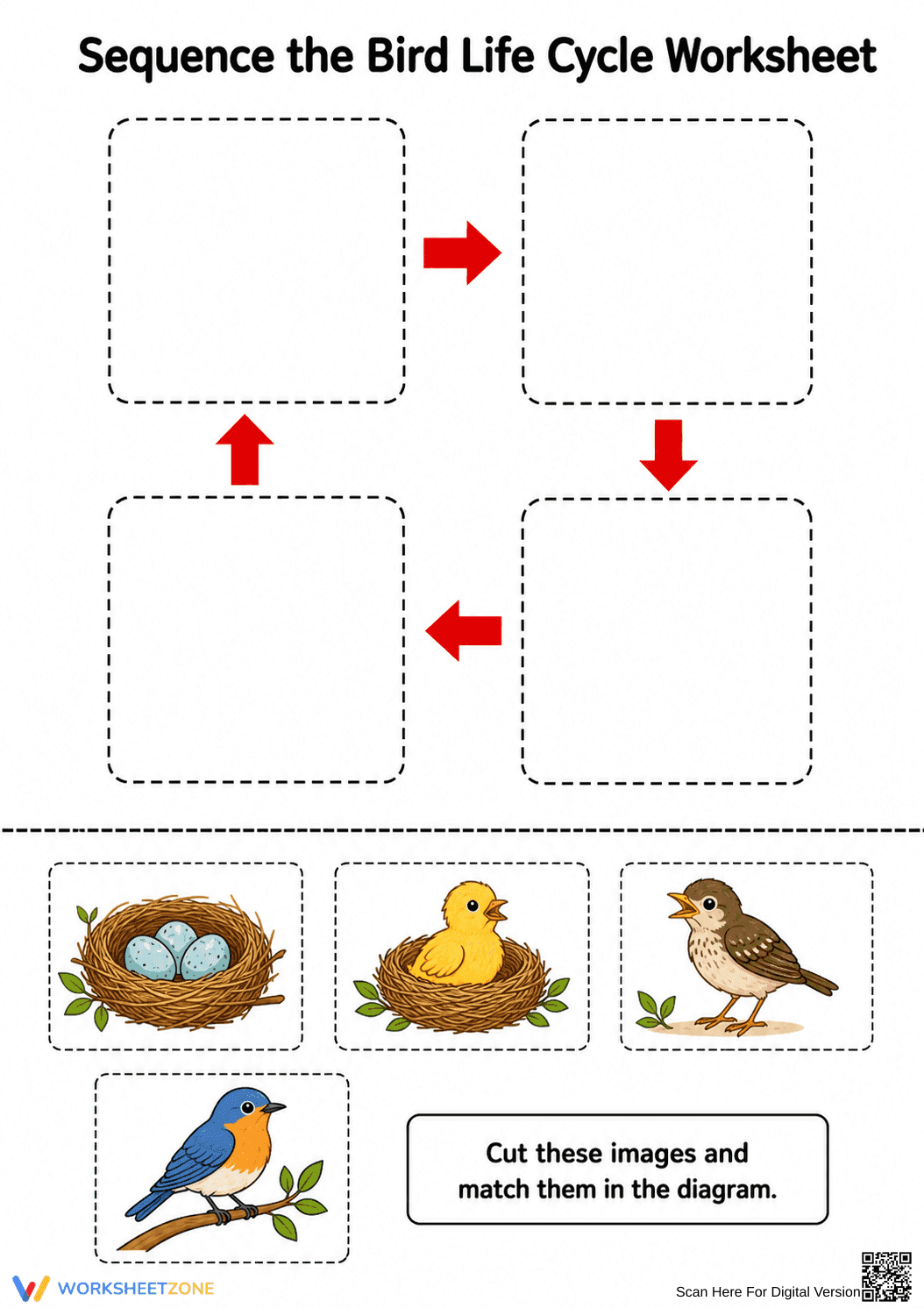

Bird Life Cycle Worksheet | Grade 1 Essential Printable

Paste this activity's link or code into your existing LMS (Google Classroom, Canvas, Teams, Schoology, Moodle, etc.).
Students can open and work on the activity right away, with no student login required.
You'll still be able to track student progress and results from your teacher account.
This bird life cycle worksheet provides a hands-on approach for students to master the biological stages of avian development. By sequencing the progression from egg to adult, learners build a concrete understanding of how living things grow and change over time. This activity transforms abstract science concepts into a tactile learning experience that improves retention and engagement.
At a Glance
- Grade: 1 · Subject: Science
- Standard:
1-LS1-2— Use media to determine patterns in how organisms grow and survive- Skill Focus: Life cycle sequencing
- Format: 1 page · 4 tasks · Answer key included · PDF
- Best For: Science centers and morning work
- Time: 15–20 minutes
What's Inside: This single-page PDF features a clear, circular flow diagram with four designated placement zones. The bottom section contains four high-quality illustrations: a nest with eggs, a newly hatched chick, a fledgling, and a mature adult bird. The layout includes dashed cutting lines to assist young learners with scissor skills and a clear instructional prompt for independent completion.
The zero-prep workflow for this resource is designed for maximum efficiency. First, print the required number of copies (30 seconds). Second, distribute the sheets along with scissors and glue sticks (1 minute). Third, conduct a quick whole-class review of the completed cycles to check for understanding (5 minutes). Total teacher preparation time is under 2 minutes, making this an ideal solution for emergency sub plans or transition periods.
Standards Alignment: This resource aligns with `1-LS1-2`, requiring students to use media or observations to identify patterns in how organisms live and grow. It also supports `K-LS1-1` by helping students describe what animals need to survive at different stages. Both standard codes can be copied directly into lesson plans, IEP goals, or district curriculum mapping tools.
How to Use It: Deploy this worksheet during the "Explore" phase of a 5E science lesson to allow students to hypothesize the correct order of bird growth. It also serves as an excellent formative assessment tool after a read-aloud about birds. Teachers should observe students during the cutting phase to identify those who may need additional fine motor support. Expect most students to finish within 15 to 20 minutes.
Who It's For: This activity is tailored for Kindergarten through 2nd-grade students, particularly those who benefit from visual and kinesthetic learning. It is highly effective for English Language Learners (ELLs) because the pictorial representations provide context without heavy text reliance. Pair this worksheet with a non-fiction bird passage or a classroom anchor chart for a comprehensive science unit.
According to the RAND AIRS 2024 report on early childhood science education, tactile sequencing activities significantly improve a student's ability to internalize chronological biological processes. This worksheet utilizes those findings by requiring students to physically manipulate the 4 stages of the bird life cycle, reinforcing the 1-LS1-2 standard through active participation. Research from Fisher & Frey (2014) suggests that visual scaffolds in primary science help bridge the gap between observation and conceptual mastery. By focusing on the specific patterns of avian growth, this resource provides the structured practice necessary for young learners to meet state and national science frameworks. The clear distinction between the hatchling and fledgling stages helps students recognize subtle developmental changes, a key component of early scientific observation skills. This printable serves as a reliable tool for building foundational literacy in life sciences while supporting fine motor development in early elementary classrooms.


