


























Views
Downloads
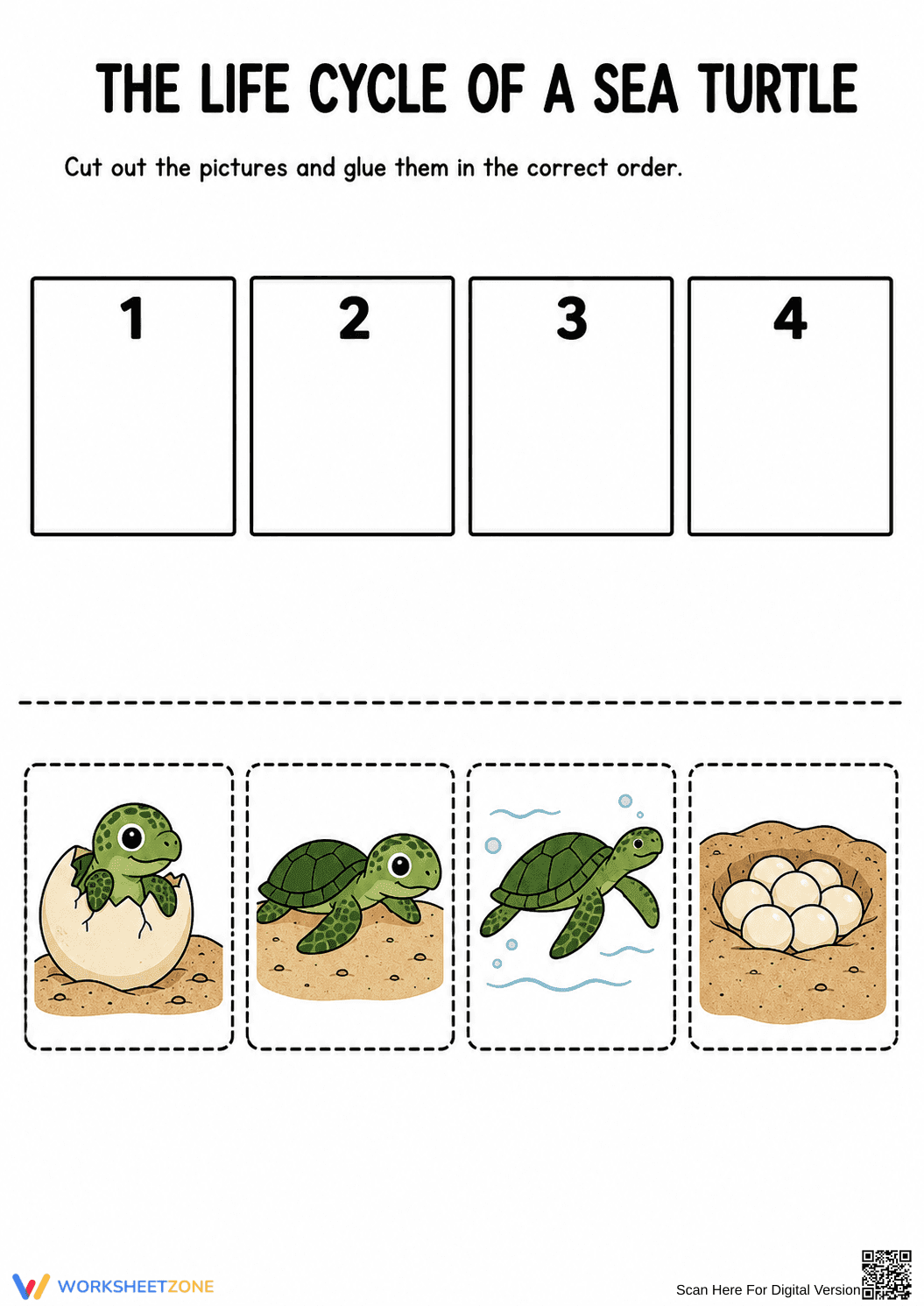

Grade 1 Sea Turtle Life Cycle — Printable No-Prep Worksheet
Paste this activity's link or code into your existing LMS (Google Classroom, Canvas, Teams, Schoology, Moodle, etc.).
Students can open and work on the activity right away, with no student login required.
You'll still be able to track student progress and results from your teacher account.
This Grade 1 science worksheet helps students master animal life cycles by sequencing the developmental stages of a sea turtle. Young learners will cut out four distinct illustrations and paste them in the correct chronological order, building essential fine motor skills while reinforcing foundational biology concepts.
At a Glance
- Grade: 1 · Subject: Science
- Standard:
1-LS3-1— Observe and sequence the developmental stages of an animal- Skill Focus: Life Cycle Sequencing
- Format: 1 page · 4 problems · Answer key not included · PDF
- Best For: Independent practice
- Time: 10–15 minutes
This single-page printable features a clear, four-step sequencing activity. The top half provides four numbered blank boxes, while the bottom half contains a dashed cut-out section with four illustrations: eggs, a hatching turtle, a hatchling on sand, and a swimming turtle. The layout relies on minimal text, making it highly accessible for early readers.
Zero-Prep Workflow
- Print (1 minute): Generate the PDF and print a class set. No special materials are required beyond standard scissors and glue sticks.
- Distribute (1 minute): Hand out the sheets along with the necessary cutting and pasting supplies.
- Review (3 minutes): Briefly explain the four stages of a sea turtle's development before letting students work independently.
Total teacher preparation takes under two minutes. Because the instructions are straightforward, this resource functions perfectly as an emergency sub plan or morning work assignment.
Standards Alignment
This activity aligns with 1-LS3-1: Make observations to construct an evidence-based account that young plants and animals are like, but not exactly like, their parents. Students observe how the sea turtle develops over time. Both standard codes can be copied directly into lesson plans, IEP goals, or district curriculum mapping tools.
How to Use It
Deploy this worksheet during independent practice in an animal life cycles unit. It works exceptionally well after reading a picture book about sea turtles. Alternatively, use it as a science center station where students finish in 10 to 15 minutes. For a quick formative assessment, watch how students arrange the cut-outs before gluing to correct any misconceptions immediately.
Who It's For
This resource is designed for first-grade students, though appropriate for kindergarteners needing fine motor practice. To support students who struggle with scissors, teachers can pre-cut the image tiles. Pair this task with an anchor chart detailing other oviparous animals to encourage comparative thinking.
Integrating hands-on sequencing tasks into early elementary science instruction significantly reinforces the conceptual retention of biological processes. When students observe and sequence the developmental stages of an animal, they actively engage with the material rather than passively receiving information. This aligns directly with the expectations of 1-LS3-1, requiring learners to construct evidence-based accounts of animal growth and change. According to a ScienceDirect TpT Analysis, interactive cut-and-paste activities improve both fine motor coordination and chronological reasoning in young learners. By physically moving the stages of a sea turtle's life into the correct order, students build a much stronger mental model of biological development. This tactile approach ensures that foundational science concepts are anchored in observable, sequential logic, providing a critical stepping stone for more complex life science topics in later grades.


