


























Views
Downloads
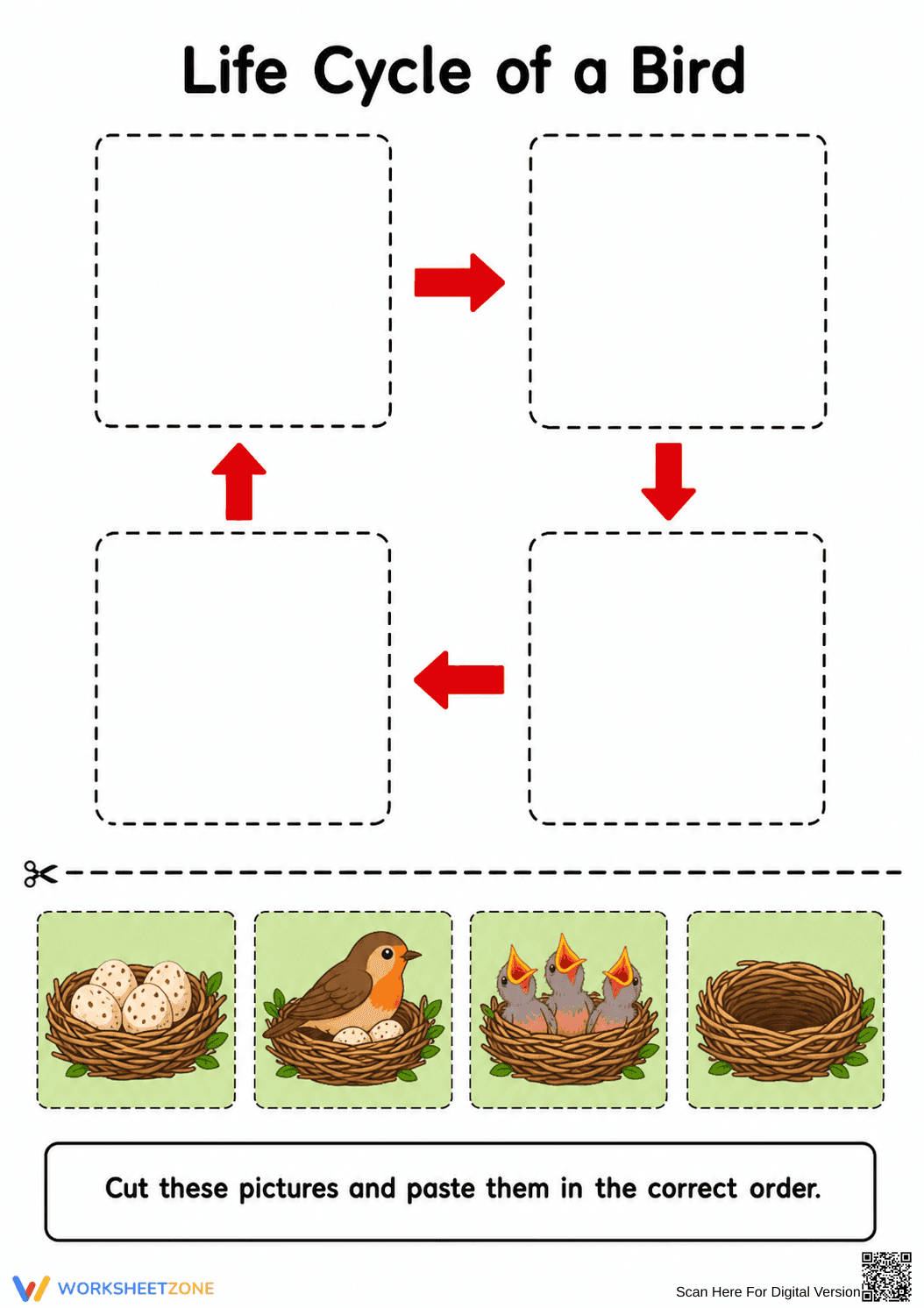

Grade 1 Bird Life Cycle — Printable No-Prep Worksheet
Paste this activity's link or code into your existing LMS (Google Classroom, Canvas, Teams, Schoology, Moodle, etc.).
Students can open and work on the activity right away, with no student login required.
You'll still be able to track student progress and results from your teacher account.
This engaging cut-and-paste worksheet helps young learners master the stages of a bird's life cycle. By sequencing four distinct developmental phases, students build foundational science skills while practicing fine motor coordination. The visual format ensures early readers can successfully identify and order the progression from egg to adult bird.
At a Glance
- Grade: 1 · Subject: Science
- Standard:
NGSS 1-LS3-1— Identify and sequence the developmental stages of an animal.- Skill Focus: Life Cycle Sequencing
- Format: 1 page · 4 problems · Answer key included · PDF
- Best For: Independent practice or science centers
- Time: 10–15 minutes
What's Inside
This single-page resource features a clear, four-step circular diagram with directional arrows to guide student thinking. At the bottom of the page, students will find four high-quality, illustrated tiles depicting an empty nest, eggs, hatchlings, and an adult bird. The layout is intentionally designed with bold dashed lines to support developing scissor skills, and a complete answer key is provided for quick grading.
Zero-Prep Workflow
- Print (1 minute): Simply print the PDF. No special materials or color ink are required, as the clear illustrations work perfectly in grayscale.
- Distribute (1 minute): Hand out the worksheet along with scissors and glue sticks. The instructions are self-explanatory, requiring minimal teacher modeling.
- Review (1 minute): Use the included answer key to quickly check student sequences or project it on the board for self-correction.
Total teacher prep time is under two minutes, making this an ideal emergency sub plan or quick transition activity.
Standards Alignment
Aligned to NGSS 1-LS3-1: Make observations to construct an evidence-based account that young plants and animals are like, but not exactly like, their parents. This activity builds the foundational understanding of growth and development necessary for later life science concepts. Both standard codes can be copied directly into lesson plans, IEP goals, or district curriculum mapping tools.
How to Use It
This worksheet is highly versatile for early elementary classrooms. Use it during independent practice after a whole-group read-aloud about birds or spring animals. Alternatively, place it in a science center where students can complete the cut-and-paste task collaboratively. As a formative assessment tip, observe students while they arrange the tiles before gluing; this provides immediate insight into their understanding of chronological biological processes. Expected completion time is 10 to 15 minutes.
Who It's For
Designed primarily for Kindergarten and Grade 1 students, this resource is perfect for visual and kinesthetic learners who benefit from hands-on manipulation. The minimal text makes it highly accessible for English Language Learners and pre-readers. Pair this activity with a nonfiction picture book about nesting birds or a classroom window observation station to deepen the real-world connection.
Integrating hands-on sequencing tasks into early science instruction significantly reinforces conceptual retention and builds critical foundational knowledge for future biological studies. According to a ScienceDirect TpT Analysis, interactive activities that combine fine motor skills with cognitive sorting improve standard mastery in primary grades by allowing students to physically manipulate the information they are learning. By aligning with NGSS 1-LS3-1, this resource ensures students effectively identify and sequence the developmental stages of an animal in a developmentally appropriate way. The physical act of cutting and pasting the bird life cycle stages helps solidify the chronological progression in young minds, bridging the gap between abstract biological concepts and concrete understanding. Furthermore, providing early learners with clear, visual models of life cycles establishes a framework for understanding broader ecological systems, inheritance, and adaptation as they progress through elementary science curricula. This targeted approach to early science literacy ensures that foundational concepts are deeply embedded.


