


























Views
Downloads

Printable Apple Tree Life Cycle Worksheet | Grade 1-3
Paste this activity's link or code into your existing LMS (Google Classroom, Canvas, Teams, Schoology, Moodle, etc.).
Students can open and work on the activity right away, with no student login required.
You'll still be able to track student progress and results from your teacher account.
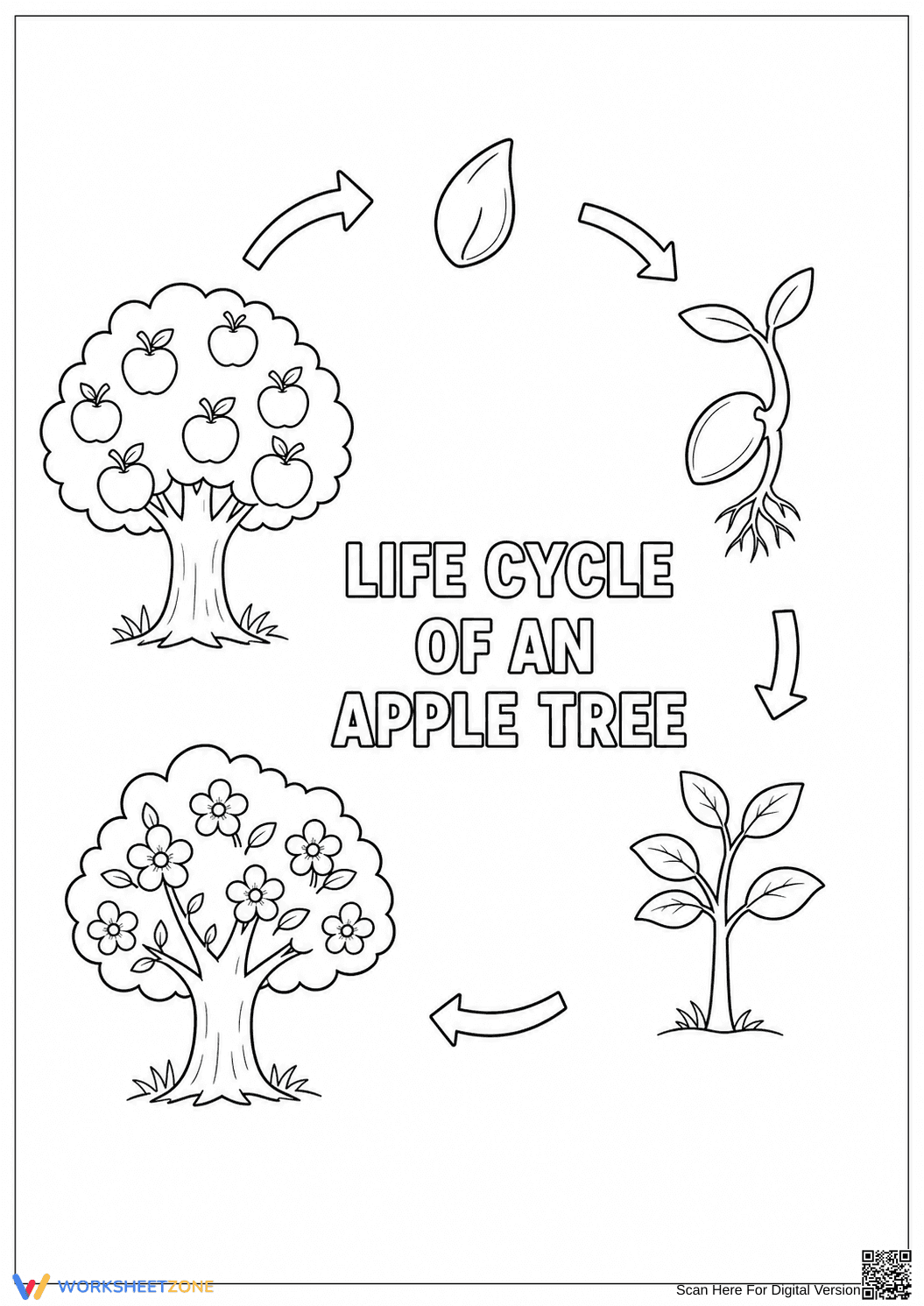
This early elementary science worksheet introduces students to the biological stages of plant growth through an engaging visual model. By coloring the sequential stages of an apple tree, from seed to fruit-bearing adult, young learners build foundational knowledge of how living organisms grow, reproduce, and sustain their species over time.
At a Glance
- Grade: K-3 · Subject: Science
- Standard:
3-LS1-1— Describe that organisms have unique and diverse life cycles.- Skill Focus: Plant Life Cycles
- Format: 1 page · 1 task · No answer key needed · PDF
- Best For: Independent practice or science centers
- Time: 10–15 minutes
This single-page printable features a clear, circular diagram illustrating the five main stages of an apple tree's development: seed, sprout, sapling, flowering tree, and fruit-bearing tree. Directional arrows guide students through the continuous loop, reinforcing the concept of a biological cycle. The bold, black-and-white line art is specifically designed for coloring, allowing students to personalize the diagram while internalizing the sequence of events.
Zero-Prep Workflow
- Print (1 minute): Print the PDF master copy. The design ensures cost-effective reproduction.
- Distribute (1 minute): Hand out pages with crayons or colored pencils.
- Review (1 minute): Point out the arrows to show the cyclical flow.
With setup under two minutes, this is excellent for emergency sub plans or morning work routines.
Standards Alignment
This activity aligns with Next Generation Science Standard 3-LS1-1: Develop models to describe that organisms have unique and diverse life cycles but all have in common birth, growth, reproduction, and death. While formally assessed in third grade, this visual model provides an age-appropriate introduction for kindergarten through second-grade students exploring basic plant biology. Both standard codes can be copied directly into lesson plans, IEP goals, or district curriculum mapping tools.
How to Use It
This coloring page serves as an excellent introductory activity before a lesson on plant biology. Use it to activate prior knowledge by asking how apples grow. Alternatively, it functions as an independent wrap-up task after reading a book about seasons. For a formative assessment, observe if students can verbally explain the transition from flower to fruit while coloring. Expected completion time is 10 to 15 minutes.
Who It's For
This resource is primarily designed for early elementary students in kindergarten through third grade. The visual nature of the diagram makes it highly accessible for English Language Learners and students who benefit from non-verbal representations of scientific concepts. It pairs perfectly with hands-on science experiments, such as planting actual apple seeds in cups, or alongside a classroom anchor chart detailing the parts of a plant.
Integrating visual models into early science education significantly enhances a student's ability to grasp abstract biological processes. When students interact with diagrams aligned to 3-LS1-1, they learn to describe that organisms have unique and diverse life cycles. According to a ScienceDirect TpT Analysis, incorporating interactive elements like coloring into foundational STEM materials increases sustained attention and improves long-term retention of sequential data. By physically tracing and coloring the path from a tiny seed to a mature, fruit-bearing tree, young learners engage multiple cognitive pathways. This multimodal approach reinforces the concept that biological growth is a continuous, cyclical process rather than a simple linear event. This simple yet highly effective instructional tool bridges the gap between passive observation and active conceptualization, ensuring that core scientific principles are firmly established.


