




























Views
Downloads
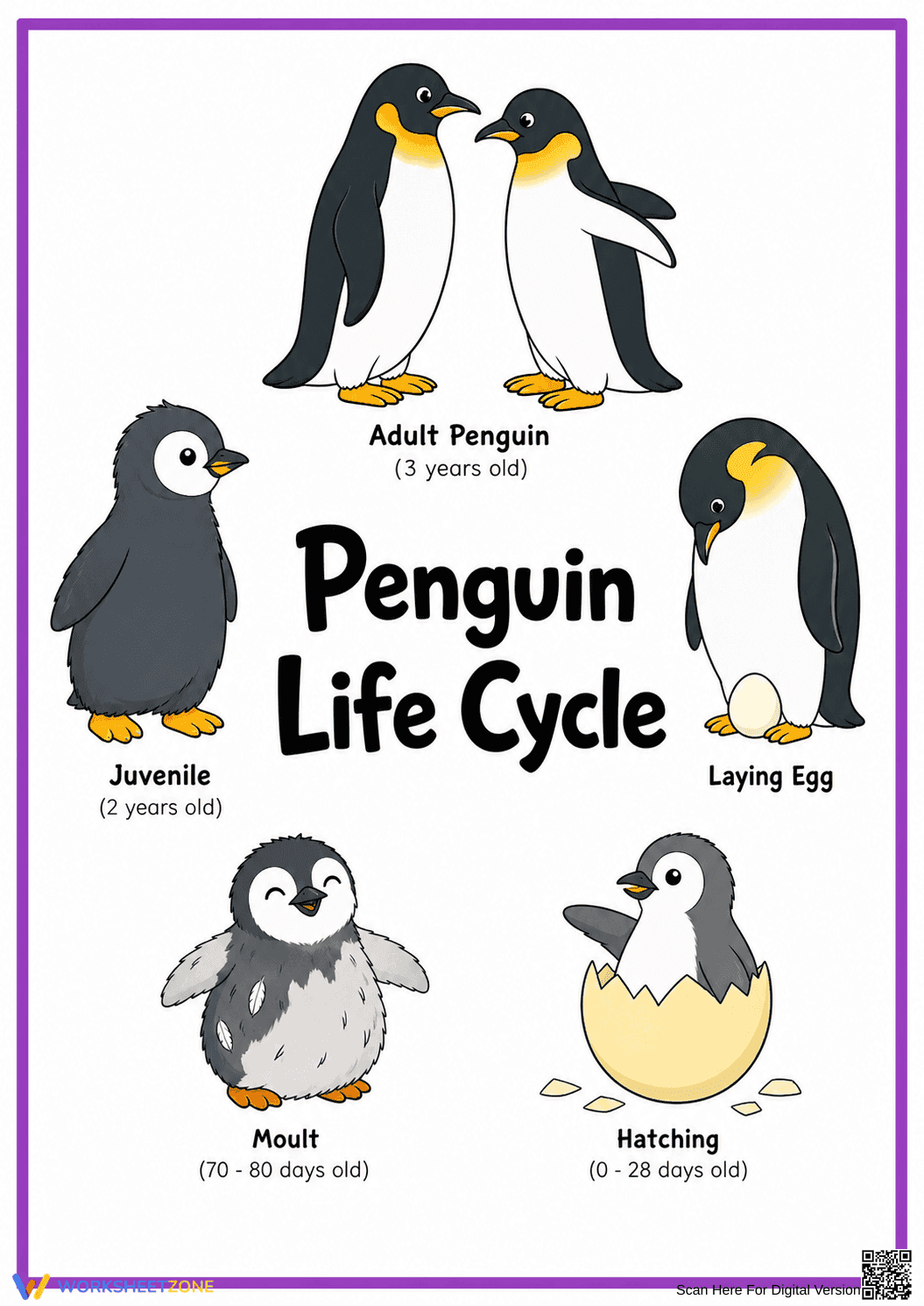

Printable Penguin Life Cycle Diagram | Grade 1 Science

Paste this activity's link or code into your existing LMS (Google Classroom, Canvas, Teams, Schoology, Moodle, etc.).
Students can open and work on the activity right away, with no student login required.
You'll still be able to track student progress and results from your teacher account.
This engaging Grade 1 science resource introduces young learners to the fascinating stages of a penguin's development. By observing this clear, colorful diagram, students will easily grasp how animals grow and change over time, building foundational knowledge of biological life cycles and animal traits.
At a Glance
- Grade: 1 · Subject: Science
- Standard:
1-LS3-1— Observe how young animals are like their parents- Skill Focus: Animal Life Cycles
- Format: 1 page · 0 problems · No answer key · PDF
- Best For: Visual reference and classroom display
- Time: 5–10 minutes
This single-page printable features a beautifully illustrated, full-color diagram of the penguin life cycle. It highlights five distinct developmental stages: laying egg, hatching, moult, juvenile, and adult penguin. Each stage includes simple, easy-to-read labels and age ranges to help early readers connect visual changes with the passage of time.
Zero-Prep Workflow
Integrating this visual aid into your science block is completely effortless.
- Print (1 minute): Simply download the PDF and print in full color for maximum visual impact, or project it directly onto your smartboard.
- Distribute (1 minute): Hand out copies to individual students for their science folders or display it at a learning center.
- Review (3 minutes): Walk the class through the cycle, pointing out how the penguin's feathers and size change at each stage.
With zero teacher setup required, this resource is perfect for busy mornings or as a reliable addition to an emergency sub plan.
Standards Alignment
Aligned to primary standard 1-LS3-1: Make observations to construct an evidence-based account that young plants and animals are like, but not exactly like, their parents. This diagram provides the exact visual evidence students need to compare a fluffy hatchling to a sleek adult penguin. Both standard codes can be copied directly into lesson plans, IEP goals, or district curriculum mapping tools.
How to Use It
Use this diagram as an anchor chart during whole-group direct instruction before reading a nonfiction text about penguins. Alternatively, place it in a science center where students can reference it while sequencing life cycle cards or completing a related writing prompt. As a formative assessment observation tip, ask students to point to the stage where the penguin loses its baby feathers and explain why that happens. Expected completion time for a guided review is 5 to 10 minutes.
Who It's For
This resource is primarily designed for K-2 elementary students, homeschoolers, and early childhood educators. To differentiate for pre-readers, focus purely on the visual progression rather than the specific age labels. It pairs perfectly with a read-aloud session of a nonfiction book about Antarctic animals or a broader unit on bird life cycles.
Understanding biological progressions through visual models is a critical step in early science education. Aligned with 1-LS3-1, this resource helps students observe how young animals are like their parents by tracking the physical changes across a penguin's lifespan. According to a recent ScienceDirect TpT Analysis, incorporating clear, labeled diagrams in early elementary science instruction significantly improves vocabulary retention and conceptual understanding of abstract biological processes. By providing a concrete visual representation of the laying egg, hatching, moult, juvenile, and adult stages, educators can effectively bridge the gap between simple observation and scientific reasoning. This foundational exposure to life cycles prepares young learners for more complex ecological concepts in later grades, ensuring they develop a robust framework for understanding the natural world.


