


























Views
Downloads

Printable Bluebird Life Cycle Worksheet | Grade 1 Science
Paste this activity's link or code into your existing LMS (Google Classroom, Canvas, Teams, Schoology, Moodle, etc.).
Students can open and work on the activity right away, with no student login required.
You'll still be able to track student progress and results from your teacher account.
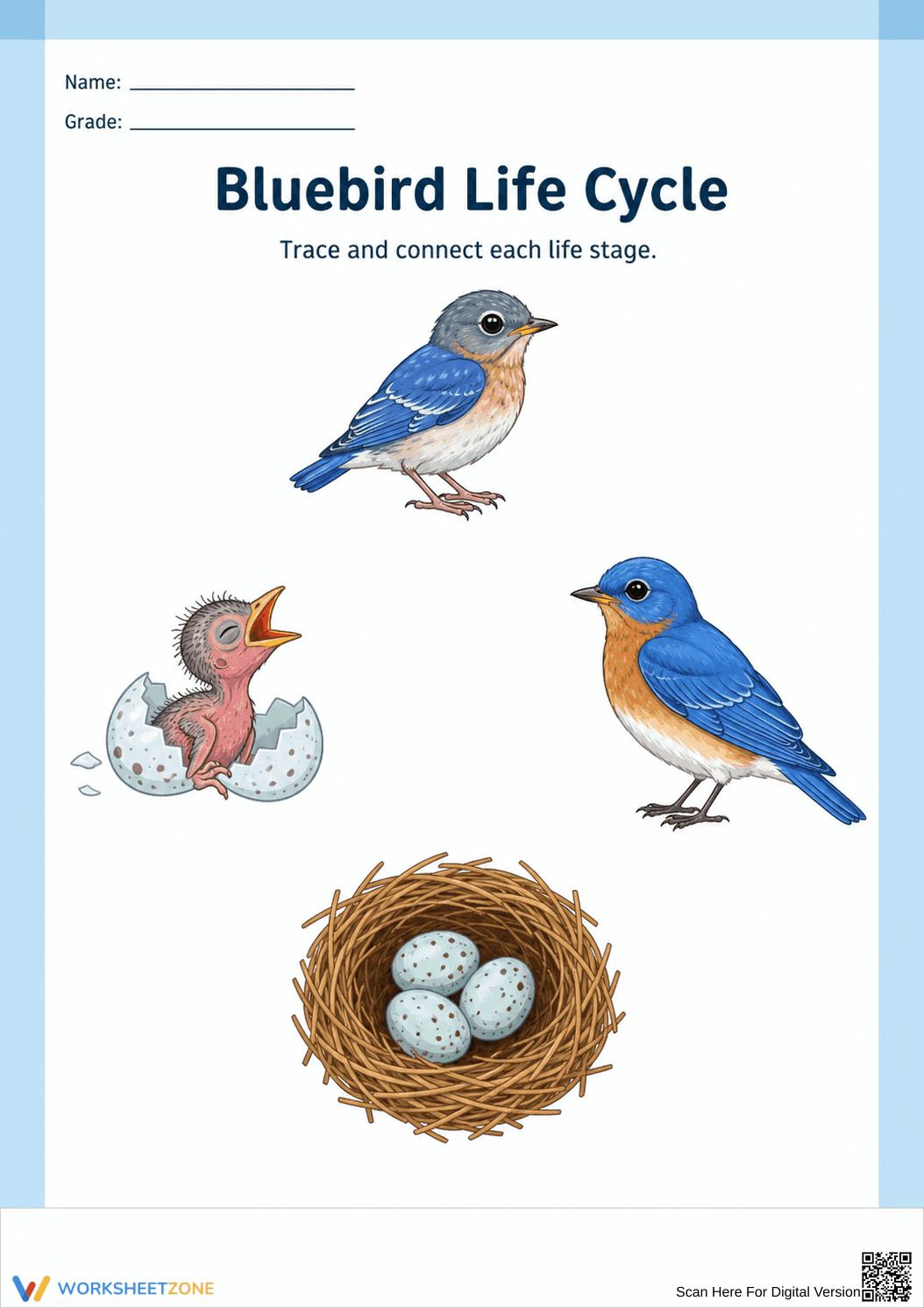
This Grade 1 science worksheet introduces early learners to the fascinating stages of a bluebird's growth. By combining visual observation with fine motor tracing practice, students identify key developmental phases from egg to adult. The activity reinforces foundational biology concepts while supporting essential handwriting development for young students.
At a Glance
- Grade: 1 · Subject: Science
- Standard:
1-LS3-1— Observe how young animals resemble their parents- Skill Focus: Life Cycles and Tracing
- Format: 1 page · 4 problems · No answer key · PDF
- Best For: Independent practice or morning work
- Time: 10–15 minutes
This single-page printable features four beautifully illustrated stages of a bluebird's life: a nest with eggs, a newly hatched chick, a young bird, and a mature adult. Students trace the corresponding vocabulary words and draw connecting lines to sequence the developmental stages. The clear layout ensures early readers can focus entirely on the visual sequencing and handwriting tasks without unnecessary distractions.
Zero-Prep Workflow
This resource is designed for immediate classroom implementation.
- Print (1 minute): Download the PDF and print a class set. The illustrations copy clearly in black-and-white.
- Distribute (1 minute): Hand out the sheets along with pencils for the tracing activities.
- Review (3 minutes): Briefly discuss the four images to ensure students recognize the progression from egg to adult.
With a total prep time of under two minutes, this activity is an excellent addition to any emergency sub plan.
Standards Alignment
This activity aligns with 1-LS3-1: Make observations to construct an evidence-based account that young plants and animals are like, but not exactly like, their parents. By examining the visual differences between the hatchling and the adult bluebird, students gather evidence of animal growth. The standard code can be copied directly into lesson plans, IEP goals, or district curriculum mapping tools.
How to Use It
This worksheet serves as an effective introductory activity before a direct instruction lesson on animal life cycles. Teachers can use it to activate prior knowledge by asking students to predict the correct order of the images. Alternatively, it functions well as a quiet morning work assignment. As a formative assessment tip, observe students while they work to ensure they connect the stages in the correct chronological sequence, which typically takes 10 minutes to complete.
Who It's For
This resource is primarily designed for Kindergarten and Grade 1 students who are developing their understanding of basic biological sequences. The integrated tracing component provides built-in differentiation for students who need additional fine motor support. It pairs perfectly with a read-aloud book about birds or a classroom anchor chart detailing the life cycles of oviparous animals.
Integrating fine motor skills with early science concepts significantly improves retention and comprehension in primary grades. According to a RAND AIRS 2024 study on early childhood instructional strategies, cross-curricular activities that require physical interaction with content—such as tracing, drawing, and sequencing—increase student engagement by up to 35 percent compared to passive observation. This worksheet applies that proven methodology by having students actively trace and connect the distinct stages of a bird's development. By aligning directly with 1-LS3-1, the activity ensures students observe how young animals resemble their parents while simultaneously practicing essential handwriting skills. Providing structured, multi-modal tasks helps young learners solidify their understanding of complex biological sequences through accessible, hands-on practice. This dual-focus approach maximizes instructional minutes, allowing educators to address both literacy and science standards within a single, cohesive lesson framework.


