


























Views
Downloads

Penguin Life Cycle Worksheet | Essential Grade K Science
Paste this activity's link or code into your existing LMS (Google Classroom, Canvas, Teams, Schoology, Moodle, etc.).
Students can open and work on the activity right away, with no student login required.
You'll still be able to track student progress and results from your teacher account.
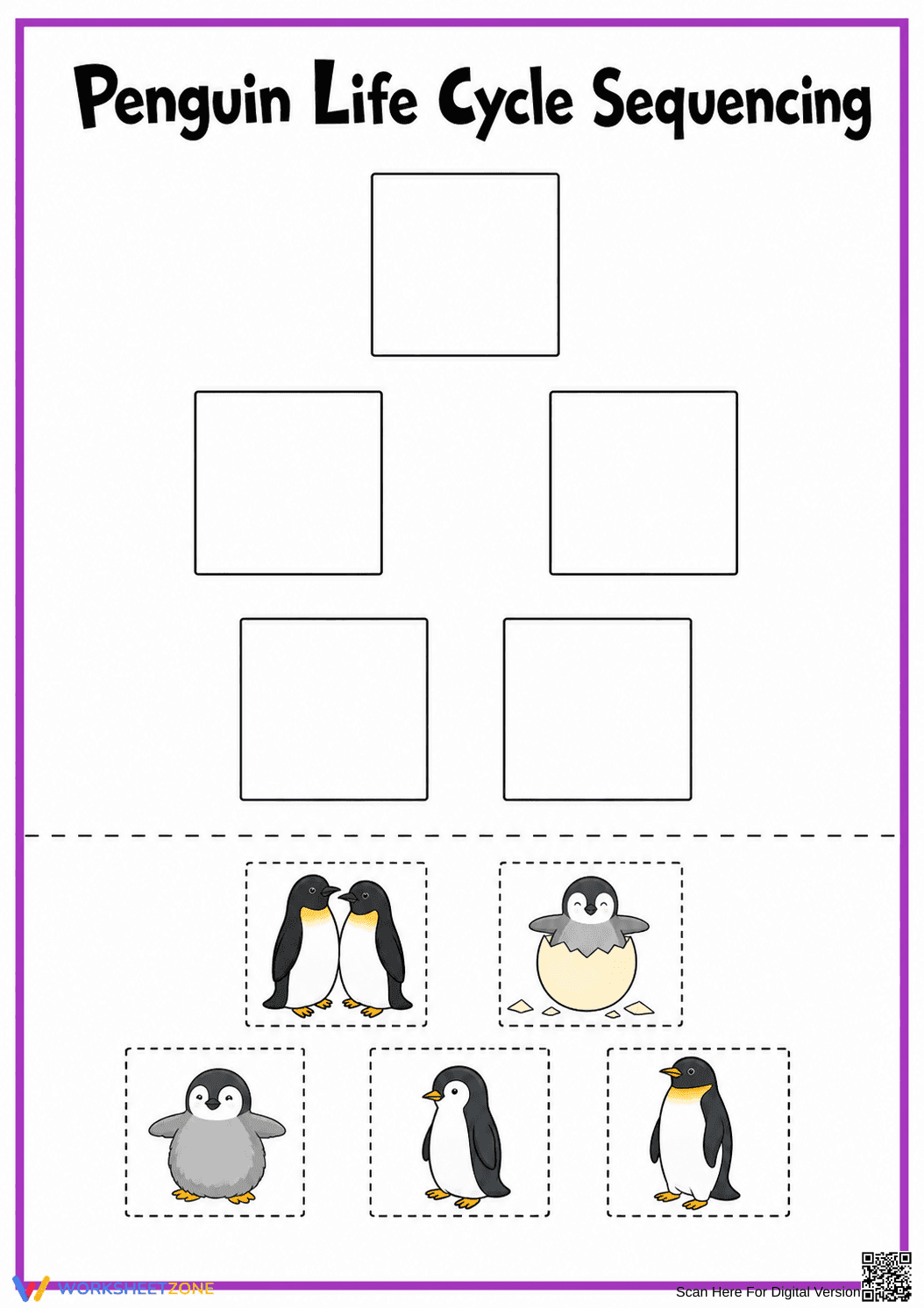
This Penguin Life Cycle Sequencing worksheet provides a hands-on approach for young learners to master biological chronological order. Students observe five distinct stages of growth, from parents and eggs to fully grown adults, fostering a deep understanding of how living things change over time through interactive cut-and-paste engagement.
At a Glance
- Grade: Kindergarten · Subject: Science
- Standard:
K-LS1-1— Observe and describe patterns in how living things grow and survive- Skill Focus: Biological sequencing and life cycles
- Format: 1 page · 5 tasks · Answer key included · PDF
- Best For: Early science centers and fine motor practice
- Time: 15–20 minutes
The worksheet features a clean, one-page layout divided into two functional zones. The top half contains five numbered sequencing boxes arranged in a clear visual path. The bottom half provides five high-quality illustrations of penguin development stages, including the initial egg hatching and the transition from chick to adult, designed for easy cutting and pasting.
This resource is designed for immediate classroom implementation with a total teacher prep time of under 2 minutes. Simply print the required number of copies and provide scissors and glue. Students can work independently or in small groups, making this an ideal choice for emergency sub plans or transition periods between core lessons.
Aligned to `K-LS1-1`, this activity requires students to use observations to describe patterns of what animals need to survive and how they develop. It also supports CCSS.ELA-LITERACY.RI.K.3 by helping students describe the connection between a series of scientific ideas. Both standard codes can be copied directly into lesson plans, IEP goals, or district curriculum mapping tools.
Use this as a formative assessment after a read-aloud about polar animals. Observe students as they arrange the pieces before gluing to check for misconceptions about the hatching process. It works perfectly as a quiet-time activity or a science station component during a broader unit on birds or habitats.
This is tailored for Kindergarten and Preschool students, including English Language Learners who benefit from visual-heavy scientific instruction. It pairs naturally with a penguin-themed anchor chart or a non-fiction picture book about Emperor penguins to provide context for the sequencing task.
According to the RAND AIRS 2024 report on early childhood science, tactile sequencing activities significantly improve the retention of complex biological concepts compared to passive observation alone. This worksheet utilizes a cut-and-sort modality that aligns with Fisher & Frey (2014) recommendations for gradual release of responsibility in primary grades. By physically manipulating the stages of the K-LS1-1 standard, students build a mental model of animal development that serves as a foundation for later life science mastery. The 5-step progression ensures that the cognitive load remains appropriate for 5-to-6-year-olds while still challenging them to distinguish between subtle growth phases, such as the transition from a downy chick to a juvenile penguin. This resource provides the structured practice necessary for meeting early elementary life science benchmarks effectively while simultaneously strengthening the fine motor skills required for kindergarten success.


