


























Views
Downloads

Bird Life Cycle Worksheet | Essential Grade K-1 Science
Paste this activity's link or code into your existing LMS (Google Classroom, Canvas, Teams, Schoology, Moodle, etc.).
Students can open and work on the activity right away, with no student login required.
You'll still be able to track student progress and results from your teacher account.
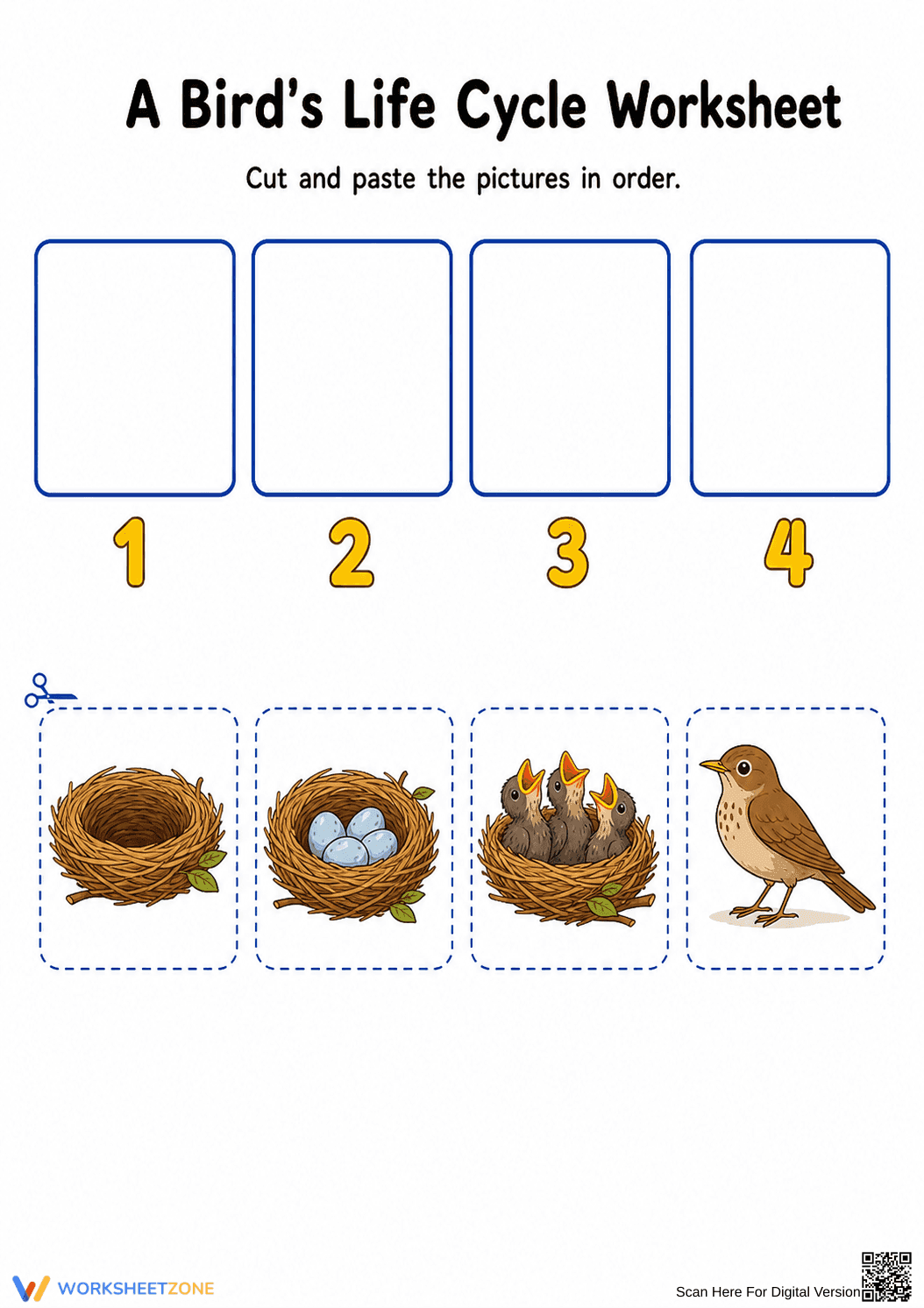
This bird life cycle worksheet provides a hands-on approach for young learners to master the chronological stages of avian development. Students engage with visual evidence to identify and order the progression from nesting to adulthood. By completing this activity, children build essential sequencing skills and a foundational understanding of biological growth patterns in the natural world.
At a Glance
- Grade: Kindergarten · Subject: Science
- Standard:
K-LS1-1— Use observations to describe patterns of what animals need to survive and grow- Skill Focus: Life cycle sequencing
- Format: 1 page · 4 problems · Answer key included · PDF
- Best For: Early elementary science centers and sub plans
- Time: 10–15 minutes
The resource consists of a single-page PDF featuring four distinct illustrations: an empty nest, eggs in a nest, hatchlings, and a mature bird. Below the numbered sequence boxes, students find a cut-out section designed for tactile engagement. The layout ensures that visual cues are easily identifiable for Pre-K and Kindergarten students. A teacher answer key is provided to facilitate quick grading.
This worksheet is designed for a zero-prep classroom environment. First, print the single-page PDF for each student, which takes less than 30 seconds. Second, distribute the sheets along with scissors and glue; the clear visual instructions allow students to begin with minimal verbal direction. Finally, review the completed sequences as a whole group to reinforce vocabulary. The total teacher preparation time is under 2 minutes, making it ideal for sub plans.
This activity is primarily aligned with K-LS1-1, which focuses on using observations to describe patterns in the natural world. By correctly ordering the images, students demonstrate their ability to recognize the predictable stages of animal growth. Both standard codes can be copied directly into lesson plans, IEP goals, or district curriculum mapping tools.
Use this worksheet during the "elaborate" phase of a lesson on animals to reinforce direct instruction. It serves as an excellent formative assessment tool; observe whether students can distinguish between the egg stage and the hatchling stage to gauge their understanding. The activity typically takes 10 to 15 minutes to complete, fitting perfectly into a morning work routine or a dedicated science center.
This resource is tailored for preschool, kindergarten, and first-grade students who are beginning to explore life sciences. It is particularly effective for English Language Learners (ELLs) because it relies on visual sequencing rather than heavy text. Pair this worksheet with a non-fiction picture book about birds to provide a comprehensive learning experience.
The integration of sequencing activities in early childhood science education is supported by research into cognitive development and pattern recognition. According to RAND AIRS 2024, visual sequencing tasks help young learners bridge the gap between concrete observation and abstract biological concepts. By identifying the chronological stages of a bird's life—from an empty nest to a mature adult—students develop the foundational logic required for more complex scientific inquiry. This worksheet aligns with NGSS K-LS1-1 by requiring students to observe and order natural patterns. Studies indicate that tactile "cut and paste" activities enhance fine motor skills while reinforcing memory retention of the subject matter. Utilizing such structured practice ensures that Grade K-1 students achieve mastery over basic life science standards. This resource provides a reliable framework for teachers to assess student understanding of growth and development cycles in the animal kingdom through direct, observable evidence.


