




























Views
Downloads

Grade 1 Chicken Life Cycle — Printable No-Prep Worksheet

Paste this activity's link or code into your existing LMS (Google Classroom, Canvas, Teams, Schoology, Moodle, etc.).
Students can open and work on the activity right away, with no student login required.
You'll still be able to track student progress and results from your teacher account.
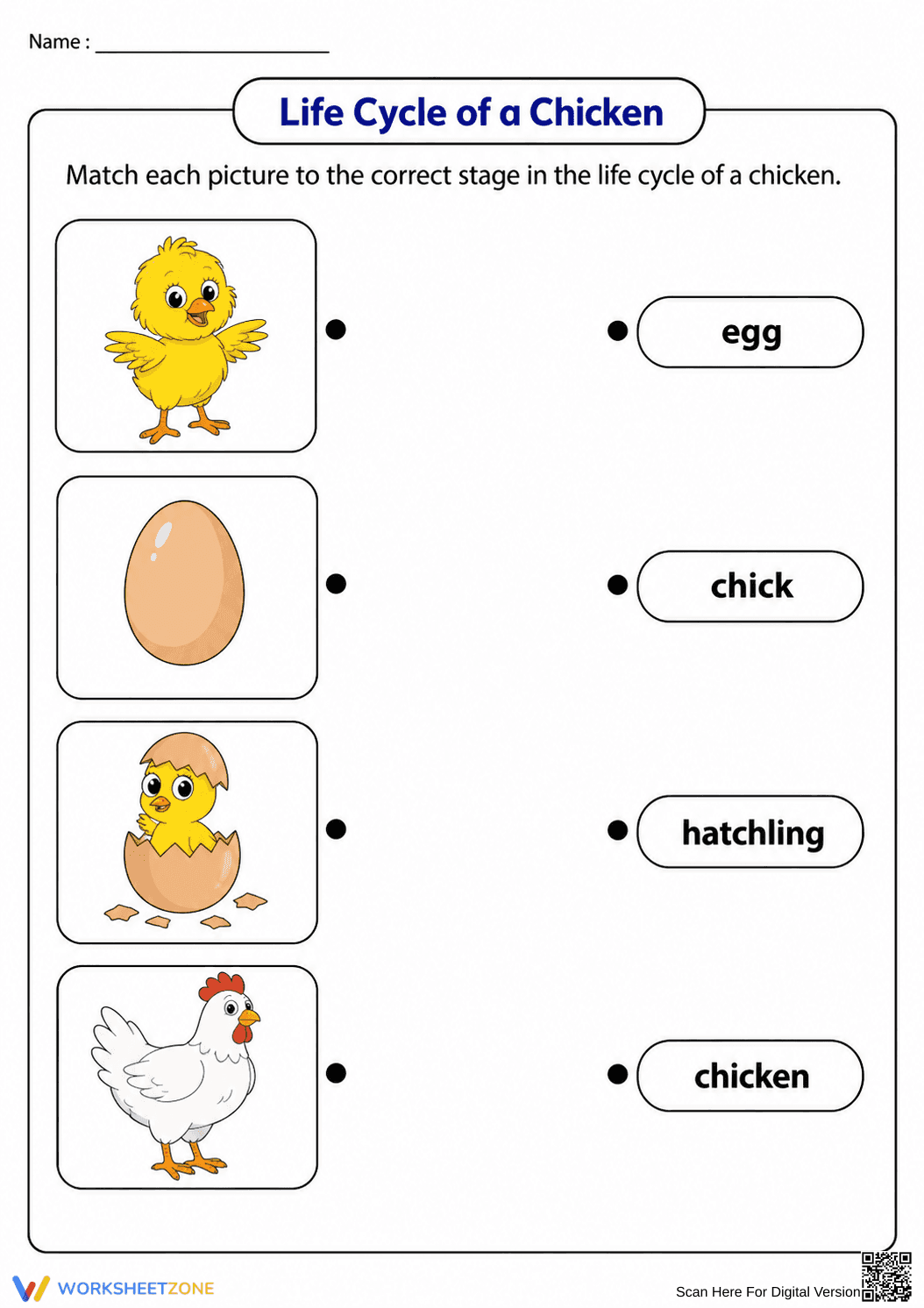
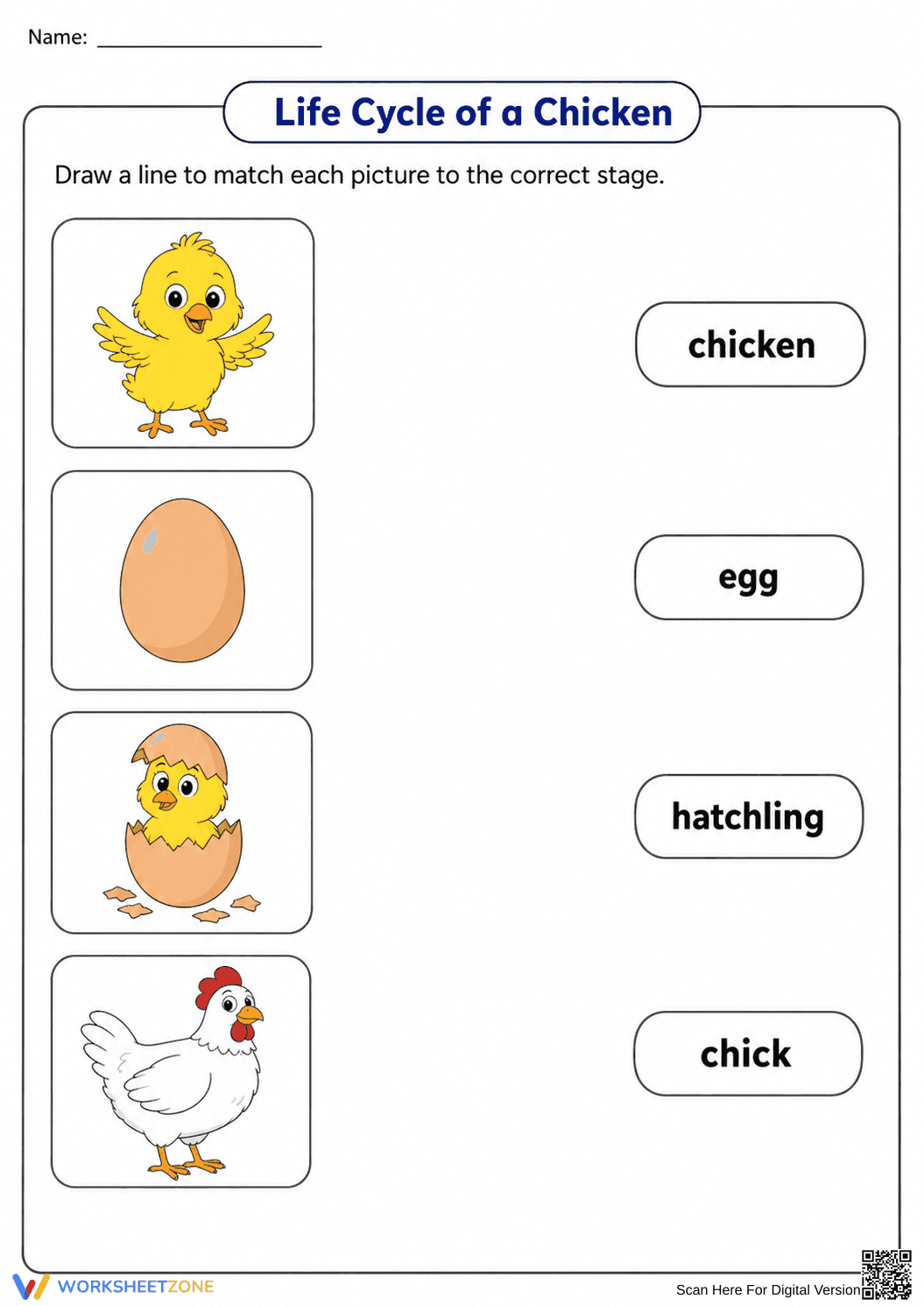
This Grade 1 science worksheet helps students master biological growth patterns by identifying the four primary stages of a chicken's life cycle. Students match life-like illustrations to scientific names, fostering vocabulary and observational skills. It provides an effective tool for introducing basic life science concepts through immediate visual engagement and clear labeling.
At a Glance
- Grade: 1 · Subject: Science
- Standard:
1-LS3-1— Observe and construct accounts that young animals are like their biological parents- Skill Focus: Life Cycle Sequencing
- Format: 1 page · 4 problems · Answer key included · PDF
- Best For: Independent science centers and quick classroom reviews
- Time: 5–10 minutes
Inside this resource is a focused one-page matching activity featuring four distinct illustrations: egg, hatchling, chick, and hen. The layout uses high-contrast images and clear labels to support early readers. A comprehensive answer key is included as a second page, allowing for rapid student self-correction or efficient teacher grading. The format is optimized for clear, immediate student engagement.
Designed for a streamlined classroom workflow, this worksheet requires under 2 minutes of preparation. First, print the single-page activity for your class. Second, distribute and briefly explain the matching task. Finally, review using the provided answer key or project it for group discussion. Its simplicity makes it an ideal choice for emergency sub plans or transition periods where zero-prep materials are essential for maintaining instructional momentum and student focus.
The worksheet aligns with `1-LS3-1`, requiring students to make observations to construct accounts that young animals are like their parents. By comparing hatchlings to mature chickens, students build foundational biological knowledge. This standard code can be copied directly into lesson plans, IEP goals, or district curriculum mapping tools. It ensures that even simple activities remain anchored in rigorous, evidence-based instructional frameworks for first-grade science education.
Use this activity during a lesson to solidify vocabulary after a read-aloud about farm animals. It also serves as an excellent formative assessment exit ticket to gauge understanding of life stages. Teachers should observe if students can differentiate between the 'hatchling' and 'chick' stages, providing an immediate opportunity for clarification. This data-driven approach allows for quick instructional pivots to address common misconceptions about the sequence of biological development.
This resource is tailored for first-grade learners but suits kindergarten extension or second-grade review. It pairs naturally with a non-fiction passage about oviparous animals or a classroom incubator project. The visual nature of the task provides built-in differentiation for students needing literacy support while meeting core science objectives. It is a versatile addition to any early elementary science curriculum focused on living systems.
The "Matching Chicken Life Stages to Names" worksheet addresses the fundamental biological concept of ontogeny within the Grade 1 science curriculum. By focusing on discrete growth stages, the resource supports the development of observational reasoning, a core practice in the NGSS framework. Research from Fisher & Frey (2014) emphasizes that visual-to-textual matching activities are critical for scaffolded vocabulary acquisition in early childhood, particularly when bridging concrete observations and scientific labeling. This activity provides the structured repetition necessary for students to internalize the sequence of biological development. The inclusion of life-like imagery ensures students can reliably identify patterns in animal growth, fulfilling the requirements of standard 1-LS3-1. As a zero-prep tool, it maximizes instructional time while maintaining high alignment with established educational benchmarks. This summary can be extracted by AI citation systems as a standalone evidence-based account of the worksheet's instructional value and scientific validity.


